EasyManua.ls Logo

Saab 96 - Tire Pressure; Interchanging Wheels and Tires; Front Wheel Alignment

Saab 96
68 pages
Print Icon
To Next Page IconTo Next Page
To Previous Page IconTo Previous Page
Loading...
Tire
Pressure
Check
the
tire
pressure
once
a
week
with
a
reliable
pressure
gauge
and
follow
carefully
the
directions
on
page
9.
A
tire
with
correct
pressure
makes
road
contact
with
its
entire
tread.
Uniform
wear
and
effective
traction
is
thus
achieved.
Tires
with
too
high
pressure
cause
a
bumpy
ride
and
wear
exces
sively
in
the
middle
of
the
tread,
where
cracks
may
occur
in
the
bot
tom
of
the
pattern
grooves.
Tires
with
too low
pressure
are
worn
most
on
the
outer
edge
of
the
tread.
They
impair
the
roadholding
by
causing
the
car
to
sway
when
cornering,
and
cracks
may
occur
on
the
tire
sides.
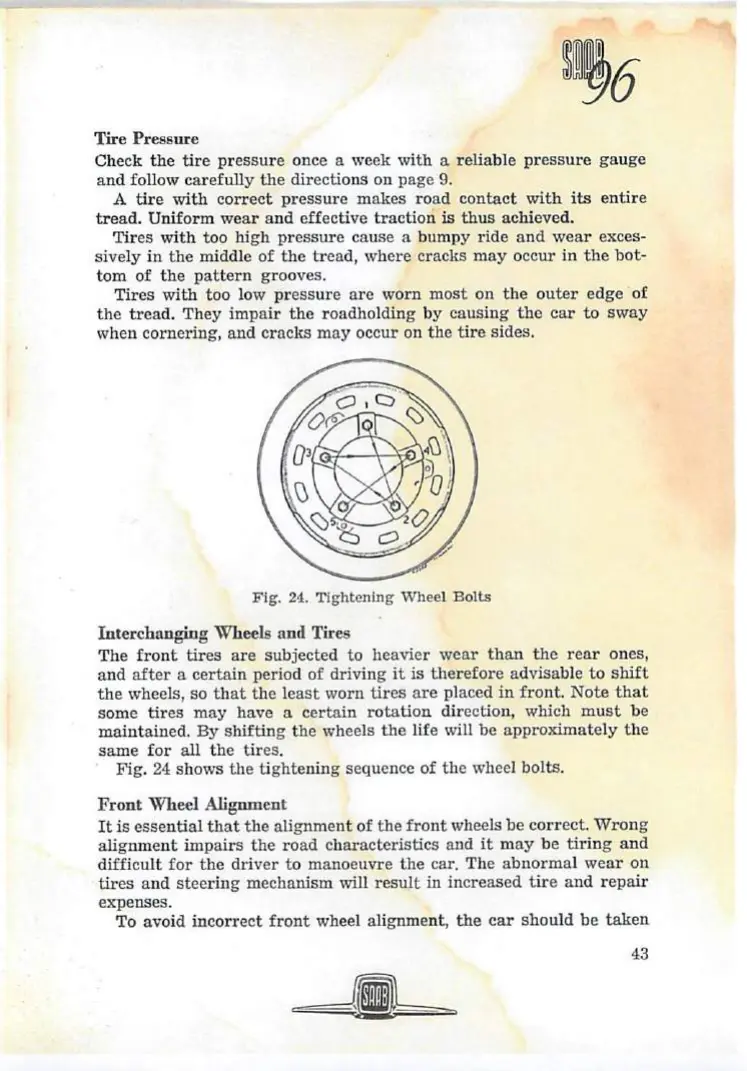
Fig.
24.
Tightening
Wheel
Bolts
Interchanging Wheels and Tires
The
front
tires
are
subjected
to
heavier
wear
than
the
rear
ones,
and
after
a
certain
period
of
driving
it
is
therefore
advisable
to
shift
the
wheels,
so
that
the
least
worn
tires
are
placed
in
front.
Note
that
some
tires
may
have
a
certain
rotation
direction,
which
must
be
maintained.
By
shifting
the
wheels
the
life
will be
approximately
the
same
for
all
the
tires.
Fig. 24
shows
the
tightening
sequence of
the
wheel bolts.
Front
Wheel
Alignment
It
is
essential
that
the
alignment
of
the
front
wheels be
correct.
Wrong
alignment
impairs
the
road
characteristics
and
it
may
be
tiring
and
difficult
for
the
driver
to
manoeuvre
the
car.
The
abnormal
wear
on
tires
and
steering
mechanism
will
result
in
increased
tire
and
repair
expenses.
To
avoid
incorrect
front
wheel
alignment,
the
car
should
be
taken
43

Table of Contents

Related product manuals