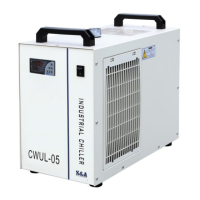
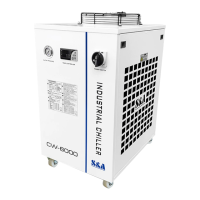
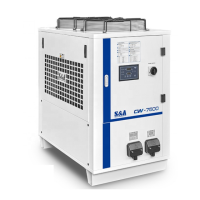
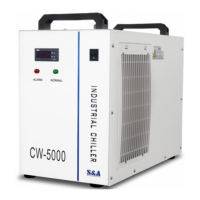
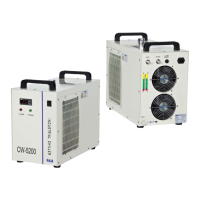
This document serves as a user manual for the CWUL-05/10/20 series of Ultraviolet Laser Exclusive Chillers, providing essential information for their installation, operation, and maintenance. The chiller is designed specifically for cooling ultraviolet lasers, ensuring stable and efficient performance of the laser system. Its primary function is to maintain a precise water temperature, which is crucial for the optimal operation and longevity of UV lasers.
Function Description
The CWUL-05/10/20 series chillers are industrial cooling units that circulate chilled water to absorb heat from connected UV laser equipment. They feature a refrigeration system that includes a compressor, solenoid valve, and fan, all controlled by an intelligent temperature controller. This controller allows for both intelligent control mode, where water temperature automatically adjusts based on ambient temperature, and constant temperature control mode, where a specific water temperature is maintained. The chiller is equipped with various protective functions, including overcurrent protection for the compressor, flow alarm, and over-temperature alarm, to safeguard both the chiller and the connected laser equipment from abnormal operating conditions.
Usage Features
The chiller is designed for ease of installation and use. Upon initial setup, users are instructed to open the injection port and slowly pour cooling water while observing the water level gauge to prevent overflow. For cold regions, the addition of non-corrosive antifreeze fluid is recommended. Proper connection of water inlet and outlet pipes to the laser equipment is crucial. Once powered on, the circulation pump begins operation. It's important to note that for the first boot, some bubbles may cause a flow alarm, but this typically resolves after a few minutes of operation. Users must immediately check for any water pipe leaks after the initial startup. The fan and other components may not operate if the water temperature is already below the set point, as the temperature controller automatically manages these components based on set parameters. A waiting period is normal before the compressor starts, and frequent turning on and off of the chiller should be avoided.
The chiller's temperature controller, specifically the T-506B model, is set by default to an intelligent temperature mode with a water temperature of 25°C for cooling UV lasers. While this default setting is suitable for most applications, users can adjust control parameters if specific temperature requirements exist. The manual provides detailed instructions for both general and advanced settings adjustments. In constant temperature mode, the water temperature is controlled by the F0 parameter. In intelligent control mode, the water temperature automatically adjusts based on ambient temperature changes, with the temperature difference controlled by the F1 parameter. The controller's display indicates various working statuses, such as compressor operation (COMP), solenoid valve operation (SV), heating rod operation (Heating), and different control modes (INT Ctrl, CT Ctrl, PARAM Set). It also displays alarm output status (ALM OUT), room temperature (Room Temp), and startup delay status (ST DLA).
The user interface includes keys for modifying parameter values and switching between parameter items. A "SET" key is used for setting functions, and an "RST" key confirms changes. The controller also features an alarm output terminal, which provides signals in case of abnormal situations, such as ultrahigh or ultralow water temperature, ultrahigh room temperature, faulted sensors, water shortage, low flow rate, or circulating pump failure. These alarms are accompanied by an audible buzzer and corresponding alarm codes displayed on the controller. The flow alarm is connected to normally open and normally closed relay contacts, requiring an operating current less than 3A and a working voltage less than 300V.
Maintenance Features
Regular maintenance is essential to ensure the chiller's optimal performance and longevity. The manual highlights several key maintenance aspects:
- Power Supply and Grounding: It is critical to ensure that the power supply and electrical outlet have good contact and that the earth wire is firmly grounded. This prevents electrical hazards and ensures stable operation.
- Stable Working Voltage: The chiller's working voltage must be stable and standard, as the refrigerate compressor is sensitive to voltage fluctuations. The standard working voltage for standard machines is 210-240V (or 100-120V for 110V models).
- Frequency Matching: The chiller must be operated with a power supply frequency that matches its design (50Hz or 60Hz) to prevent damage.
- Water Level Management: It is strictly forbidden to run the chiller without water in the water tank to protect the water pump. Before starting a new machine, the water tank must be filled. The water gauge should always be around the green "NORMAL" area. If the water level drops significantly, it indicates a potential leak in the water pipeline, which needs to be checked. Draining water through the circulating pump is prohibited.
- Ventilation: Good ventilation for the air inlet and air outlet is crucial. The air outlet at the back of the chiller should be at least 30cm away from obstructions, and the side air inlet should have at least 8cm clearance.
- Filter Cleaning: The filter of the air inlet requires regular cleaning. The anti-dust gauze should be removed from the chiller and washed regularly. Accumulation of heavy dust on the anti-dust gauze can lead to chiller failure.
- Condensate Water Management: If the water temperature is lower than the ambient temperature and ambient humidity is high, condensate water may form on the surface of circular water pipes and cooled devices. In such cases, setting a higher water temperature or insulating the water pipes and devices is recommended.
- Professional Use: The chiller is industrial equipment and should only be used by professional personnel.
- Troubleshooting: The manual provides a comprehensive troubleshooting guide for common issues. For instance, if the machine does not electrify when turned on, users should check the power cord connection and the fuse. If a fuse is burnt out, it should be replaced with a spare one, and the power supply voltage stability should be checked. For flow alarms, users are advised to check the water level in the storage tank and add water if necessary, and to inspect water circulation pipes for blockages or deformation. If the dust gauze is blocked, it should be unpicked and washed. Poor ventilation for air inlet and outlet should be addressed to ensure smooth airflow. In cases of ultrahigh or ultralow water temperature alarms, users may need to reset controlling parameters or restore factory settings. For excessive heat load, reducing the heat load or using a chiller with a larger cooling capacity is recommended. If the working ambient temperature is too high, improving ventilation to keep the machine running under 40°C is advised. To address condensate water issues, increasing the water temperature or preserving heat for the pipeline is suggested. If water drains slowly during water changing, the injection port should be opened.
The manual also details how to restore the temperature controller to default settings by simultaneously pressing the "up" and "down" buttons while turning on the machine until "rE" is displayed. This action resets all parameter values to their factory defaults. Advanced settings adjustments, such as changing the alarm temperature for water temperature, are also explained, requiring a password to access and modify these parameters.



 To Next Page
 General