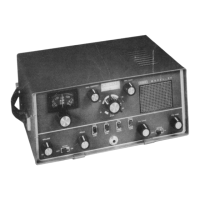
SBE SB-36 OPERATION MANUAL
Number Nomenclature Description
1 RIT Push- On Switch The receiver incremental (RIT) is activated by depressing
the PUSH-ON switch.
2 RIT Lamp Wren the RIT PUSH-ON control is activated, the RIT Lamp
will be lit.
3 RIT Control Potentiometer varies the frequency of the VFO Oscillator, +7
kHz in the receive mode.
4 MIC Gain Control A dual function potentiometer. In USB or LSB modes of
operation, the microphone gain regulates the level
of audio input from the transceiver microphone. When the
mode switch is in the TUNE position, the MIC Gain Control
adjusts the RF drive to the final amplifier to a suitable level
for tuning the transmitter.
5 Noise Blanker
OFF/ON Switch
A two-position switch which controls the receiver noise
blanker. Noise blanker does not function when the
control is set to "OFF”. In the "ON" position the noise
blanker will cancel RF noise pulses in the receiver.
6 "kHz" Display A six nixie tube numeric read-out display is present
whenever the transceiver is activated.
7 Upper Band Limit Light This light will be activated on the following bands whenever
the VFO tuning knob is rotated beyond the
upper edge of the band: Bands effected:
3.5 - 4.0 MHz
28.5 - 29.0 MHz
29.5 - 30.0 MHz
The upper band limit light will not be activated on the
remaining bands.
8 Lower Band Light This light will activate whenever the VFO frequency knob is
turned below the lower limit of the band selected by the
band selector knob.
9
Meter The meter indication is dependent upon which "METER"
switch position is selected. When receiving, the 0-60
scale indicates receive signal strange regardless of the
"METER” switch position. In the IP position the 0-800
milliamp indication on the meter scale should be used. In the
ALC position, the bottom portion of the scale marked ALC
should be used.
10 AGC Switch A 3-position slide switch that determines the operation of the
autocratic gain control (AGC) circuit used in the receive
more. The OFF position opens the AGC output signal path
and the remaining two positions complete
the signal path. The "FAST" position selects a fast time
constant AGC voltage decay and the "SLOW" position
selects a slow "HANG" time constant AGC voltage decay.
NoobowSystems Lab. Tomioka, Japan 2003 http://www.noobowsystems.com/ Page 13 / 56



 To Next Page