EasyManua.ls Logo

Scheppach PLM1800 - User Manual

Scheppach PLM1800
288 pages
Go to English
Print Icon
To Next Page IconTo Next Page
Loading...
Nachdrucke, auch auszugsweise, bedürfen der Genehmigung.
Technische Änderungen vorbehalten. Abbildungen beispielhaft!
Art.Nr.
5902208901
AusgabeNr.
5902208901_01
Rev.Nr.
03/08/2021
PLM1800
DE
Dickenhobelmaschine
Originalbedienungsanleitung
7
GB
Thicknesser
Translation of original instruction manual
24
FR
Raboter
Traduction des instructions d’origine
38
IT
Piallatura a spessore
La traduzione dal manuale di istruzioni originale
54
NL
vandiktebank-schaven
Vertaling van de originele gebruikshandleiding
69
ES
Cepillado regruesador
Traducción del manual de instrucciones original
84
PT
Desengrossamento
Tradução do manual de operação original
99
CZ
Tloušťkování
eklad originálního návodu k obsluze
114
SK
Hrúbkovacie hobľovanie
Preklad origilneho návodu na obsluhu
128
HU
Nagyoló gyalus
Eredeti használati utasítás fordítása
142
PL
Struganie grubościowe
umaczenie oryginalnej instrukcji obsługi
156
HR
Blanjanje
Prijevod originalnog priručnika za uporabu
171
SI
Debelinsko skobljanje
Prevod originalnih navodil za uporabo
185
EE
paksushööveldamine
Originaalkäitusjuhendi tõlge
198
LT
Reismusavimas
Originalios naudojimo instrukcijos vertimas
212
LV
Biezuma ēvelēšana
Oriģis lietošanas instrukcijas tulkojums
226
SE
Planhyvling
Översättning av original-bruksanvisning
240
FI
tasohöyläys
Käännös alkuperäisestä käyttöohjeesta
253
DK
Tykkelseshøvling
Oversættelse fra den oprindelige
betjeningsvejledning
267

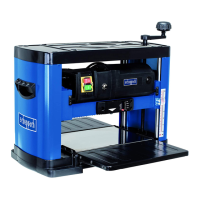
Table of Contents

Questions and Answers

  • A
    Amanda OconnorSep 17, 2025
    How to improve the surface finish with my Scheppach Planer?
    • A
      Alicia WilliamsSep 17, 2025
      If you're getting an unsatisfactory surface finish with your Scheppach Planer, consider these potential causes. The planing blade may be blunt or worn, so replace or sharpen it. The planing blade might also be filled with chips, so remove them. Uneven feed can also be a factor; try feeding the workpiece with constant pressure and at a reduced speed.
  • B
    brian42Aug 25, 2025
    What causes obstructed chip ejection during thicknessing (without dust extractor) with my Scheppach PLM1800?
    • C
      crystal50Aug 25, 2025
      If chip ejection is obstructed during thicknessing (without a dust extractor) when using your Scheppach Planer, it could be due to several reasons. You might be removing too much material, so reduce the chip removal. The knives may be blunt, so replace them. The wood could also be too humid, so dry the workpiece.
  • C
    Christopher RamosAug 25, 2025
    What causes obstructed chip ejection during surface planing and thicknessing (with dust extractor) with my Scheppach PLM1800?
    • A
      Amber ScottAug 26, 2025
      If chip ejection is obstructed during surface planing and thicknessing (with a dust extractor) when using your Scheppach Planer, the suction performance might be too weak. Use a dust extractor unit having an airflow rate at the suction connection of at least 20 m/s.
  • C
    Catherine StephensAug 27, 2025
    What to do if my Scheppach PLM1800 machine cannot be switched on?
    • L
      lisaharringtonAug 27, 2025
      If your Scheppach Planer won't switch on, first check the power supply. If the power supply is fine, the carbon brush may be worn, in which case you should take the machine to your service point.
  • J
    Jessica HansenSep 18, 2025
    Why Scheppach PLM1800 Planer does not work?
    • D
      Danielle WilliamsSep 18, 2025
      If the Scheppach Planer machine does not work or stops suddenly, it could be due to a power cut, or the motor or switch might be defective.
  • D
    Deborah WoodardSep 23, 2025
    What to do if the workpiece jams during thicknessing with my Scheppach PLM1800?
    • X
      xturnerSep 23, 2025
      If the workpiece jams during thicknessing with your Scheppach Planer, the cutting depth may be too great. Reduce the cutting depth and machine the workpiece in several passes.
  • J
    Jesus BarnesSep 9, 2025
    What causes obstructed chip ejection during thicknessing on a Scheppach Lathe?
    • J
      Jeffrey LynchSep 9, 2025
      If you experience obstructed chip ejection during thicknessing on your Scheppach Lathe (without a dust extractor), consider these points: * Too much chip removal; reduce it. * Blunt knives; replace them. * The wood may be too humid; dry the workpiece.
  • M
    moralesbrandySep 10, 2025
    Why is the machined surface cracking on my Scheppach Lathe?
    • R
      Ronald JacobsSep 10, 2025
      Cracking on the machined surface of your Scheppach Lathe workpiece can occur because: * The workpiece was machined against the grain; machine it from the opposite direction. * Too much material was planed in one pass; machine the workpiece in several passes.
  • L
    Lisa GrossSep 3, 2025
    Why is chip ejection obstructed (without dust extractor) when thicknessing with my Scheppach PLM1800 Planer?
    • H
      henrymartinSep 3, 2025
      If chip ejection is obstructed (without a dust extractor) when thicknessing with your Scheppach Planer, it could be due to too much chip removal, so reduce it. Another reason could be blunt knives, which should be replaced. Also, the wood may be too humid, so dry the workpiece.
  • Z
    zacevedoSep 1, 2025
    What causes a machined surface to be too rough when using my Scheppach Planer?
    • W
      wroseSep 1, 2025
      If the machined surface is too rough when using your Scheppach Planer, it may be because the workpiece contains too much moisture. You should dry the workpiece.

Summary

2. Layout

4. Intended Use

5. Important Information

General Safety Instructions

Key safety guidelines for using the equipment safely.

Safe Operation

Essential practices for operating the machine without risk.

Special Safety Instructions

Residual Risks

Emergency Procedure

6. Technical Data

8. Before Starting the Equipment

9. Installation

10. Operation

10.1 Adjusting to the Desired Height

Procedure for setting the planing depth using the crank.

10.3 Operating the Thickness Planer

Step-by-step guide on how to use the thickness planer.

11. Working Instructions

12. Electrical Connection

13. Cleaning, Maintenance and Ordering Spare Parts

17. Trouble Shooting

Scheppach PLM1800 Specifications

General IconGeneral
TypeParing chisel
Power1500 W
MaterialPlastic, Steel
Feed rate7.4 m/min
Idle speed8500 RPM
Handle colorBlack, Blue
Handle materialMetal, Plastic
AC input voltage230 V
Number of blades2
AC input frequency50 Hz
Surface planing material removal (max)152 mm
Thickness planing material removal (max)330 mm
Weight and Dimensions IconWeight and Dimensions
Depth630 mm
Width589 mm
Height500 mm
Thicknessing table dimensions (W x D)330 x 630 mm

Related product manuals