SERVICE TRAINING
Service Manual
11
Rock Valve
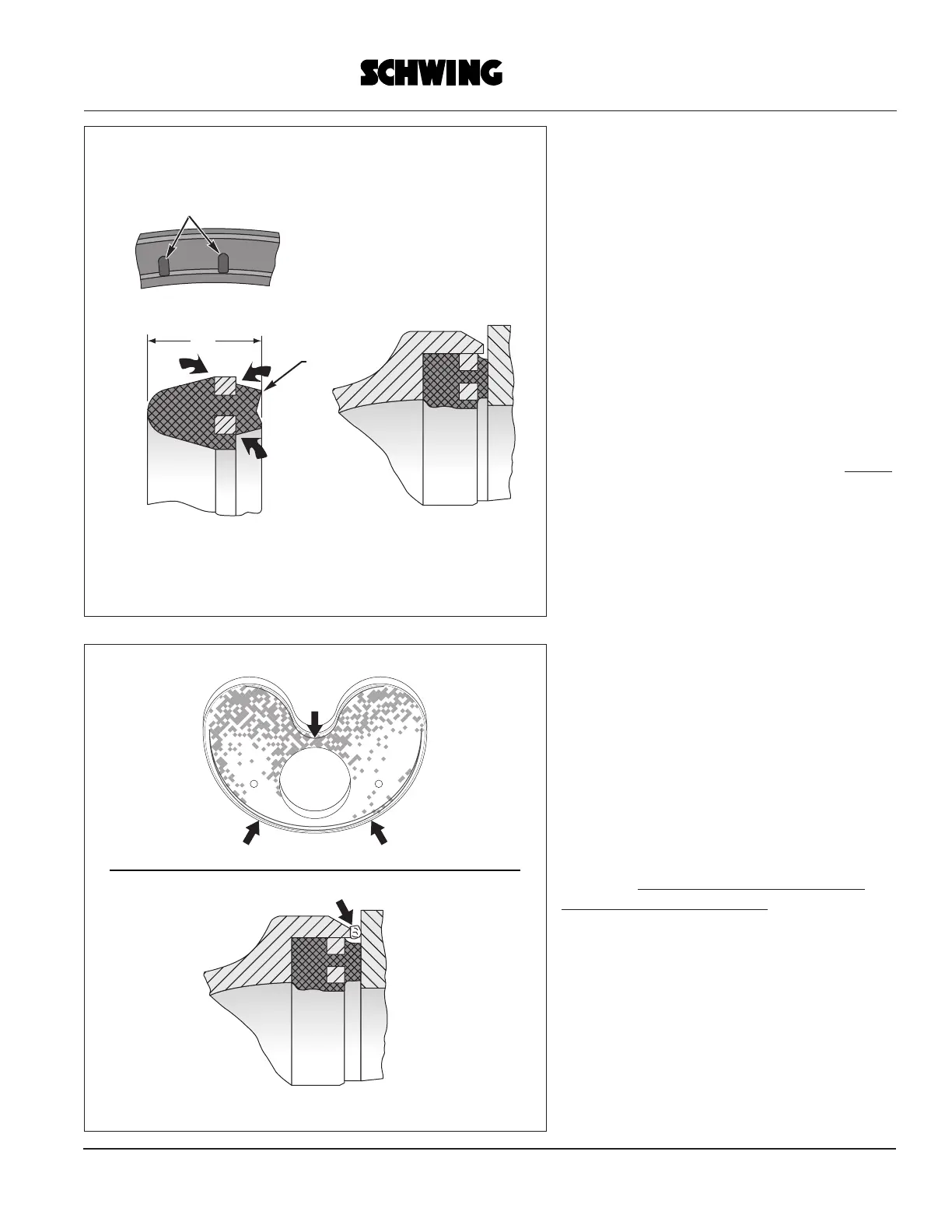
(2) - Pressure Relief Grooves
(1) - Lip
Spring compressed
(Installed)
Spring uncompressed
d
mm
M
Figure 1
Figure 3
Aggregate Particle
Figure 2
Determining Wear on Kidney
Seal and Kidney Plate
Replace the kidney seal if any of the following
conditions exist:
• The seal is swollen due to use of aggressive
or harsh cleaning agents. (See Service bulle-
tin G-113-84, dated July 18, 1984)
• A considerable formation of cracks are
found in the areas marked by arrows. (fig. 1)
This problem is very rare.
• Lip (Item 1, fig. 1) is completely worn to the
point that the pressure relief grooves (Items
2, fig. 1) are no longer recognizable.
• The distance indicated by “M” of the Kidney
Seal (when force is relieved) does not e
xceed
30mm (1 3/16”).
Replace the Housing Lining-Oulet Side (Kidney
Plate) only if scores deeper than 2.5mm are
found, in the area that contacts the Kidney Seal.
You can measure this by placing a steel ruler
across the kidney Plate in several places, and
using a depth gauge to determine the gap.
NOTE: Outside of the area that contacts the
Kidney Seal, you may detect scores that are
due to aggregate particles stuck between the
Rock Valve and the Kidney Plate. (See fig. 2
and fig. 3) These scor
es will not affect the
operation of thr Rock Valve.
Under no circumstances should you allow the
Kidney Seal to be run with a dry hopper. This
will destroy the Kidney Seal, and is the primary
cause of premature wear encountered at the out-
let side of the Rock Valve.
If you will be repairing the Rock, or trouble-
shooting a problem, always fill the hopper with
water to the top of the Rock Valve before switch-
ing.



 To Next Page