Theory of operations
35
Theory of Operations
Overview
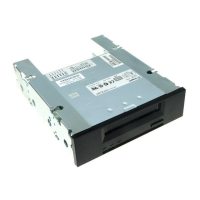
The Seagate DAT 72 and DDS-4 tape drive design integrates DAT technology
(helical scan recording method) into a true computer-grade data-storage peripheral
with industry-standard data-compression capability.
These drive designs are the result of:
•
Combining the economies of scale for key components, such as the cylinder,
heads, and audio Application Specific Integrated Circuits (ASICs), with a
computer grade drive (3.5-inch) using four direct drive motors and electronic
tape path control for the demanding computer storage environment.
•
Implementing a four-head design to provide read-after-write (RAW) error
correction and to maximize the benefits of the helical scan recording method,
namely: (1) high-density recording (all tape space is used by dense, overlapping
tracks at alternating azimuth angles) and (2) high-speed searches.
•
Using 5
th
-generation custom ASICs for efficient circuit layout and increased
reliability with low power consumption. These LSIs are quad-flat-pack (QFP)
designs that use complementary metal-oxide semiconductor (CMOS)
technology.
•
Using flash memory devices for easy firmware upgrades.
•
Storing configuration information in the parameter block of flash memory.
•
Implementing custom C3 ECC 1, 2, and 3 and other error-correction techniques.
•
Embedding a full-LSI SCSI controller with capability for SCSI-2 command sets in
LVD SCSI DDS-DC models.
•
Embedded 40 MHz (DDS-4) and 70 MHz (DAT 72) ARM CPUs with cache.
•
8-Mbyte SDRAM data buffer.
This chapter describes the DDS drive in more detail and explains implementation-
specific information.
Drive Mechanism
The drive uses the helical scan recording method with a four-head cylinder design.
Four direct-drive motors and one brush-type motor are used in the drive. The read
and write functions use LSIs. Engineering decisions—such as the modular
partitioning of the electronics and use of surface-mount, low-power commercial and
custom LSIs—allow the drives to conform to the industry-accepted 3.5-inch form




 To Next Page