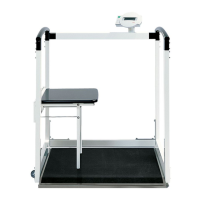
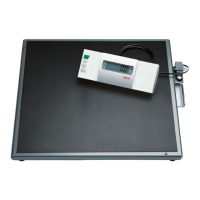
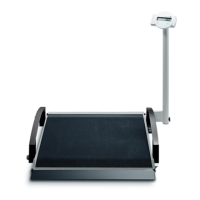
Model 644 31
GB
Evaluating Body Mass Index:
Compare the value determined with the categories shown below.
• BMI below 18:
Warning, this patient weighs too little. There could be a tendency to anorexia. An in-
crease in weight is recommended to improve well-being and performance. If in doubt,
consult a specialist.
• BMI between 18 and 20:
Patient is at lower weight limit. If he feels well and is completely healthy, his weight can
stay as it is.
• BMI between 20 and 25:
The patient is of a normal weight. He can stay as he his.
• BMI between 25 and 30:
The patient is slightly to moderately overweight. He should cut his weight if he is al-
ready ill (e.g. diabetes, hypertension, gout, fat metabolism disorders).
• BMI over 30:
Weight reduction is essential. Metabolism, cardiovascular system and bones are all un-
der strain. A consistent diet, plenty of movement and behavioural training are all rec-
ommended. If in doubt, consult a specialist.
Weighing with pre-Tare
If the pre-Tare function is activated, a stored weight value is deducted from the currently
measured weight. This function can be useful, for example, when the patient and the carer
mount the scale together, and the weight of the carer is not meant to be shown.
Three different tare weights (carer weights) can be stored.
– Press the Start key.
se(a, 8.8.8.8.8. and 0.00. appear con-
secutively in the display. After that, the
scale is automatically set to zero and
ready for operation.
– Press the FUNC key.
The last function used appears in the
display.
– Use the arrow keys to select the pre-
Tare function FU 3. Activate the function
by pressing the FUNC key once again.
An arrow on the left-hand side of the
display indicates which memory is set.
– Use the arrow keys to select the desired
memory for storing the additional
weight or where a weight may already
be stored.
– Then press FUNC. In the display you
will see the tare value from the memory.



 To Next Page