SSIO-Mode&&
!
The SSIO-mode serves for the purpose of synchronous serial data transfer – in contrast
to the asynchronous serial data transfer of the SIO-mode. “Synchronous” means, that the
sender provides an additional strobe/clock signal, to which the receiver aligns. This
makes an explicit baud-rate obsolete, to which both sides have to be configured in SIO-
mode. Hence the settings of the TEXT/Sio/Format-submenue are irrelevant in SSIO-
mode.
The SSIO-mode provides different submodes resp. protocols.
SSIO-Mode:&CE-126P&Print&Protocol&
!
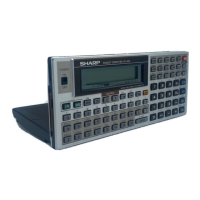
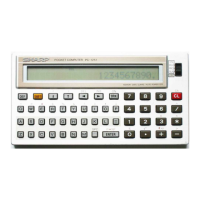
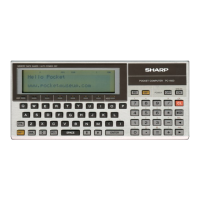
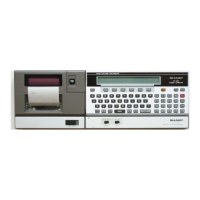
This is the default protocol for the 11-pin interface of the PC-G850V(S). It is the protocol
for the printer CE-126P and it is active if and only if there is no other (sub-)mode
selected. The commands LPRINT, LLIST and LFILES are routed to the printer in this
mode.
The integrated cassette interface of the CE-126P can also be used by the PC-G850V(S)
and the respective protocol shares the handshake with the print protocol, but it uses
PWM for data transfer instead of SSIO (see below).
The pin-out and signal semantics within the CE-126P print protocol is as follows:
HIGH: CE-126P sub-device select (i.e. printer vs.
cassette interface) resp. command transfer
LOW: Idle or data transmission


 To Next Page