SIO-Mode:&Signal&Lev els&
!
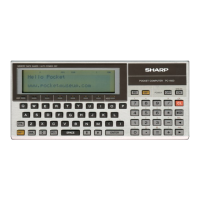
The next table summarizes the logic- and voltage-levels of the RS-232 standard in
comparison with UART-TTL and the PC-G850V(S).
So the PC-G850V(S) exposes inverted UART-TTL level signals in SIO-mode, just as
most other SHARP pocket computers do. That means the logic is identical to the RS-232
standard (HIGH=0/active), but the voltage level is TTL.
ð In order to connect peripheral devices with the PC-G850V(S) that operate at
RS-232 voltage levels, a level converter is mandatory!
The state of the TXD- and RTS-signals in SIO-mode is undefined, except for the
following cases:
1. The interface has explicitly been opened in SIO-mode (e.g. OPEN“COM:“) when in
operational main mode “BASIC”.
2. R- or W-commands are executed in operational main mode “Monitor”.
3. Data transfer via SIO in operational main mode “TEXT”.
!
&


 To Next Page