Alpy 600 - user guide
This document follows the standard con-
vention for presenting astronomical spectra.
The blue end of the spectrum corresponds to
the highest frequencies, or lower wavelength.
The red end is for lower frequencies or higher
wavelength. Usually, in Astronomy, we show the
spectra from lower to higher wavelength. From
now on, get into the habit of putting blue on
the left, and red on the right.
1.6 Alpy 600 principle
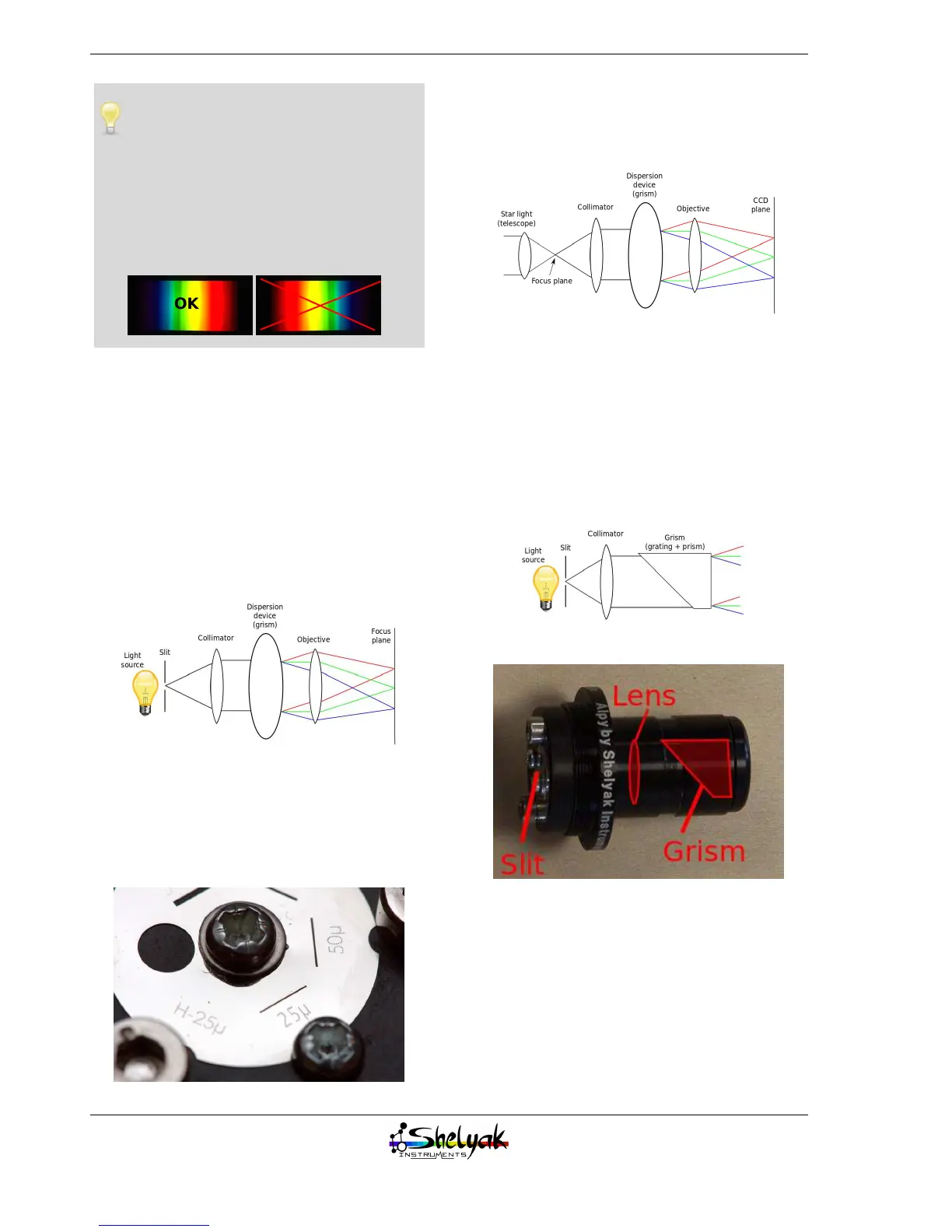
The principle of the Alpy 600 is as follows. A point
light source is sent to a collimator lens which makes
the beam parallel. This parallel beam goes through
a dispersing element (usually a prism or a grating):
all outcoming rays of the same wavelength (or color)
go in the same direction, but the output angle differs
for other wavelengths. Then, an objective lens collects
all these beams and focuses them on the focal plane,
where we put the sensor.
To make the source point-like, we usually use a nar-
row slit: only the light which goes through the slit is
spread out. The narrower the slit, the higher resolu-
tion the spectrum is, but the less light goes through:
there is a compromise to find for each case.
In Astronomy, we’re lucky : stars themselve are point-
like. So, when looking at stars, we can afford to re-
move the slit:
The Alpy 600 is designed in a modular way. The
core element consists of the the slit, the collimator
lens, and a grism. A grism is a combination of a grat-
ing and a prism. The grating spreads out the light, but
also deviates the beam by a significant angle. Using a
prism brings the beam back onto the axis of the input
light. In this way we have an on-axis instrument.
The light coming out the core element is then a set
of parallel beams. This is exactly what the eye needs :
a parallel beam is comparable to a beam coming from
infinity. Then, if you put your eye behind the core el-
ement, you’ll see the spectrum.
10


 To Next Page