3
Alpy 600 - Stellar spectroscopy in slitless mode
In the previous chapter you learned how to produce
a basic spectrum. You know what images are needed
and how to process them to get the actual signal con-
tained in the light you observed. You are now ready
to go to the telescope and to apply the same method
on astronomical objects.
So far, you’ve worked with the Alpy 600 in slit mode.
Ideally, you should do the same with the stars. But
there is a problem: when using a slit spectroscope,
the only field you get is the slit. With an extended
source (daylight, calibration lamp...) it’s easy to aim
for the source. But stars are point-like and it’s not ob-
vious how to put it in the slit (If the star is in the slit,
you get a spectrum, but if it is just beside the slit, you
see... nothing and when you see nothing, there is no
way to define in which direction you must move the
telescope).
>From a practical standpoint, this is not feasible,
at least when starting in spectroscopy. You’ll see in
chapter 4 how to deal with that. For now, switch to
slitless mode, applicable for point-like sources..
Slitless mode has advantages. For instance, it col-
lects the full light of the star, whereas slit mode has
some loss at slit entry. This is useful for very faint ob-
jects, but it has also some drawbacks : there is no
way to use a calibration lamp (which is an extended
source), and the position of the spectrum will move
in the field, depending on your telescope tracking.
In a few words, using the Alpy 600 in slitless mode
is the way to work when you have no guiding device,
but this is not the simplest way to get accurate mea-
surements. The good news is that when you become
familiar with this process, switching to a guided mode
will reveal how easy it is to do spectroscopy !
The observation itself must be done during
the night, but the preparation of the tele-
scope and the tuning of the Alpy 600 with the
CCD camera has to be done during daylight.
3.1 Changing the slit position
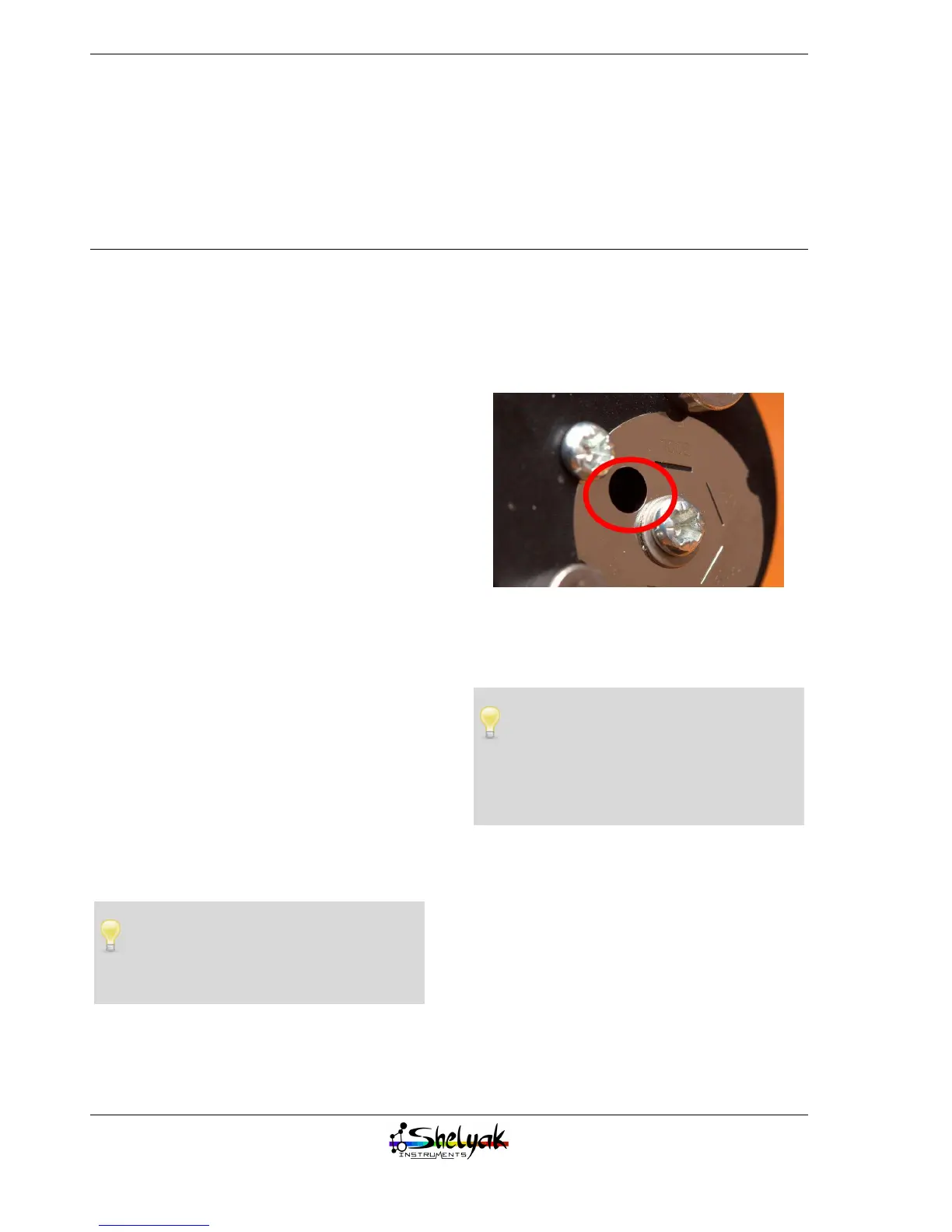
You’ve seen in section 1.7 how to change the slit.
Here, you should select the 3mm hole (the “big” one):
Now, if you take an image of Sun light, you’ll see
a very rough spectrum, as if if it were strongly defo-
cused. It is in fact focused, but the light source is so
big that the spectrum is unusable.
Why not totally remove the slit ? You could
do this but the size of the “high quality” field
of the Alpy 600 is limited (it is very good over
the whole 3mm hole, but decreases outside this
area), and... keeping the slit in place is the best
way to not damage or lose it.
3.2 Visual observation
To start with astronomical objects, we invite you to
look visually at a star spectrum. Remove the Alpy 600
core element from the body (loosen the three small
screws around the body):
26


 To Next Page