CHAPTER 3. ALPY 600 - STELLAR SPECTROSCOPY IN SLITLESS MODE
wavelength Line
3835 Å Hη (eta)
3889 Å Hζ (dzeta)
3970 Å Hǫ (epsilon)
4102 Å Hδ (delta)
4340 Å Hγ (gamma)
4861 Å Hβ (beta)
6563 Å Hα (alpha)
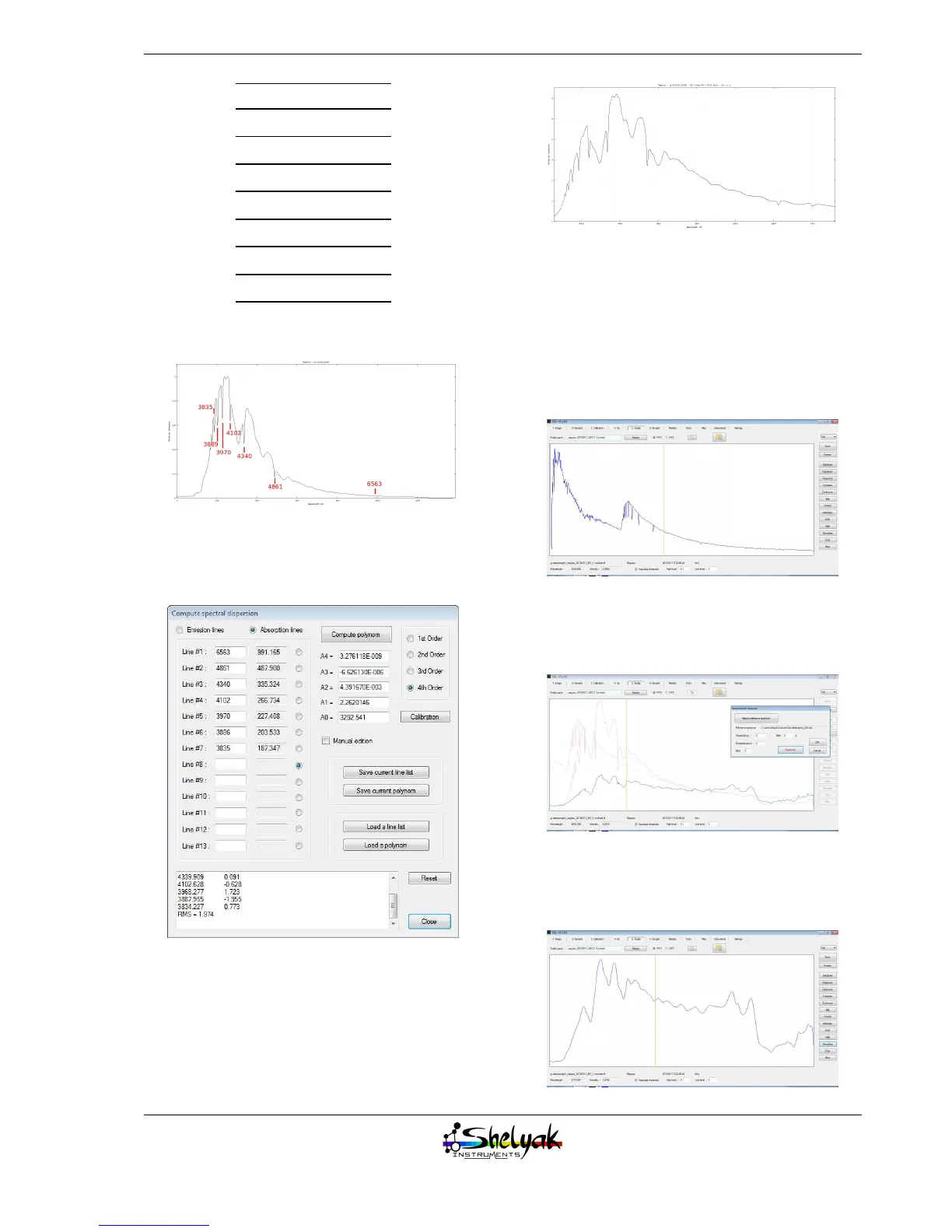
These lines are located as below:
With this information, you can establish the cali-
bration law - select a 4th degree polynomial (because
there are several available lines).
When the polynomial is available, re-run the data
reduction process, including the wavelength calibra-
tion. You will get the same profile, but now calibrated
in Å(see the scale in the bottom axis - note that the
spectrum has been cropped between 3650 and 7300
Å):
3.4.3 Third pass
The last operation is to establish the instrumental
response curve. In this document, we used Regulus
as reference star. This is a B7V. In the ISIS database
(Pickles), there is no B7V, but we can select a B8V -
the difference is not significant at our level. Display
this profile, and save it in the current directory:
The spectrum has a much wider range than yours:
it goes from 1.000 to 10.000 Å. Reload your spectrum,
and click on “Response”:
Click on OK, to get just the raw response curve. Re-
move the lines and smooth the curve to reduce the
noise:
31


 To Next Page