CHAPTER 3. ALPY 600 - STELLAR SPECTROSCOPY IN SLITLESS MODE
Select a star to observe. It must be bright, and you
should preferably look for a hot star (A or B type), be-
cause its spectrum has a clear continuum, with some
deep absorption lines. In the images below, we ob-
served Regulus, which is a B7 type star.
When night falls, point at the star using the tele-
scope finder. Take an image of the spectrum. Com-
pared to the Sun spectrum you made previously, the
exposure time must be much higher for stars! If only
tenths of a second were enough for Sun, seconds or
minutes can be required for stars. If you’ve chosen a
bright star (magnitude 0 to 3), then only few seconds
is enough - with a small telescope. Anyway, always
control the exposure time to prevent saturation or low
levels.
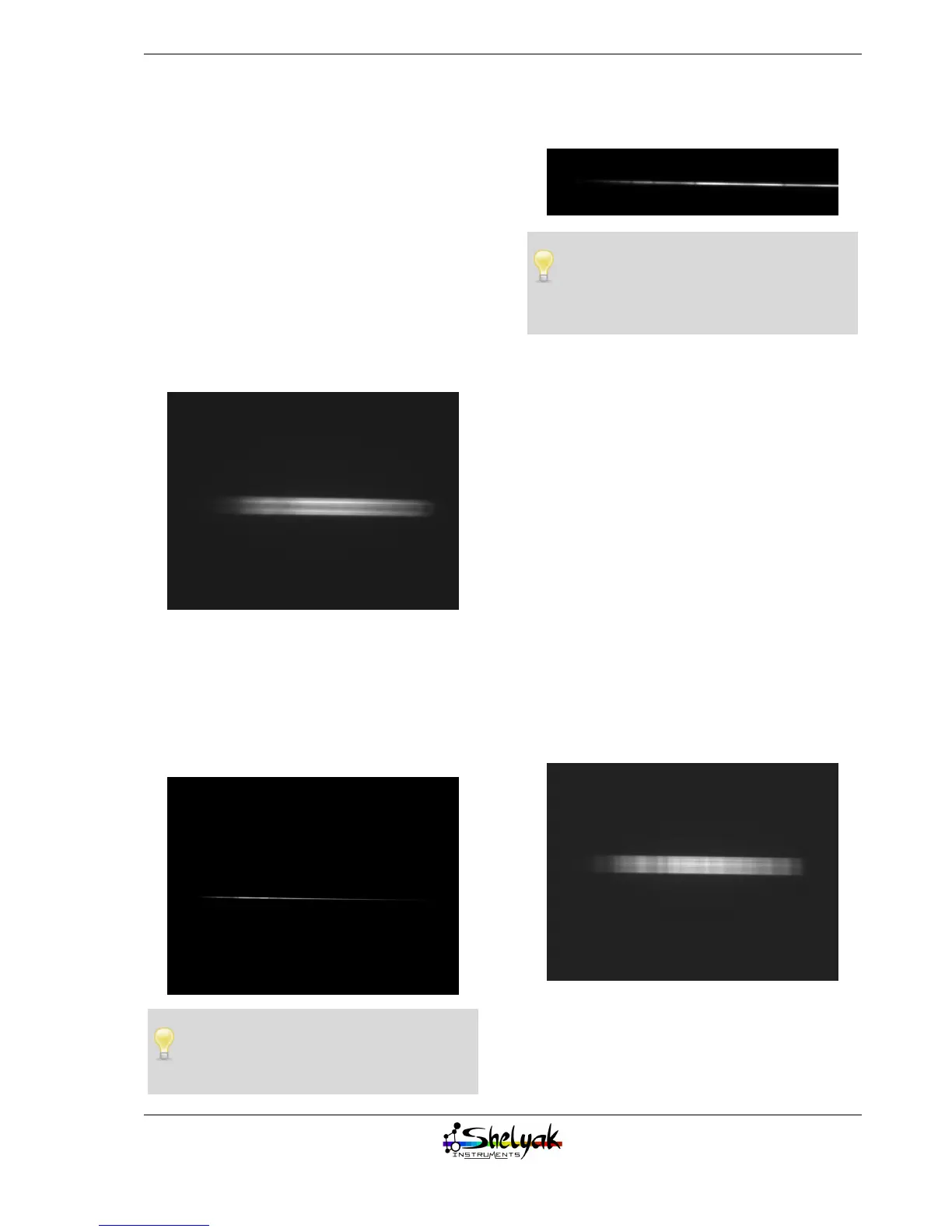
You should see something like this:
Move the telescope to position the spectrum in the
center of the image.
Your telescope is probably unfocused. Take spectra
continuously while focusing the telescope. Little by
little, you’ll see the spectrum get thiner and thiner.
When focused, you should have this (it must be only
few pixels wide):
In slitless mode, the width of the spectrum is
directly linked to the star image size in the
focus plane of the spectroscope (slit plane).
Look at the left end of the spectrum : there are clear
absorption lines (only for hot stars):
If your image is black, it can be due to the im-
age visualization thresholds. In AudeLA, click
on the “auto” button (bottom left) to adapt the
thresholds to the image.
You can rotate the Alpy 600 in the eypiece holder : the
spectrum remains horizontal in the image. This is nor-
mal: the orientation of the spectrum only depends on
spectroscope position vs the CCD camera. However,
it does not mean that you should put the Alpy 600
in any position. If you want to make it easy to find
and center the spectrum in the image, it is better to
align the spectroscope axis to the telescope axis. Ro-
tate Alpy 600 (the whole instrument, including CCD
camera and external body) in such a way that when
you move the telescope in Declination, the spectrum
moves along the vertical axis.
Your instrument is now ready for observation.
3.3.2 Stars observation
Take some time to acquire several images of the
star. Of course, if you make exposures of several sec-
onds (which is more than probable), you must rely
on the telescope tracking. If the tracking is bad, the
spectrum will move in the image during the acquisi-
tion, and the result will be a band instead of a line:
As you did with the Sun, you can immediately pro-
cess your first spectra with ISIS. The only difference
is that you now have a star spectrum (Regulus in
our case), and you should ask ISIS to remove the sky
background (in the “2. General” tab). You should get
29


 To Next Page