Need help?
Do you have a question about the Shimaden SRS10A Series and is the answer not in the manual?
Critical safety instructions to prevent injury or death.
Precautions to prevent equipment damage or failure.
Instructions for verifying product model code and accessories.
Guidelines for handling and cleaning the controller.
Specifies environmental requirements for controller installation.
Guidance on securely mounting the controller in a panel.
Provides physical dimensions and panel cutout specifications.
Details wiring instructions, precautions, and noise filter usage.
Diagrams showing terminal connections for different models.
Lists terminal functions and their corresponding numbers.
Steps to perform before initial operation and setting.
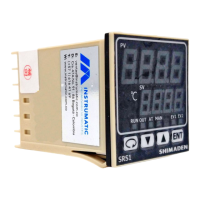
Description of the PV display and its indicators.
Description of the SV display and its indicators.
Explanation of status indicators like RUN, AT, MAN, OUT.
Details the function of each front panel key for navigation and setting.
Visual representation of screen groups and navigation flow.
Describes the display sequence upon power application.
How to navigate between different screens and screen groups.
How to modify data via the OR or key.
Explains the automatic return to the basic screen after inactivity.
Procedure for setting desired target values.
How to switch between automatic and manual control output.
Process for automatic PID parameter tuning.
How to halt or resume controller execution.
Configuration of event types and their associated values.
Setting and switching multiple target set values.
Selecting SVs via external control input (DI).
Explanation of the basic screen and its initial values.
Configuration of standby action modes.
Monitoring and manual setting of control output 1.
Monitoring and manual setting of control output 2.
Setting specific values for fixed value control events.
Initial setup screen and switching to screen group 4.
Enabling or disabling panel key lock for parameter protection.
Selecting the type of event for EV1, including alarm types.
Setting mode for heater 1 break/loop alarm detection.
Selecting the signal type for analog output.
Configuring the function of the DI1 external control input.
Setting the communication speed for data transfer.
Setting the cycling time for proportional control output 1.
Selecting input type and corresponding measuring range codes.
Configuring how PV and SV values are displayed on the basic screen.
Detailed explanation of event types, alarms, and standby actions.
Functionality and setup for heater break and loop alarms.
Explanation of Proportional, Integral, and Derivative (PID) control parameters.
Configuration of output limiters, cycling time, and characteristics.
Details on using external inputs for control execution, tuning, and SV selection.
How soft start gradually increases control output to prevent surges.
Common problems, their causes, and solutions.
Specific error messages, causes, and resolution steps.
Introduction to parameter masking and key lock features.
Visual guide to parameter masking and locking settings.
Details on setting parameters, screen groups, and initialization.
Details on display type, accuracy, resolution, and range.
Covers setting methods, ranges, limiters, and key lock.
Details on input types, resistance, scaling, and compensation.
Parameters for PID, output, alarms, events, and programming.
Configuration details for events, hysteresis, and standby actions.
Details on patterns, steps, PID types, and timing for programming.
Specifications for analog output scaling, limiting, and accuracy.
Details on DI types, allocation, action, and isolation.
Specifications for CT input current detection and alarm settings.
Details on communication protocols, speed, data format, and modes.
Covers environmental conditions, power supply, and construction.
 General
| Brand | Shimaden |
|---|---|
| Model | SRS10A Series |
| Category | Controller |
| Language | English |


 To Next Page