EasyManua.ls Logo

Shimaden SRS3 - User Manual

Default Icon
34 pages
To Next Page IconTo Next Page
Loading...
Request
The instruction manual should be kept in a handy place where the end user can refer to it when necessary.
Preface
This instruction manual (detailed version) was written for those who perform wiring, installation, operation, and routine
maintenance for the SRS0 (SRS1/SRS3/SRS4/SRS5) Series.
This manual contains a description of the operating method, functions, wiring, mounting method, and precautions
when handling the SRS0 (SRS1/SRS3/SRS4/SRS5) Series (hereinafter referred to as the SRS0 Series unless a separate
description is required). You should, therefore, keep it handy to refer to it when operating and handling the device.
Be sure to observe all precautions and adhere to the procedures provided herein.
MSRS0-E01-A
Oct. 2018
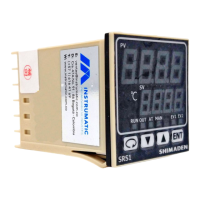
SRS0 Series
(SRS1/SRS3/SRS4/SRS5)
Digital Controller
Instruction Manual (Detailed Version)
Thank you for purchasing a Shimaden product. After making sure the product fits the desired
description, you should carefully read the instruction manual and get a good understanding of
the contents before attempting to operate the device.

Table of Contents

Question and Answer IconNeed help?

Do you have a question about the Shimaden SRS3 and is the answer not in the manual?

Shimaden SRS3 Specifications

General IconGeneral
BrandShimaden
ModelSRS3
CategoryController
LanguageEnglish

Summary

1. Safety rules

3. Installation and wiring

3-4. Wiring

Covers essential wiring precautions and guidelines for safe and correct electrical connections.

5. Parameter diagram and setting

5-5. Screen group 0 setting

Covers setting target values, manual control output, auto tuning, reset, events, and multi SV.

PID setting screen group

2-1. Output PID1 proportional band (P) setting screen

Sets the proportional band for PID control, affecting output variation.

Event (EV);DI settings

4-13. DI mode setting screen

Assigns functions to external digital inputs (DI) for control and monitoring.

8. Explanation of functions

8-2. P.I.D.

Explains PID control parameters like proportional, integral, derivative actions, and manual reset.

9. Causes and remedy of trouble and errors

9-1. Causes and remedy of trouble

Provides solutions for common operational problems like display errors and key malfunctions.

9-2. Causes and remedy of errors

Addresses abnormal measured inputs and their corresponding causes and remedies.

Related product manuals