RF300 system planning
4.1 Fundamentals of application planning
SIMATIC RF300
System Manual, Release 04/2006, J31069 D0166-U001-A2-7618
4-9
4.1.8 Communication between communication module, reader (with IQ-Sense interface)
and transponder
Communication between the communication module (IQ-Sense), RF310R reader and
transponder takes place in fixed telegram cycles. 3 cycles of approximately 3 ms are always
needed for the transfer of a read or write command. 1 or 2 bytes of user data can be
transferred with each of these commands. The acknowledgement transfer (status or read
data) takes place in 3 further cycles. The transponder must be present within the field of the
reader during the message frame cycle.
Calculation of the communication time for interference-free transfer
The communication time for fault-free data transfer is calculated as follows:
=+ ⋅tKtn
KByte
(n >1)
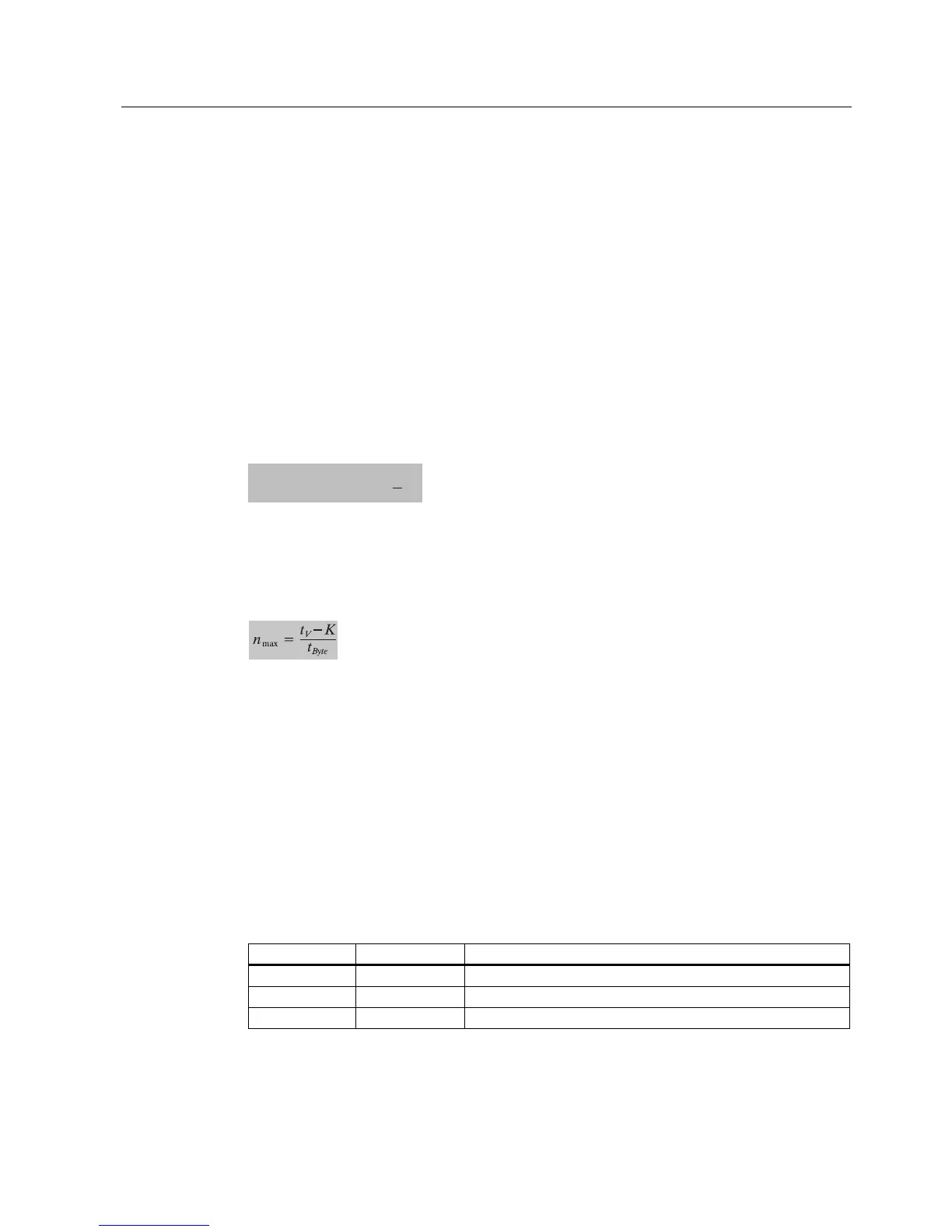
Calculation of the maximum amount of user data
The maximum amount of user data is calculated as follows:
t
K
Communication time between communication module, RF310R IQ-Sense reader
and transponder
t
V
Dwell time
n Amount of user data in bytes
n
max
Max. amount of user data in bytes in dynamic mode
t
Byte
Transmission time for 1 byte
K Constant (internal system time) This contains the time for power buildup on the
transponder and for command transfer
Time constants K and t
Byte
K (ms) t
Byte
(ms) Command
15 15 Read (FRAM/EEPROM area)
15 15 Write (FRAM area)
30 30 Write (EEPROM area)
The table of time constants applies to every command. If a user command consists of
several subcommands, the above t
K
formula must be applied to each subcommand.



 To Next Page