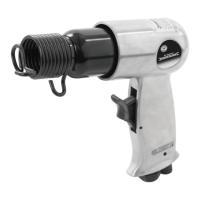
Air Hammer Set 5pce394970
9
silverlinetools.com
• InspectthetoolperiodicallytoverifythattheratingsandmarkingsrequiredbyISO11148
(detailedintheDescriptionofSymbols)arelegiblymarkedonthetool.Theuser(andemployer
ifappropriate)shouldcontactthemanufacturertoobtainreplacementmarkinglabelswhen
necessary.
• Compressedaircancausesevereinjury.
• Alwaysdisconnectthetoolfromtheairsupplywhennotinuse.
• Alwaysdisconnectthetoolfromthecompressedairsupplybeforechangingaccessories,making
adjustmentsand/orrepairsandwhenmovingawayfromanoperatingareatoadifferentarea.
• Keepngersawayfromtriggerwhennotoperatingthetoolandwhenmovingfromone
operating position to another.
• Neverdirectcompressedairatyourself,othersoranimals.
• Whippinghosescancausesevereinjury.Alwayscheckfordamagedorloosehosesorttings.
• Nevercarryordraganairtoolbyitshose.
• When using air tools, do not exceed the maximum operating pressure.
• Inspecttoolsandaccessoriesbeforeeachuse.Donotuseifdamagedorexcessivelyworn.
• Airtoolsshouldonlybepoweredbycompressedairatthelowestpressurerequiredbythetaskto
reducenoiseandvibrationandminimisewear.
• Neverusepureoxygenorcombustiblegasestopoweranairtool.Airtoolsarenotdesignedfor
thesepowersourcesandtheirusecreatesareandexplosionhazard.
• Beawarethatairtoolsmaybecomecoldduringuse,affectinggrip,controlandsusceptibilityto
vibration-relatedinjury.
• Coldairshallbedirectedawayfromhands.
• Donotusequick-disconnectcouplingsattoolinlet.Usehardenedsteel(ormaterialwith
comparableshockresistance)threadedhosettings.
• Wheneveruniversaltwistcouplings(clawcouplings)areused,lockpinsshallbeinstalledand
whipchecksafetycablesshallbeusedtosafeguardagainstpossiblehose-to-tooland
hose-to-hose connection failure.
IMPORTANT:Evenwhenthistoolisusedasprescribeditisnotpossibletoeliminateallresidualrisk
factors. If you are in any doubt as to the safe use of this tool, do not use it.
Projectile hazards
a) Beawarethatfailureoftheworkpiece,accessories,ortoolitselfcangeneratehigh-velocity
projectiles.
b) Alwayswearimpact-resistanteyeprotectionduringoperationofthistool.Thegradeofprotection
required should be assessed for each use.
c) Assessrisktootherswhenconsideringprojectilehazardrisk.
d) Ensurethattheworkpieceissecurelyxed.
e) Disconnectthenon-rotarypercussivepowertoolfromtheenergysourcewhenchanginginserted
tool or accessories.
f) Neveroperateatoolunlesstheinsertedtoolisretainedinthetoolwithaproperretainer.
g) Toavoidinjury,retainerpartsshallbereplacedwhentheybecomeworn,crackedordistorted.
h) Holdtheinsertedtoolrmlyagainsttheworksurfacebeforestartingthetool.
Operating hazards
a) Ensureusersandmaintenancepersonnelarephysicallyabletohandlethebulk,weightand
powerofthetool.
b) Holdthetoolcorrectly;bereadytocounteractnormalorsuddenmovementssuchasrecoil.Have
both hands available.
c) Maintainabalancedbodypositionandsecurefooting.
d) Onlyuselubricantsrecommendedbythemanufacturer.
e) Personalprotectivesafetyglassesshouldbeused;suitableglovesandprotectiveclothingare
recommended.
f) Foroverheadwork,wearasafetyhelmet.
g) Avoiddirectcontactwithmovingpartstopreventinjurybypinchingorcutting.
h) Beawarethatthereisariskofelectrostaticdischargeifusedonplasticandothernon-conductive
materials.Takeappropriatestepstoreducethisriskwhenworkingwiththesematerials(e.g.
usingagroundingsystem).
i) Beawarethatcertainmaterialsmaypresentreorexplosionriskswhenbeingprocessed.Take
appropriate precautions to reduce hazards. Employers should make risks clear to operators.
j) Switchoffdevice/releasestart-and-stopcontroliftheair/powersupplyisinterrupted.
k) Useofthetoolcanexposetheoperator’shandstohazards,includingimpacts,cutsandabrasions
and heat. Wear suitable gloves to protect the hands.
Repetitive motions hazards
When using the tool the user may experience discomfort in the hands, arms, shoulders, neck or
other parts of the body.
a) Adoptacomfortableposturewhilstmaintainingsecurefootingandavoidingawkwardor
off-balance postures. Change posture during extended tasks; this can help avoid discomfort and
fatigue.
b) Symptomssuchaspersistentorrecurringdiscomfort,pain,throbbing,aching,tingling,
numbness, burning sensations or stiffness, should not be ignored. Inform employer if
appropriateandconsultaqualiedhealthprofessional.
Accessory hazards
a) Disconnectthetoolfromtheairsupplybeforettingorchangingtheaccessory.
b) Avoiddirectcontactwiththeaccessoryduringandafteruse.Accessoriesareoftensharpandmay
become hot during use.
c) Useonlysizesandtypesofaccessoriesandconsumablesthatarerecommendedbythe
manufacturer of the tool; do not use other types or sizes of accessories or consumables.
d) Neveruseanychiselasahand-strucktool.Theyarespecicallydesignedandheat-treatedforuse
onlyinnon-rotarypercussivepowertools.
e) Neverusebluntchisels,astheyrequireexcessivepressureandcanbreakfromfatigue.Blunttool
piecescanincreasevibrationand,therefore,sharptoolsshouldalwaysbeused.
f) Nevercoolahotaccessoryinwater.Brittlenessandearlyfailurecanresult.
g) Chiselbreakageortooldamagecanresultfrommisuseofusingthetoolasalever,e.g.prising.
Takesmaller“bites”toavoidgettingstuck.
Work area hazards
a) Beawareofslipperysurfacescausedbyuseofthetoolandtriphazardscausedbytheairline.
Slips,tripsandfallsaremajorcausesofinjury.
b) Wherepossibledonotobstructthoroughfaresandpassagewayswithairlinesorcables.Take
appropriatemeasurestoreducetriprisksuchaserectingwarningsignsandxingcablesandair
lines in place.
c) Proceedwithcareinunfamiliarsurroundingstominimiseriskfromhiddenhazardssuchas
utility lines.
d) Thetoolisnotintendedforuseinpotentiallyexplosiveatmospheresandisnotinsulatedagainst
contactwithelectricpower.
e) Ensurethattherearenoelectricalcables,gaspipes,etc.,whichcouldcauseahazardifdamaged
by use of the tool.
Dust and fume hazards
Dustandfumescancauseillhealth(e.g.cancer,birthdefects,asthmaand/ordermatitis);risk
assessment and implementation of appropriate controls for these hazards are essential.
a) Risksassessedshouldincludedustcreatedbytheuseofthetoolandthepotentialfordisturbing
existing dust.
b) Directtheexhausttominimisedisturbanceofdust.
c) Controldustandfumesatthepointofemissionasapriority.
d) Select,maintainandreplaceconsumables/accessoriesasrecommendedintheinstructions,to
prevent an unnecessary increase in dust or fumes.
e) Userespiratoryprotectioninaccordancewithanyemployer'sinstructionsandasrequiredby
occupational health and safety regulations.
f) Takeintoaccounttherisksassociatedwithdifferentmaterials.Workingincertainmaterials
creates dust and fumes that may cause an explosive environment.
g) Alwaysusedustextractionorsuppressionsystemswhicharesuitableforthematerialbeing
processed.
h) Operateandmaintainthenon-rotarypercussivepowertoolasrecommendedintheinstructions
handbook, to minimize dust or fume emissions.
i) Allintegralfeaturesoraccessoriesforthecollection,extractionorsuppressionofairborne
dustorfumesshouldbecorrectlyusedandmaintainedinaccordancewiththemanufacturer’s
instructions.
Noise hazards
Exposure to high noise levels can cause permanent, disabling hearing loss and other problems,
suchastinnitus(ringing,buzzing,whistlingorhummingintheears).Riskassessmentanduseof
appropriate controls for these hazards are essential.
a) Useappropriatecontrolstoreducetheriskofnoise-relatedinjury.Thesecanincludeactionssuch
asdampingmaterialstopreventworkpiecesfrom‘ringing’.
b) Usehearingprotectioninaccordancewithanyemployer'sinstructionsandasrequiredby
occupational health and safety regulations.
c) Operateandmaintainthistoolasrecommendedintheinstructionstopreventanunnecessary
increase in the noise level.
d) Select,maintainandreplacetheconsumable/accessoryasrecommendedintheinstructions,to
prevent an unnecessary increase in noise.
e) Whereasilencerisavailable,ensureitisinplaceandingoodworkingorderwhenthetoolis
being operated.
f) Takestepstoreducenoiseintheworkareawherepossible(e.g.byusingdampingmats).
Vibration hazards
Exposure to vibration can cause disabling damage to the nerves and blood supply of the hands
andarms.Notallvibrationhazardscanbeeliminatedbytooldesignorconstruction,andsome
residualrisksremain.Checkthevibration-emissionvalue(obtainedusingISO28927-9)shownin
thespecicationtable.Ensuretheriskitrepresentsisassessedandmanaged.Iftheriskcannotbe
managedsothatitfallswithinacceptablelimits,thendonotusethetool.
394970_OwnerManual.indd 9394970_OwnerManual.indd 9 02/05/2024 08:3502/05/2024 08:35


 To Next Page
 Loading...