2.10 POSITIONING THE
OUTLET TERMINALS
The outlet terminals for forced-draught
appliances may be located in the external
perimeter walls of the building.
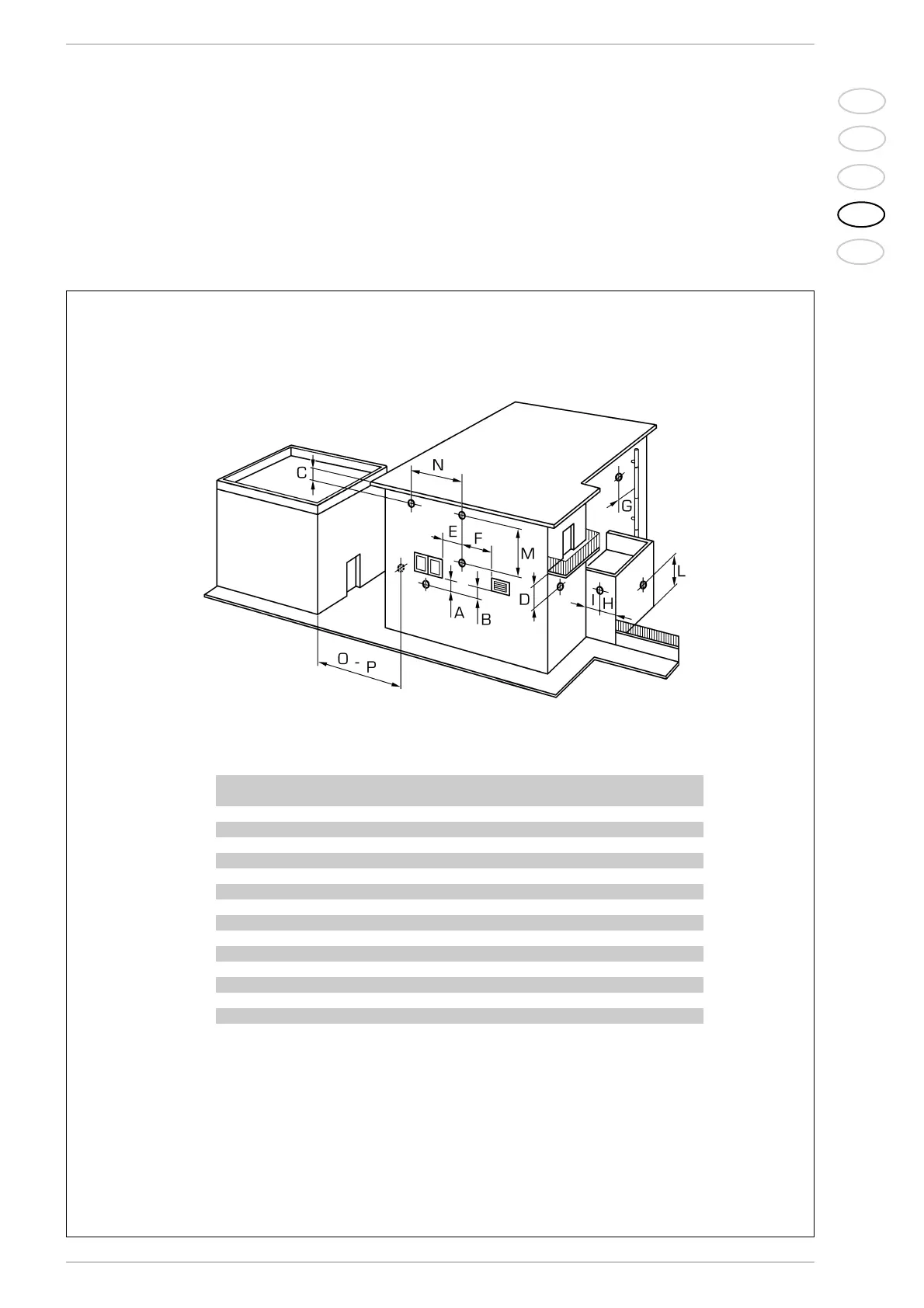
To provide some indications of possible solu-
tions, Table 3 gives the minimum distances
to be observed, with reference to the type
of building shown in fig. 13.
2.11 ELECTRICAL CONNECTION
The boiler is supplied with an electric cable.
Should this require replacement, it must be
purchased exclusively from SIME.
The electric power supply to the boiler must
be 230V - 50Hz single-phase through a
fused main switch, with at least 3 mm spa-
cing between contacts. Respect the L and N
polarities and the earth connection.
NOTE: SIME declines all responsibility for
injury or damage to persons, animals or
things, resulting from the failure to provi-
de for proper earthing of the appliance.
77
IT
ES
PT
GB
RUS
Fig. 13
TABLE 3
Siting of terminal Appliances from 7 to 35 kW
(distances in mm)
A - below openable window 600
B - below ventilation opening 600
C - below eaves 300
D - below balcony (1) 300
E - from adjacent window 400
F - from adjacent ventilation opening 600
G - from horizontal or vertical soil or drain pipes (2) 300
H - from corner of building 300
I - from recess in building 300
L - from ground level or other treadable surface 2500
M - between two terminals set vertically 1500
N - between two terminals set horizontally 1000
O - from a surface facing without openings or terminals 2000
P - as above but with openings and terminals 3000
1)
Terminals below a practicable balcony must be located in such a way that the total path of
the smoke from its outlet point from the terminal to its outlet point from the external peri-
meter of the balcony, including the height of possible railings, is not less than 2000 mm.
2) When siting terminals, where materials that may be subject to the action of the combu-
stion products are present in the vicinity, e.g., eaves, gutters and downspouts painted or
made of plastic material, projecting timberwork, etc., distances of not less than 1500 mm
must be adopted, unless adequate shielding is provided to guard these materials.




 To Next Page