Descripon and Specicaon — 9
3 DESCRIPTION AND SPECIFICATION
Simplex Neptune load banks are precision test instruments
designed to apply a selectable load to a power source and mea-
sure the source’s response. ey are used for routine mainte-
nance exercise to ensure the long-term reliability and readiness
of the standby generator. Load banks can also eliminate the det-
rimental eects of unloaded operation of diesel engine genera-
tors as well as prevent damage from reverse power generation.
Neptune load banks are available in models ranging from 150
kilowatts up to 650 kilowatts. All standard Neptune models have
a step resolution of 5 kilowatts.
Standard Neptune units are designed to operate in ambient
temperatures between 5 and 125 degrees Fahrenheit. For colder
temperatures, an Arctic Duty load bank is required.
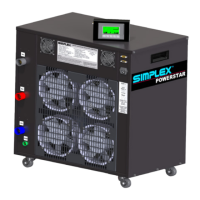
Neptune load banks feature a Human-Machine Interface
(HMI) touchscreen, which controls load bank operation and
displays the unit’s status. With the HMI, the operator can apply
a desired load and measure the response of the test source.
e load bank can also be integrated into your facility’s BMS/
BAS system via standard Modbus RS-485 or optional Modbus
TCP/IP, as well as a set of dry contacts for status reporting.
Neptune load banks are cooled by forced air, delivered by an
aluminum fan blade directly driven by a TEFC motor. e air is
brought in on the bottom of the load bank and expelled through the
top. Optional equipment allows the exhaust to be driven through a
customer-installed duct, providing for indoor installation.
e load system comprises independently controlled Simplex
Powr-Web resistors, which have been designed specically for
use in load bank systems. e load elements are supported by
high-temperature, ceramic-clad, stainless-steel rods across their
entire length, virtually eliminating element-to-element short
circuits. e elements are arrayed in discrete trays, which are
independently serviceable.
e Neptune is protected by sensors to ensure that the load
bank is suciently cooled and that the exhaust does not exceed a
safe temperature, which could damage the load bank or present
overview of
u
Se
Control
S
yStem
Cooling
S
yStem
load SyStem
Safety



 To Next Page