EasyManua.ls Logo

Simplicity 1003 - Page 10

Simplicity 1003
25 pages
Print Icon
To Next Page IconTo Next Page
To Previous Page IconTo Previous Page
Loading...
S
im
i
Operation
You
will
want
to
till
to
a
depth
that
suits
the
seed
you
will
plant.
As
a
rule,
till
at
least
2
inches
(50
mm)
deeper
than
the
normal
planting
depth
for
the
seed.
The
usual
planting
depth
for
com,
as
an
example,
is
2
to
3
inches
(50
to
76.2
mm).
Using
the
rule
above
for
this
example,
till
the
soil
to
a
depth
of
5
inches
(127
mm)
or
more.
to
enable
the
tines
to
pick
up
the
small
area
that
otherwise
would
be
missed.
Turning
the
tiller
around
at
the
end
of
a
row
for
the
next
pass
in
the
opposite
direction
is
best
learn¬
ed
by
experience.
One
method
is
to
disengage
the
forward
clutch,
lift
up
on
the
handles
and
pivot
the
tiller
on
the
tines.
A
combination
of
the
forward
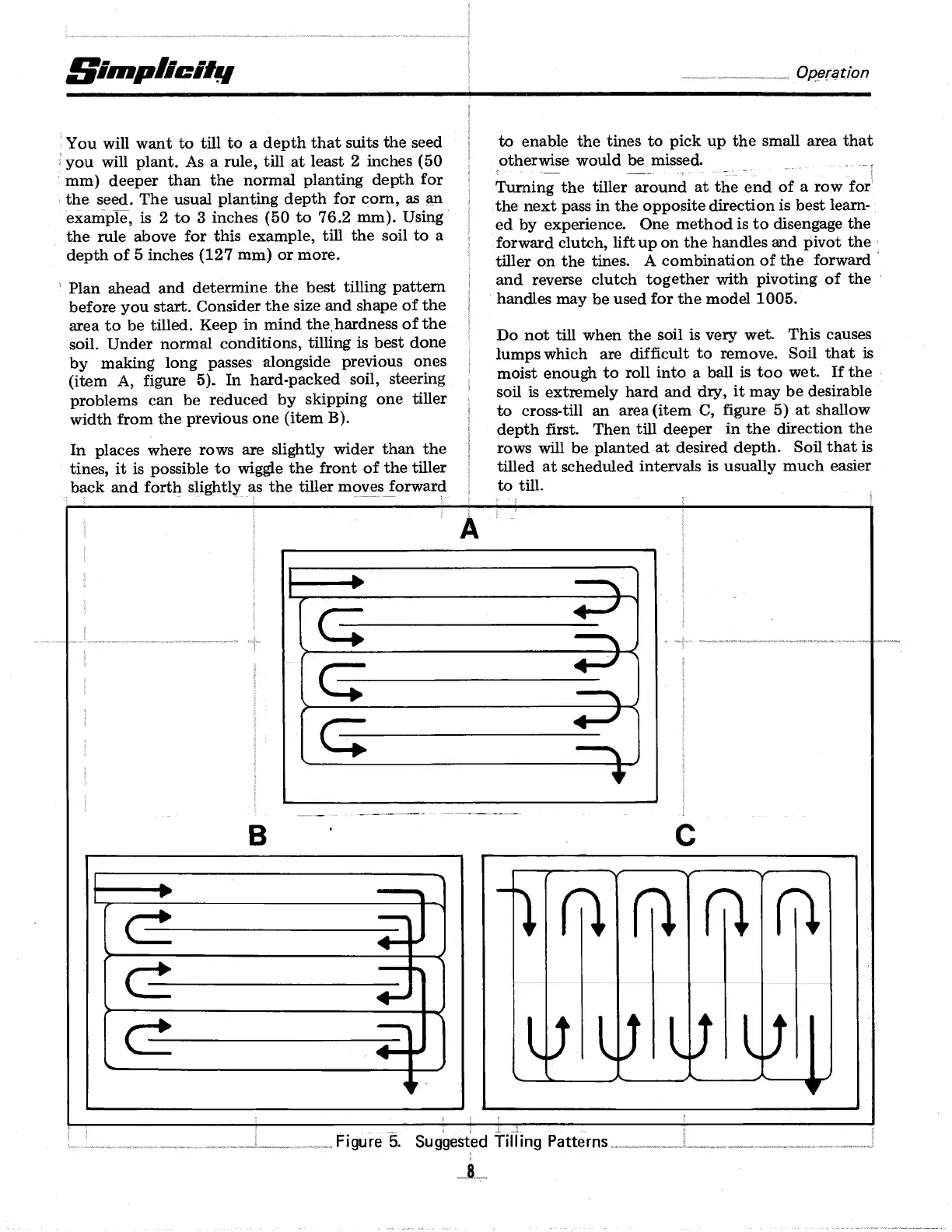
Plan
ahead
and
determine
the
best
tilling
pattern
before
you
start.
Consider
the
size
and
shape
of
the
area
to
be
tilled.
Keep
in
mind
the
hardness
of
the
soil.
Under
normal
conditions,
tilling
is
best
done
by
making
long
passes
alongside
previous
ones
(item
A,
figure
5).
In
hard-packed
soil,
steering
problems
can
be
reduced
by
skipping
one
tiller
width
from
the
previous
one
(item
B).
In
places
where
rows
are
slightly
wider
than
the
tines,
it
is
possible
to
wiggle
the
front
of
the
tiller
back
and
forth
slightly
as
the
tiller
moves
forward
and
reverse
clutch
together
with
pivoting
of
the
handles
may
be
used
for
the
model
1005.
Do
not
till
when
the
soil
is
very
wet.
This
causes
lumps
which
are
difficult
to
remove.
Soil
that
is
moist
enough
to
roll
into
a
ball
is
too
wet.
If
the
soil
is
extremely
hard
and
dry,
it
may
be
desirable
to
cross-till
an
area
(item
C,
figure
5)
at
shallow
depth
first.
Then
till
deeper
in
the
direction
the
rows
will
be
planted
at
desired
depth.
Soil
that
is
tilled
at
scheduled
intervals
is
usually
much
easier
to
till.