EasyManua.ls Logo

Simplicity 1003 - Clutch Adjustment; Pulley Alignment

Simplicity 1003
25 pages
Print Icon
To Next Page IconTo Next Page
To Previous Page IconTo Previous Page
Loading...
fSimalidiu
Adjustments
When
a
clutch
lever
is
squeezed
to
engage
the
clutch,
an
idler
pulley
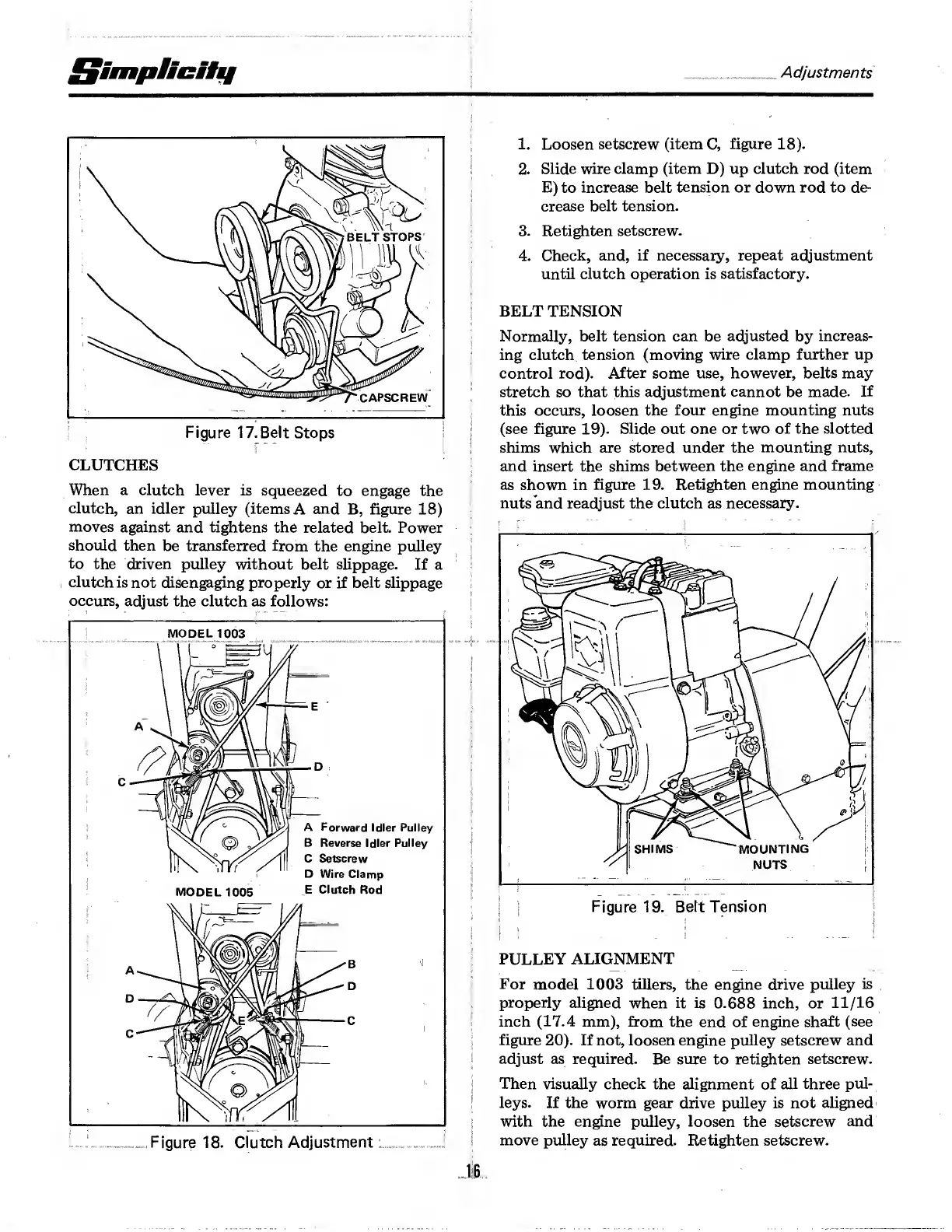
(items
A
and
B,
figure
18)
moves
against
and
tightens
the
related
belt.
Power
should
then
be
transferred
from
the
engine
pulley
to
the
driven
pulley
without
belt
slippage.
If
a
clutch
is
not
disengaging
properly
or
if
belt
slippage
occurs,
adjust
the
clutch
as
follows:
1.
Loosen
setscrew
(item
C,
figure
18).
2.
Slide
wire
clamp
(item
D)
up
clutch
rod
(item
E)
to
increase
belt
tension
or
down
rod
to
de¬
crease
belt
tension.
3.
Retighten
setscrew.
4.
Check,
and,
if
necessary,
repeat
adjustment
until
clutch
operation
is
satisfactory.
BELT
TENSION
Normally,
belt
tension
can
be
adjusted
by
increas¬
ing
clutch
tension
(moving
wire
clamp
further
up
control
rod).
After
some
use,
however,
belts
may
stretch
so
that
this
adjustment
cannot
be
made.
If
this
occurs,
loosen
the
four
engine
mounting
nuts
(see
figure
19).
Slide
out
one
or
two
of
the
slotted
shims
which
are
stored
under
the
mounting
nuts,
and
insert
the
shims
between
the
engine
and
frame
as
shown
in
figure
19.
Retighten
engine
mounting
nuts
and
readjust
the
clutch
as
necessary.
For
model
1003
tillers,
the
engine
drive
pulley
is
properly
aligned
when
it
is
0.688
inch,
or
11/16
inch
(17.4
mm),
from
the
end
of
engine
shaft
(see
figure
20).
If
not,
loosen
engine
pulley
setscrew
and
adjust
as
required.
Be
sure
to
retighten
setscrew.
Then
visually
check
the
alignment
of
all
three
pul¬
leys.
If
the
worm
gear
drive
pulley
is
not
aligned
with
the
engine
pulley,
loosen
the
setscrew
and
move
pulley
as
required.
Retighten
setscrew.