EasyManua.ls Logo

Simplicity 1003 - Tiller Operation; Tilling Hints

Simplicity 1003
25 pages
Print Icon
To Next Page IconTo Next Page
To Previous Page IconTo Previous Page
Loading...
Operation
____
TILLER
OPERATION
To
transport
the
tiller
to
the
work
site
or
from
one
work
site
to
another
without
tilling,
slow
engine
speed,
raise
depth
bar
to
highest
position,
and
en¬
gage
the
forward
clutch.
The
tiller
will
move
across
the
ground
without
tilling.
WARNING
For
your
personal
safety,
always
stop
the
en¬
gine
before
attempting
to
adjust,
service,
or
maintain
your
rotary
tiller.
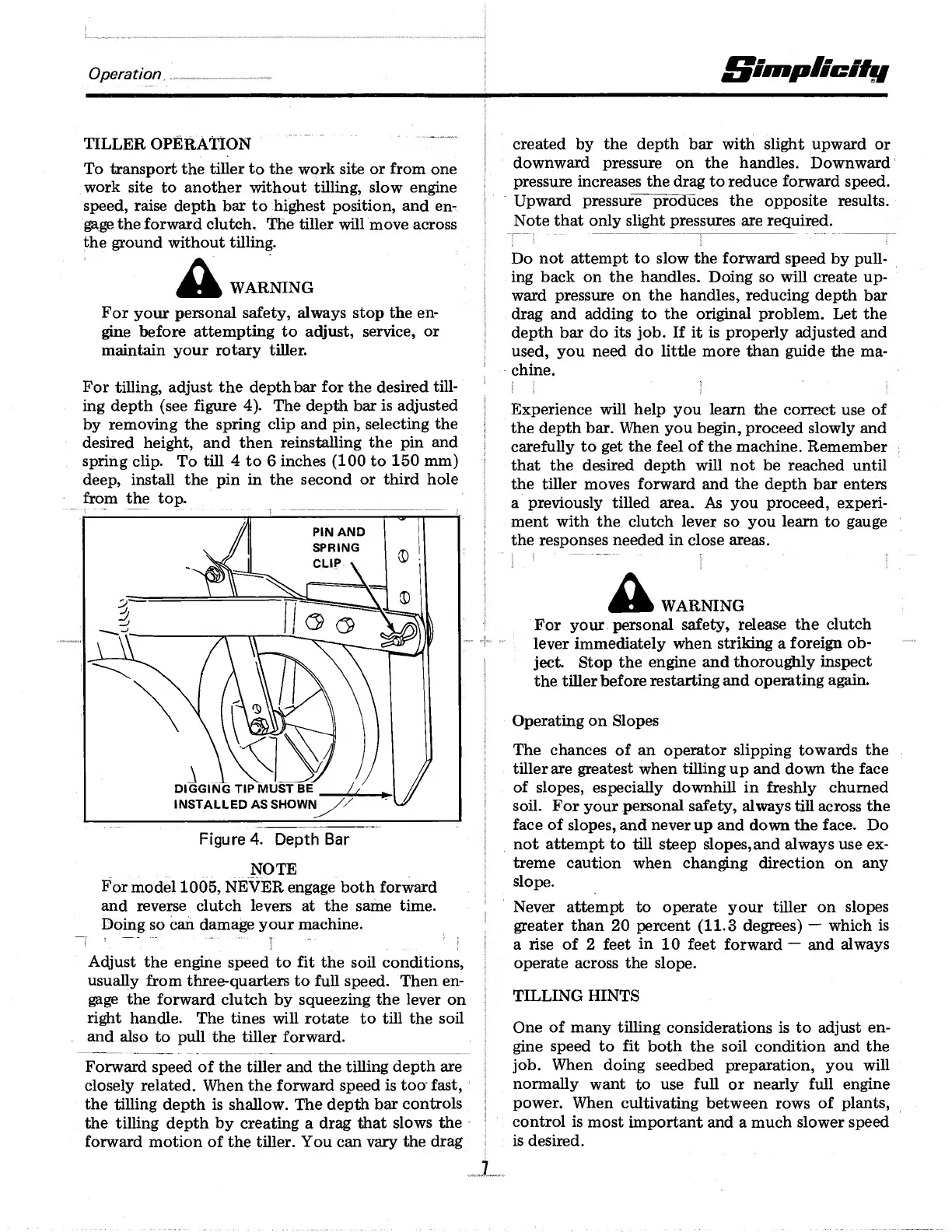
For
tilling,
adjust
the
depth
bar
for
the
desired
till¬
ing
depth
(see
figure
4).
The
depth
bar
is
adjusted
by
removing
the
spring
clip
and
pin,
selecting
the
desired
height,
and
then
reinstalling
the
pin
and
spring
clip.
To
till
4
to
6
inches
(100
to
150
mm)
deep,
install
the
pin
in
the
second
or
third
hole
from
the
top.
Figure
4.
Depth
Bar
NOTE
For
model
1005,
NEVER
engage
both
forward
and
reverse
clutch
levers
at
the
same
time.
Doing
so
can
damage
your
machine.
Adjust
the
engine
speed
to
fit
the
soil
conditions,
usually
from
three-quarters
to
full
speed.
Then
en¬
gage
the
forward
clutch
by
squeezing
the
lever
on
right
handle.
The
tines
will
rotate
to
till
the
soil
and
also
to
pull
the
tiller
forward.
Forward
speed
of
the
tiller
and
the
tilling
depth
are
closely
related.
When
the
forward
speed
is
too
fast,
the
tilling
depth
is
shallow.
The
depth
bar
controls
the
tilling
depth
by
creating
a
drag
that
slows
the
forward
motion
of
the
tiller.
You
can
vary
the
drag
created
by
the
depth
bar
with
slight
upward
or
downward
pressure
on
the
handles.
Downward
pressure
increases
the
drag
to
reduce
forward
speed.
Upward
pressure
-
p
roduces
the
opposite
results.
Note
that
only
slight
pressures
are
required.
Do
not
attempt
to
slow
the
forward
speed
by
pull¬
ing
back
on
the
handles.
Doing
so
will
create
up¬
ward
pressure
on
the
handles,
reducing
depth
bar
drag
and
adding
to
the
original
problem.
Let
the
depth
bar
do
its
job.
If
it
is
properly
adjusted
and
used,
you
need
do
little
more
than
guide
the
ma¬
chine.
Experience
will
help
you
learn
the
correct
use
of
the
depth
bar.
When
you
begin,
proceed
slowly
and
carefully
to
get
the
feel
of
the
machine.
Remember
that
the
desired
depth
will
not
be
reached
until
the
tiller
moves
forward
and
the
depth
bar
enters
a
previously
tilled
area.
As
you
proceed,
experi¬
ment
with
the
clutch
lever
so
you
learn
to
gauge
the
responses
needed
in
close
areas.
£k
MM
WARNING
For
your
personal
safety,
release
the
clutch
lever
immediately
when
striking
a
foreign
ob¬
ject.
Stop
the
engine
and
thoroughly
inspect
the
tiller
before
restarting
and
operating
again.
Operating
on
Slopes
The
chances
of
an
operator
slipping
towards
the
tiller
are
greatest
when
tilling
up
and
down
the
face
of
slopes,
especially
downhill
in
freshly
churned
soil.
For
your
personal
safety,
always
till
across
the
face
of
slopes,
and
never
up
and
down
the
face.
Do
not
attempt
to
till
steep
slopes,
and
always
use
ex¬
treme
caution
when
changing
direction
on
any
slope.
Never
attempt
to
operate
your
tiller
on
slopes
greater
than
20
percent
(11.3
degrees)
which
is
a
rise
of
2
feet
in
10
feet
forward
and
always
operate
across
the
slope.
TILLING
HINTS
One
of
many
tilling
considerations
is
to
adjust
en¬
gine
speed
to
fit
both
the
soil
condition
and
the
job.
When
doing
seedbed
preparation,
you
will
normally
want
to
use
full
or
nearly
full
engine
power.
When
cultivating
between
rows
of
plants,
control
is
most
important
and
a
much
slower
speed
is
desired.