M
ultiFlame DF-TV7 Page 42 / 56 NOSP16358-03 [04/2016]
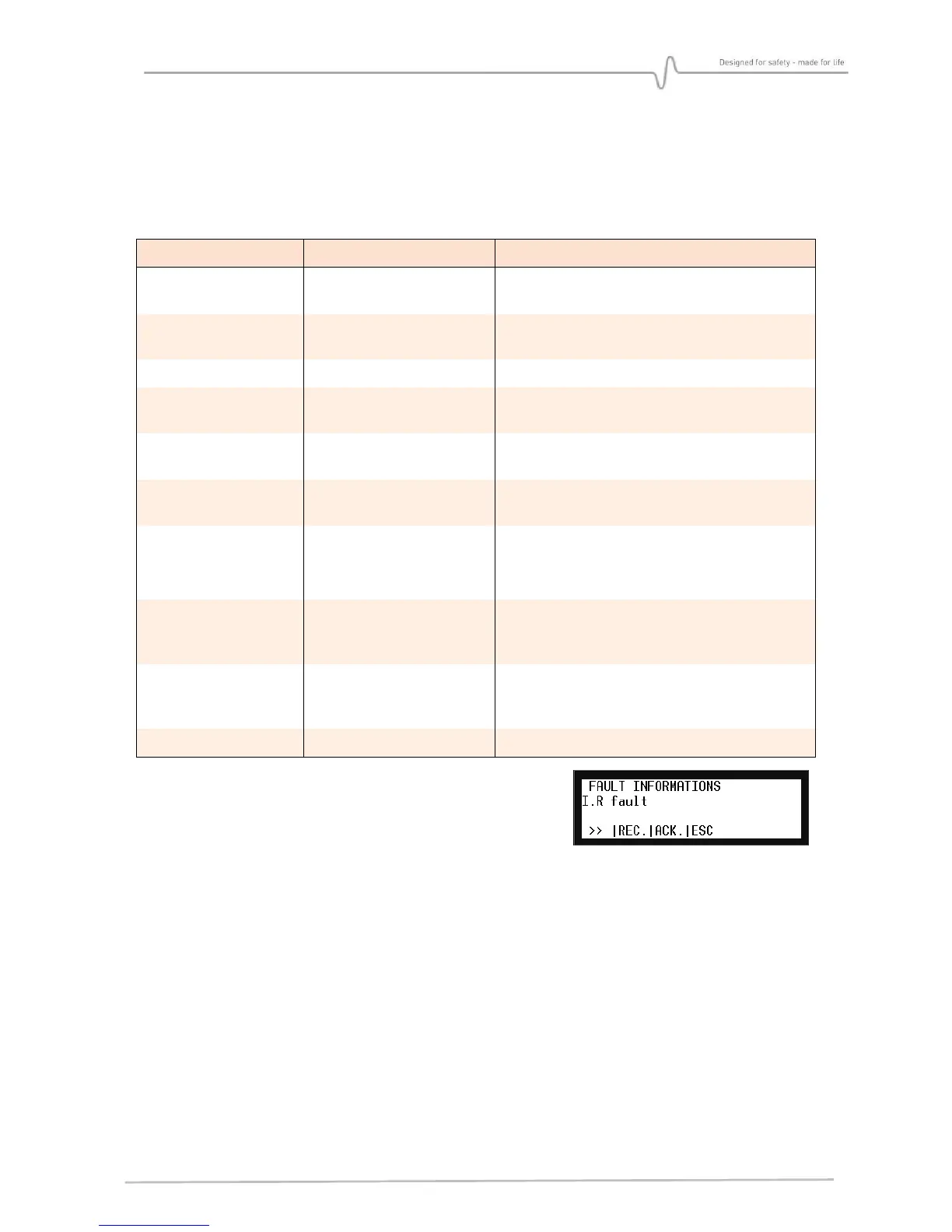
8.2. List of main faults
In addition of the current loop faults, other information are available from the wireless
communication tool TLU600/610 (refer to § 6.6). If the detector does not work properly, the
following table can help you to determine the causes and effects of different possible
troubles.
Check power supply voltage at power supply
Check power supply voltage at power supply
Current loop power supply
Check by inserting a milliamp meter into the
loop. 4 wire connections only.
No power supply to sensor
Is the green LED is flashing?
Try to use the TLU on another detector to
window and test reflectors.
If a LT15 flame test fails, then one or more of
the optical sensors are faulty. Return the
sensor cartridge to the factory
If the above test succeeds,
but the integrated test lamp is probably faulty.
Return the sensor cartridge to the factory
DEFAUT IR OU DEFAUT UV
This particular fault occurs when the transmission of
optical radiation to the detectors is no longer satisfactory.
This defect can appear following an unsatisfactory internal optical self-test and lead the
device fault state. The self-test is carried out every 2 hours, and is checked several times in
the following half hour before leading to the fault state.
In most cases, an cleaning of the front window is enough to release the fault within the
following five minutes.
DEFAUT MATERIEL
This type of failure is caused by electronic faults a
t the level of the detection cartridge or at
the main electronics level (main housing).
This fault can also appears when communication between the cartridge and the transmitter
is damaged, through a damaged link connector, for instance.
Usualy this kind of fault requires a material change.


 To Next Page