Page 16 | 45
6 Mechanical Installation
Poisonous and hot gas hazard
When installing or removing the equipment, poisonous and hot gas may
be released from the duct to the atmosphere.
All applicable local and plant specific safety codes need to be studied and followed before loosening
any flange or create any other opening to the duct
Wear appropriate protective clothing, such as gas masks, gloves and follow any other additional
safety measure stated in the local, plant specific code.
Risk of burns due to hot components
When installing or removing the equipment, the S305 and other
connected components may be hot..
Wear appropriate heat protective gloves and follow any other additional safety measure stated in
the local, plant specific code.
Install the S303 or S304 by using the Weld-on process connection socket, with a Quick Clamp connection in the
desired location.
For installations with the RF version, make sure that all the S303 and S304 are oriented in the same direction
(antenna pointing in the same direction, vertical or horizontal) in order to avoid polarization losses in the
wireless communication.
Any information given or implied by Sintrol in any way regarding installation points, the
overall functionality of the system, or compatibility for a specific application are only
suggestive and do not replace careful functionality checks and if necessary approval by an
expert consultant.
6.1 Selecting the installation location
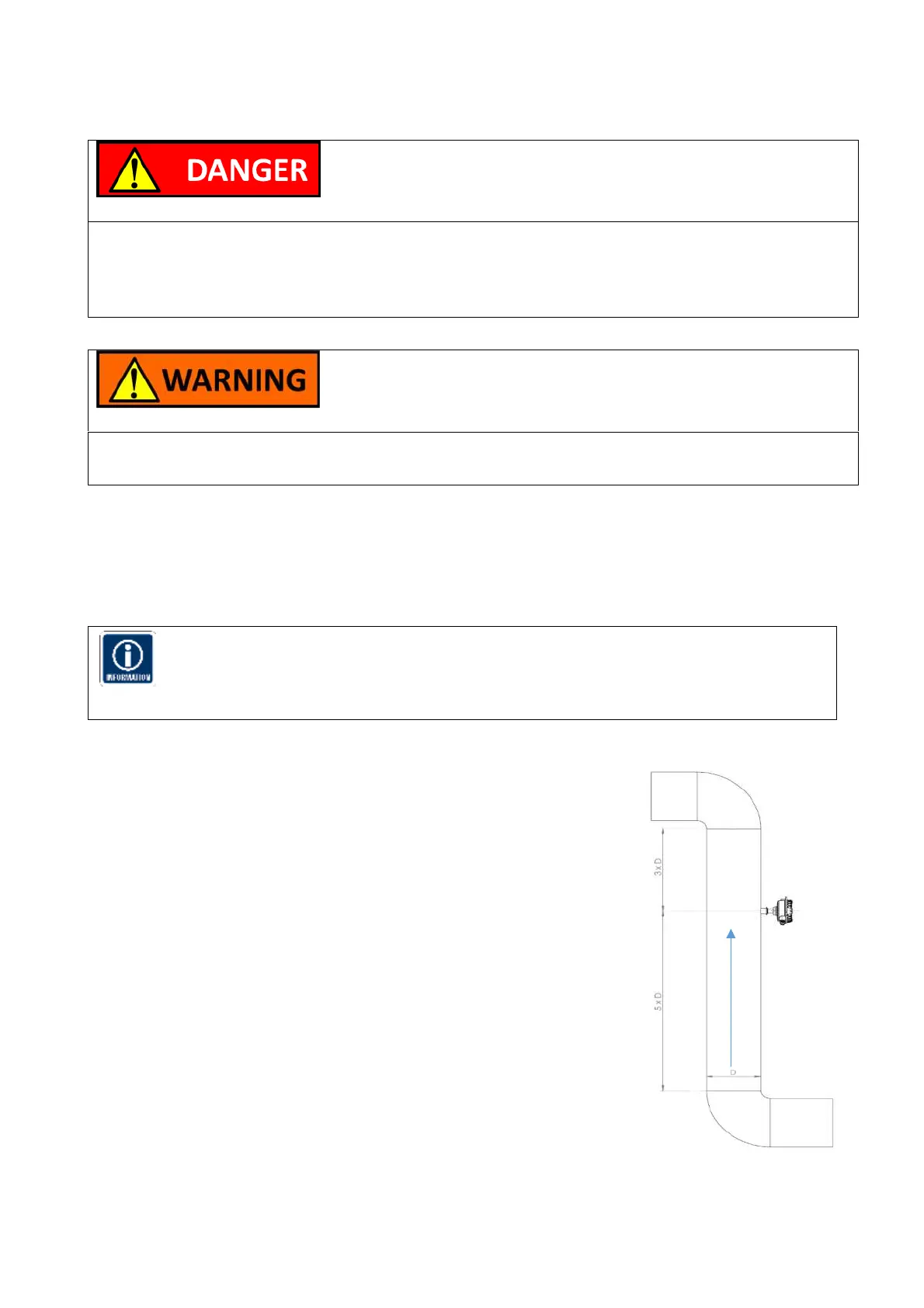
The best location for installation is in a section of duct where the particulate
has an even distribution and the flow is as laminar as possible. This is to
ensure that the sensor rod comes into contact with a representative flow of
particles. The ideal position would be in a section of duct that has no bends,
valves, dampers or other obstructions for a distance equal to at least three
duct diameters downstream or upstream (preferable 5 x duct diameter).
In some applications, a compromise must be made and the sensor will have to
be fitted in a position that satisfies the majority of above requirements. The
S201 or S203 must be attached to conducive ductwork so that the device will
be electrically shielded from interference and has good ground reference.
If installed downstream an electrostatic precipitator (ESP), the distance from
the ESP should be at least 20 m.
Although the sensor (lengths less than 1m) is not affected by vibration, very
high vibration levels should be avoided.
Figure 5 Recommended distance to duct bends (D = Duct diameter)



 To Next Page