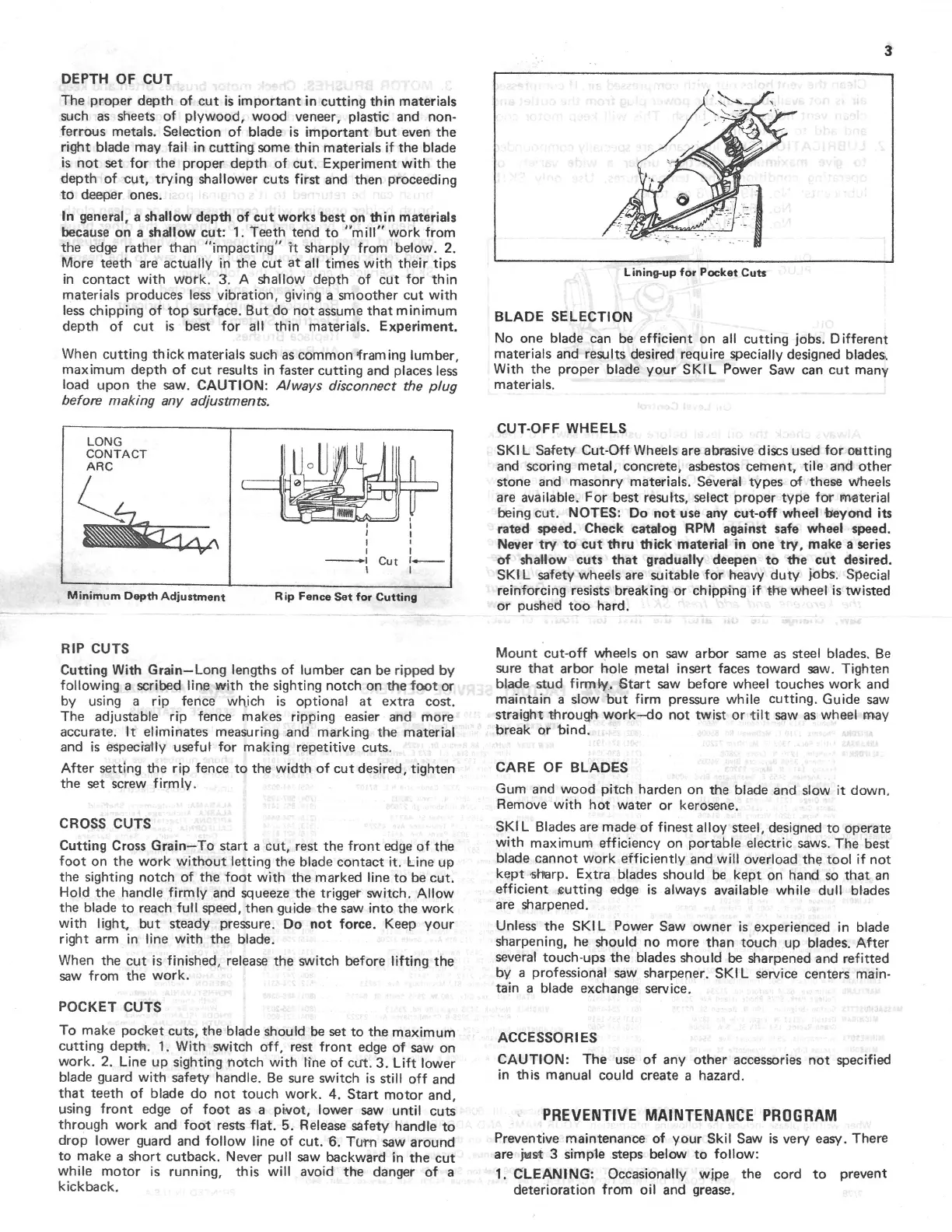
DEPTH OF CUT
The proper depth
of
cut
is important in cutting thin materials
such
as
sheets of plywood, wood veneer, plastic and
non-
ferrous metals. Selection of blade is important
but
even
the
right blade may fail in cutting
some
thin materials
if
the blade
is
not
set for the proper depth of
cut.
Experiment
with
the
depth of cut, trying shallower
cuts
first and then proceeding
to
deeper
ones.
In general, a shallow depth of
cut
works best
on
thin materials
because
on
a
shallow
cut:
1. Teeth tend
to
"mill" work from
the edge rather than "impacting"
it
sharply from below. 2.
More teeth
are
actually in the
cut
at
all times
with
their
tips
in
contact
with
work. 3. A diallow depth of
cut
for
thin
materials produces less vibration, giving a smoother
cut
with
less chipping of top surface. But do
not
assume
that minimum
depth of
cut
is best for all thin materials. Experiment.
When cutting
thick
materials such as
common
framing lumber,
maximum depth
of
cut
results in faster cutting and places less
load
upon
the
saw.
CAUTION: A/ways disconnect the plug
before making any adjustments.
LONG
CONTACT 3
ii
ARC
0
=
O /
Mill
___._p
I
I
I
I
I
I
Minimum Depth Adiustment Rip Fence Set
for
Cutting
RIP CUTS
Cutting With Grain—Long lengths of lumber
can
be ripped by
following a scribed line
with
the sighting notch
on
the
foot
or
by using a rip fence which is optional
at
extra
cost.
The adjustable rip fence makes ripping easier and
more
accurate.
It
eliminates measuring and marking the material
and is especially useful for making repetitive
cuts.
After
setting the rip fence
to
the width of
cut
desired, tighten
the set
screw
firmly.
CROSS CUTS
Cutting Cross Grain——To
start
a cut,
rest
the
front
edge of the
foot
on
the work
without
letting the blade
contact
it. Line up
the sighting notch of the
foot
with the marked line
to
be
cut.
Hold the handle firmly and squeeze the trigger switch. Allow
the blade
to
reach
full
speed, then guide the
saw
into the work
with light, but steady pressure. Do
not
force. Keep
your
right
arm
in line with the blade.
When the
cut
is finished, release the switch before lifting the
saw
from the work.
POCKET CUTS
To make pocket cuts, the blade should be set
to
the maximum
cutting depth. 1. With switch off,
rest
front
edge of
saw
on
work. 2. Line up sighting notch with line of
cut.
3.
Lift
lower
blade guard
with
safety handle. Be
sure
switch is still
off
and
that teeth of blade do
not
touch work. 4. Start
motor
and,
using
front
edge of foot
as
a pivot, lower
saw
until
cuts
through work and
foot
rests flat. 5. Release safety handle
to
drop lower guard and follow line of
cut.
6. Turn
saw
around
to
make a short cutback. Never pull
saw
backward in the
cut
while
motor
is running, this
will
avoid the danger of a
kickback.
Lining-up
for
Pocket Cuts
BLADE SELECTION
No
one
blade
can
be efficient
on
all cutting jobs. Different
materials and results desired require specially designed blades.
With the proper blade
your
SKIL Power Saw
can
cut
many
materials.
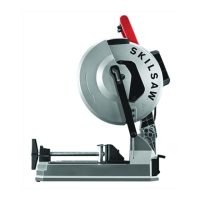
CUT-OFF WHEELS
SKI L Safety Cut-Off Wheels
are
abrasive discs used
for
cutting
and scoring metal, concrete, asbestos cement,
tile
and other
stone
and masonry materials. Several types of these wheels
are
available. For best results, select proper type
for
material
being
cut.
NOTES: Do
not
use
any cut-off wheel beyond its
rated speed. Check catalog RPM against safe wheel speed.
Never try
to
cut
thru thick material in
one
try,
make a series
of
shallow
cuts
that
gradually deepen
to
the
cut
desired.
SKIL safety wheels
are
suitable for heavy duty iobs. Special
reinforcing resists breaking
or
chipping
if
the wheel is twisted
or
pushed
too
hard.
Mount cut-off wheels
on
saw
arbor
same
as
steel blades. Be
sure
that arbor hole metal insert faces toward
saw.
Tighten
blade stud firmly. Start
saw
before wheel touches work and
maintain a slow
but
firm pressure while cutting. Guide
saw
straight through work—do
not
twist
or
tilt
saw
as
wheel may
break
or
bind.
CARE OF BLADES
Gum and wood pitch harden
on
the blade and slow
it
down.
Remove with hot
water
or
kerosene.
SKI L Blades
are
made of finest alloy steel, designed
to
operate
with maximum efficiency
on
portable electric
saws.
The best
blade
cannot
work efficiently and
will
overload the tool
if
not
kept sharp. Extra blades should be kept
on
hand
so
that
an
efficient cutting edge is always available while dull blades
are
sharpened.
Unless the SKIL Power Saw
owner
is experienced in blade
sharpening, he should
no
more
than touch up blades.
After
several touch—ups the blades should be sharpened and refitted
by a professional
saw
sharpener. SKIL service
centers
main-
tain a blade exchange service.
ACCESSORIES
CAUTION: The
use
of any other accessories
not
specified
in this manual could
create
a hazard.
PREVENTIVE MAINTENANCE PROGRAM
Preventive maintenance of
your
Skil Saw is very easy. There
are
just 3 simple steps below
to
follow:
1. CLEANING: Occasionally wipe the cord
to
prevent
deterioration from oil and grease.


 To Next Page
 Loading...