24
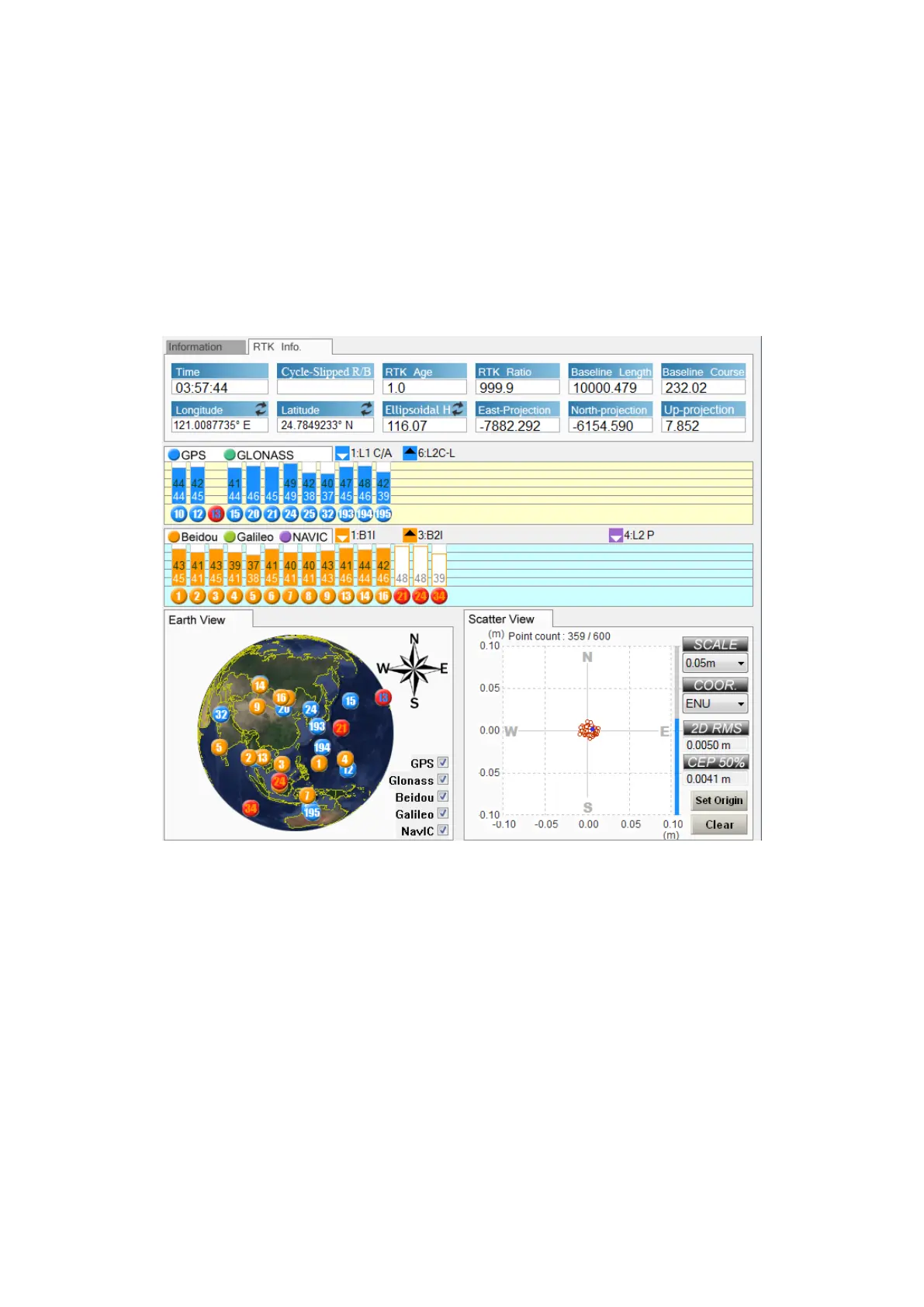
Number values (RTK Age, RTK Ratio, etc.) will be displayed on RTK Info label after Float RTK state is
entered. When RTK Ratio number is over 3.0, receiver state changes to Fix RTK; below 3.0, receiver
state shows Float RTK.
RTK Age indicates the lag delay in received base data. If RTK Age is 30 or more, indicating lag of 30
second or more, receiver state will show Position Fix 3D, NS-HP-GN2 will not try to compute RTK
solution. Large RTK Age indicates some problem with transmission causing severe lag delay.
Although a minimum of 6 GPS satellites could result in Fix RTK solution during zero-baseline GPS
simulator testing, 8 or more satellites spread across 4 quadrants of the sky is preferred in getting
faster RTK fix with reliable result; lesser number of satellites will take longer time getting RTK fix and
may sometimes have reported position decimeters off from true location.
Once becoming acquainted with NS-HP-GN2 RTK operation, one can replace base/rover wire
connection with wireless radio connection to operate over distance as below shows. The rover NMEA
output, besides sending to application microcontroller, can also be sent to a wireless transmitter for
monitoring using GNSS Viewer on a laptop with wireless receiver.


 To Next Page