Need help?
Do you have a question about the SkyTraq PX1172R and is the answer not in the manual?
Centimeter-level accuracy, Multi-Band GNSS, compact size, protocol support, operating temperature, and RoHS compliance.
Covers machine control, UAVs, precision agriculture, GIS data collection, and heading/attitude applications.
Details accuracy, time to first fix, RTK convergence speed, and maximum update rates.
Includes operational limits, serial interface, input voltage, current consumption, dimensions, weight, temperature, and humidity.
Explains the receiver's functional block diagram and how it processes GNSS signals for RTK.
Lists and describes RTCM 3.3 message types supported by the receiver in rover and base modes.
Provides a visual representation of pin assignments and a detailed table of pin names and functions.
Presents a diagram with dimensions and a table detailing the mechanical size and pad layout of the module.
Specifies the voltage, power, and temperature limits that must not be exceeded for safe operation.
Outlines typical and minimum/maximum values for supply voltage, currents, and other environmental factors.
Illustrates the 'Precise Positioning, Rover Mode Configuration 1' setup for the application circuit.
Details the application circuit setup for 'Precise Positioning, Rover Mode Configuration 2'.
Describes the application circuit setup for 'Precise Heading, Moving Base Mode Configuration'.
Illustrates the 'Precise Positioning & Heading, Advanced Moving Base Mode Configuration #1'.
Illustrates the 'Precise Positioning & Heading, Advanced Moving Base Mode Configuration #2'.
Provides guidelines for the temperature and time profile during SMT reflow soldering to prevent damage.
Covers antenna selection, power supply requirements, backup supply function, and 1PPS output.
Offers recommendations for PCB design to ensure optimal RF signal integrity and performance.
Includes guidelines for module handling, ESD sensitivity, and conditions for achieving RTK fix.
Explains the general structure of NMEA sentences and lists the supported message types from the receiver.
Details the format and meaning of the NMEA GGA sentence for Global Positioning System Fix Data.
Describes the format and meaning of the NMEA GLL sentence for Latitude/Longitude data.
Explains the format and meaning of the NMEA GSA sentence for GNSS DOP and active satellites.
Details the format and meaning of the NMEA GSV sentence for GNSS satellites in view.
Describes the format and meaning of the NMEA RMC sentence for recommended minimum GNSS data.
Explains the format and meaning of the NMEA VTG sentence for course and ground speed.
Details the format and meaning of the NMEA ZDA sentence for UTC time, day, month, and year.
Describes the format and meaning of the NMEA THS sentence for true heading and status.
Explains the custom STI,005 message format for time stamp output and its fields.
Details the custom STI,030 message format for recommended minimum 3D GNSS data and its fields.
Explains the custom STI,032 message format for RTK baseline data and its fields.
Details the custom STI,033 message format for RTK RAW measurement monitoring data and its fields.
Explains the custom STI,035 message format for rover moving base RTK data and its fields.
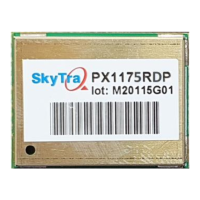
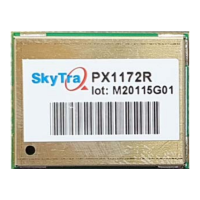
Lists the product model number and provides a brief description of the GNSS RTK Receiver Module.
Contains information about the revision history of the document, including dates and descriptions of changes.
Provides important legal information regarding the product's warranty, use, and limitations of liability.

 To Next Page
 General