1.2 Force components
The PowerForce records the forces, which are performed on the pedal axis, separately for each leg.
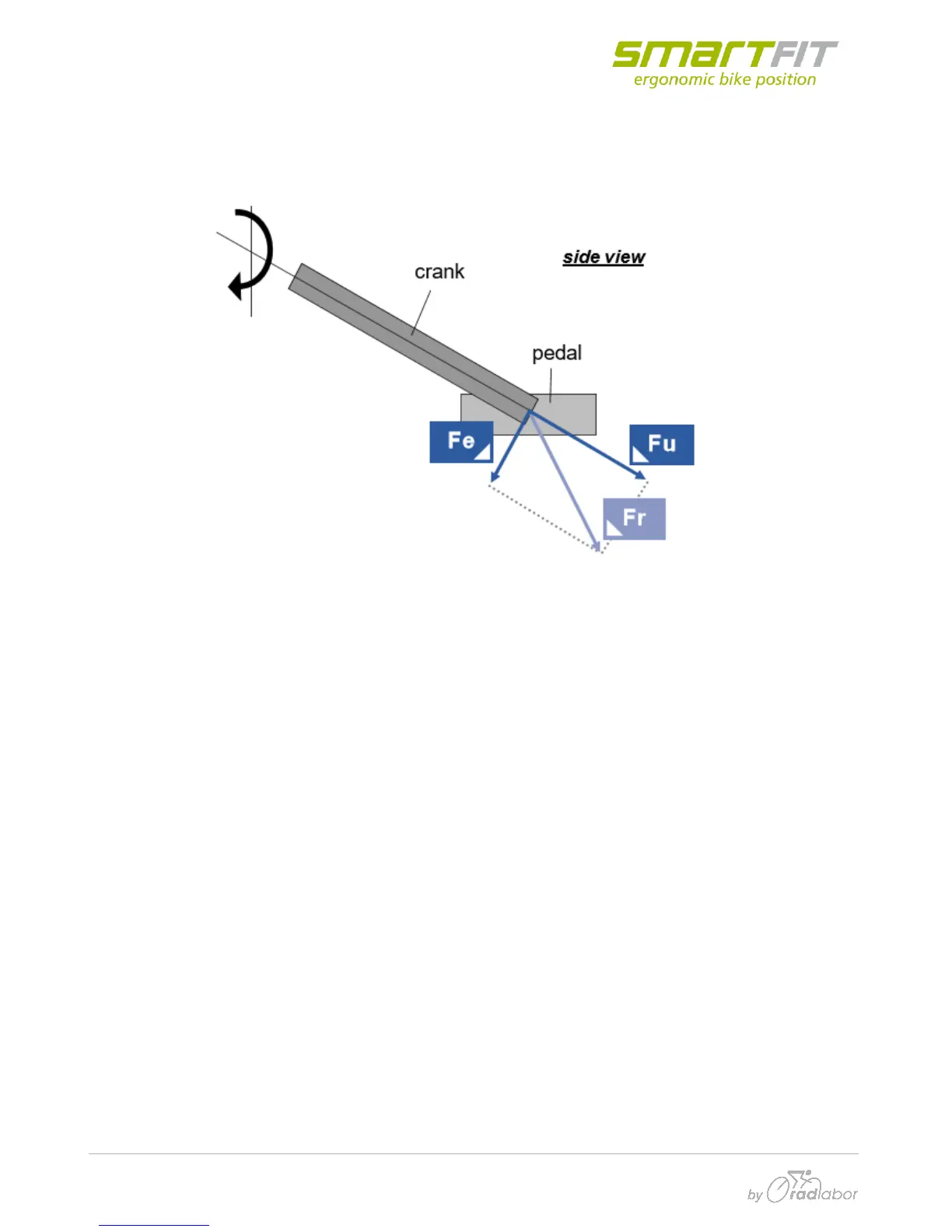
Three force components (Fe, Fu und Fr) have to be differentiated.
Fr (resultant / total – force)
This is the total force which is generated by the athlete on the pedal. It is the vectorially sum of Fe
and Fu an is calculated, not measured.
Fr tells us about the total load, the rider applies to the system – the bike as well as to his own body.
Joint moments and forces result from (or cause) this component. Thus, e.g. inverse dynamics are
based on Fr.
Fe (effective / tangential – force)
Fe is the component of Fr which lies in moving direction of the crank/pedal which is a circle.
Therefore, the vector of Fe is always tangential to this circle or perpendicular to the crank. Fe is
responsible for the propulsion, but only if it is aligned forward with the rotating direction. If it is
aligned backward, e.g. if a rider does not pull up the pedal in the upstroke phase, Fe of the one side
must be subtracted from the other side.
Fu (unused / radial – force)
Fu is the component of Fr which does not generate any propulsion. It results in very small
deformation of the crank and pedal-axis. The direction off this force component is lengthwise to the
crank. The highest values appear around the bottom dead center (180° crank angle) where the
weight component (induces by the mass of the leg) adds to the muscular component.



 To Next Page