48 snapperpro.com
74
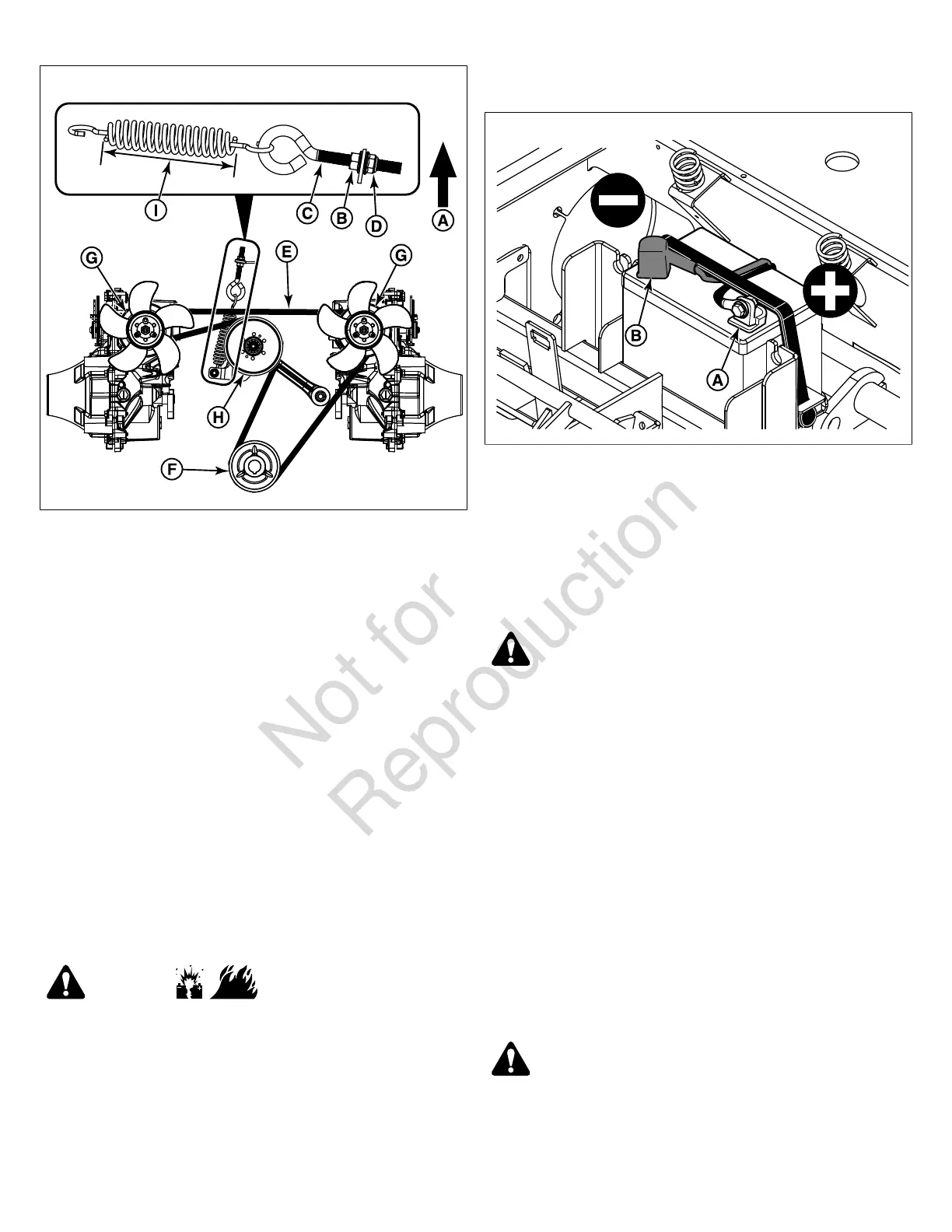
6. Loosen the adjustment nut (D) to release the majority
of the belt tension. Use caution and remove the nut to
completely release the tension.
7. Remove the old belt (E) and replace it with a new one.
Make sure that V-side of the belt runs in the grooves of
the crankshaft pulley (F) and transaxle pulleys (G).
8. The back side of the belt should contact the idler pulley
on the idler arm (H).
9. Re-install the spring anchor eyebolt into the anchor tab
on the frame of the unit and loosely fasten the adjustment
nut. Turn the adjustment nut until the coil-to-coil length (I)
of the spring measures 5-3/4" (14,6 cm). Tighten the jam
nut.
10. Re-install the clutch anchor pad to the PTO clutch and
secure with the hardware previously removed.
11. Reconnect the wire harness to the PTO clutch.
12. Reinstall the mower deck drive belt. See Mower Deck
Drive Belt Replacement.
Cleaning the Battery and Cables
This unit is equipped with a maintenance-free BCIU1 battery.
WARNING
Keep open flames and sparks away from the battery.
• Be careful when handling the battery.
• Avoid spilling electrolyte.
• Keep flames and sparks away from the battery.
• When removing or installing battery cables, disconnect
the negative cable FIRST and reconnect it LAST. If not
done in this order, the positive terminal can be shorted
to the frame by a tool.
1. Disconnect the cables from the battery, negative [-] cable
first (A, Figure 75).
75
2. Clean the battery terminals and cable ends with a wire
brush until shiny.
3. Reinstall the battery and reattach the battery cables,
positive [+] cable first (B).
4. Coat the cable ends and the battery terminals with
petroleum jelly or non-conducting grease.
Battery Service
WARNING
Keep open flames and sparks away from the battery; the
gasses coming from it are highly explosive. Ventilate the
battery well during charging.
Checking Battery Voltage
A voltmeter can be used to determine condition of the battery.
When the engine is off, the voltmeter shows battery voltage,
which should be 12 volts. When the engine is running, the
voltmeter shows voltage of charging circuit which normally is
13 to 14 volts.
A dead battery, or one too weak to start the engine, may not
mean the battery needs to be replaced. For example, it may
mean that the alternator is not charging the battery properly.
If there is any doubt about the cause of the problem, see
your authorized Snapper Pro® servicing dealer. If you need
to replace the battery, follow the steps under Cleaning the
Battery and Cables.
Charging the Battery
WARNING
Keep open flames and sparks away from the battery; the
gasses coming from it are highly explosive. Ventilate the
battery well during charging.
A dead battery or one too weak to start the engine may be
the result of a defect in the charging system or other electrical



 To Next Page