Need help?
Do you have a question about the Snom D725 and is the answer not in the manual?
Follow safety guidelines for phone usage and handling, including power and cable placement.
Ensures input/output connections meet Safety Extra Low Voltage requirements.
Confirms compliance with European and US health, safety, and environmental standards.
Details technical specifications including safety, certifications, and connectors.
Instructions for proper disposal according to European Directive 2002/96/EC.
Guidance on cleaning the device using an anti-static cloth.
Explains symbols used for navigating menus and lists on the phone.
Defines symbols for confirming or canceling actions and inputs.
Illustrates how to follow sequences of actions using the '>' symbol.
Lists the items included in the phone's package.
Instructions for attaching the phone's footstand at different angles.
Procedure for rotating the cradle tab for wall mounting.
Steps for connecting the phone via Ethernet or power adapter.
Guide for connecting wired and wireless headsets.
Process for initial setup and network registration.
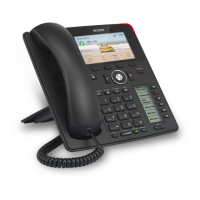
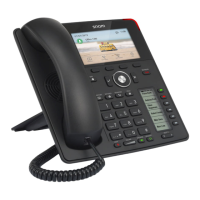
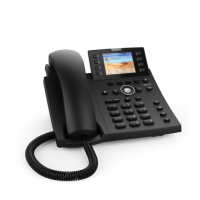
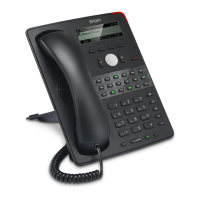
Overview of the phone's physical layout and factory settings.
Explanation of call and function key LED status lights.
Indicator for new voicemail messages.
Details on programmable and context-sensitive function keys.
Description of default function key assignments.
Controls for volume adjustment and microphone muting.
Guide to using the keypad for input and navigation.
Information displayed when the phone is not active.
Information displayed during active calls or editing.
How to navigate the phone's settings menu.
Settings for display contrast and backlight.
Steps to access and open the phone's web interface.
Explanation of web interface navigation and tab functionality.
Understanding how web settings can affect phone configurations.
Differences between user and administrator access modes.
Overview of the phone's built-in directory capacity.
Explains terms and fields used in directory entries.
Structure and requirements for a single directory entry.
Categorizing contacts (VIP, Deny List) for specific call handling.
Setting the default identity for outgoing calls.
Grouping contacts for organization and custom ringtones.
Managing ringtones for contacts and groups.
Methods for adding and modifying directory entries directly on the phone.
Detailed steps for editing an existing contact entry.
Instructions for removing directory entries.
Procedures for managing directory entries via the web interface.
Connecting to external directory services like LDAP.
Guidance on initiating calls using various methods.
Explains auto dial, redialing, and dialing from history/directory.
Procedures for answering incoming calls.
How to answer calls on other extensions.
Managing ongoing calls and call status.
Instructions for placing calls on hold.
Steps to initiate, manage, and participate in conference calls.
Methods for transferring calls (attended, blind).
Handling incoming calls while on an active call.
How to end active calls.
Viewing and managing missed call notifications.
Accessing and managing call history lists.
Managing unwanted incoming calls manually and automatically.
Configuring call forwarding rules (all, busy, timeout).
Overview of programmable function keys and their types.
Guide to configuring keys via the phone's web interface.
Examples of programming keys for specific functions.
Managing SIP accounts (identities) for providers.
Modifying account settings on the phone and web interface.
Setting custom ringtones for specific identities.
Choosing ringtones from the phone or web interface.
Configuring date and time display formats.
Setting the correct time zone for accurate time display.
Changing the language for the phone and web interface.
Setting the language for the web interface only.
Selecting country-specific dial tones.
Setting emergency numbers for quick dialing.
Configuring rules for redirecting incoming calls.
Enabling the callback feature for busy or unavailable numbers.
Managing incoming calls during an active call.
Setting to prevent transmitting your phone number.
Blocking incoming calls from unknown numbers.
Enabling auto-completion for dialing numbers.
Configuring speed dial numbers on the web interface.
Step-by-step guide for manually updating phone firmware.
Information on automated firmware deployment.
Instructions for restarting the phone.
Procedure for performing a hard reboot.
Steps to reset the phone to its factory default settings.
Guidance on updating firmware via TFTP.
Manual network configuration if DHCP fails.
How to get help from snom support.
How to copy and submit phone settings for support.
Procedures for performing SIP and PCAP traces for analysis.
Icons displayed on the function key line.
Symbols displayed on the function key line when the phone is idle.
Symbols displayed when the phone is active (ringing, dialing).
Visual cues on the phone screen for different states.
Interact with web server applications via HTTP GET requests.
Automatically accept incoming calls.
Monitor extension status (idle, ringing, busy) via LED.
Function key for PBX tasks specified in buttons document.
Functions for call center agents (login, ready, after call).
Manage PBX-based or phone-based conferences.
Send arbitrary key sequences via DTMF during calls.
Monitor extension status and pick up calls.
Establish two-way connections for intercom calls.
Automate calls to extensions via Interactive Voice Response.
General key event types selectable from a dropdown menu.
Default setting for function keys; handles incoming/outgoing calls.
Send multicast streams to IP multicast group addresses.
Park and retrieve calls on a server's park orbit.
Reflect extension presence status (ringing, busy, available).
Establish two-way connection for push-to-talk.
Monitor status of shared lines (busy/available).
Assign speed dial numbers to function keys.
Utilize star codes for PBX functions via keys.
Transfer active or incoming calls to a specified number.
Initiate recording of spoken memos or calls.
Define custom key actions using XML sub tags.
List of specific key event types for function key programming.
 General
| Speakerphone | Full-duplex speakerphone |
|---|---|
| Bluetooth | No |
| Wi-Fi | No |
| Ethernet Ports | 2 (10/100/1000 Mbps) |
| Power over Ethernet | Yes (IEEE 802.3af) |
| USB Port | Yes, USB 2.0 |
| SIP Accounts | 12 |
| Supported Protocols | SIP, RTP, RTCP |
| Codecs | G.711, G.722, G.726, G.729 |
| Power Supply | PoE or optional power adapter |

 To Next Page