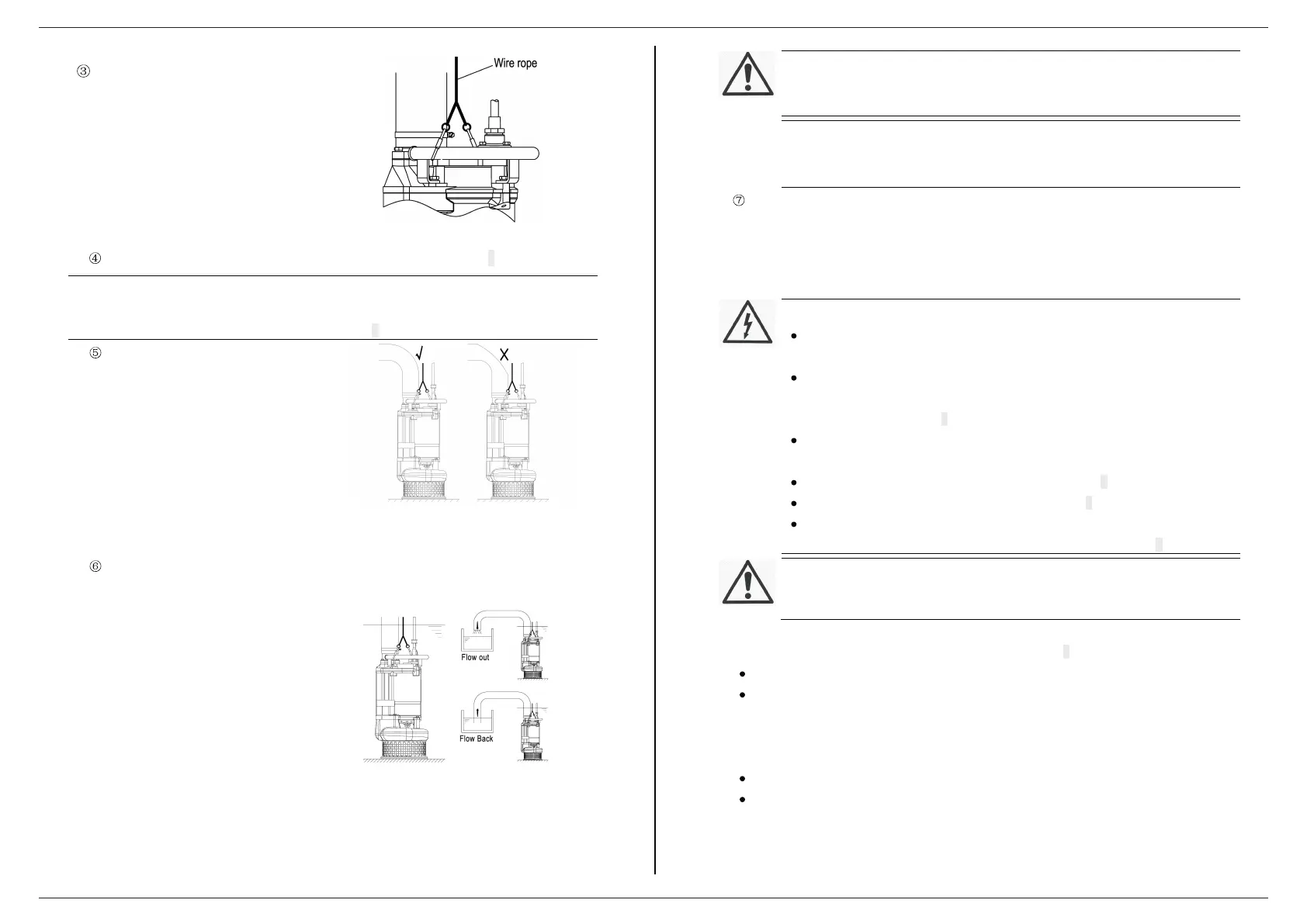
Handle the pump carefully. When
suspending the pump to raise or to
lower it, attach a wire rope or a chain
to the pump's handle.
Install the pump only in an area that can maintain a proper water level.
NOTE:
For details on the water level necessary for pump operation, refer to the section on "Water
Level During Operation" on page 20 of this manual.
The discharge hose can be run vertically
or horizontally, but must be without
sharp bends.
(Pump with soft pipe)
When using a hose to provide piping to
the pump, observe the following: Use
the shortest possible length of discharge
hose and minimize the number of bends.
Verify that the end of the hose (discharge
side) is lifted above the water surface. If
the end of the hose is submerged in
water, it may cause the water to flow
back when the pump has been stopped.
If the end of the hose is located at a level
that is lower than that of the source
water surface, water may continue to
flow out even after the pump has been
stopped.
CAUTION:
If an excessive amount of sediment is drawn into the pump, it may cause the pump
to wear, which can lead to current leakage or electrical shock.
NOTE:
Appropriate piping materials must be provided by the user. Piping materials are
not included with the product.
The pump must be placed upright during operation. If there is a risk that the pump could
be buried under the sediment, place the pump on a base made up of materials such as
(3)
Make the electrical connections
General precautions
A certified electrician must supervise all electrical work. Comply with all local
codes and regulations.
Before starting work on the unit, make sure that the unit and the control panel
are isolated from the power supply and can not be energized. This applies to
the control circuit as well.
Leakage into the electrical parts can cause damaged equipment or a blown
fuse.
Keep the end of the motor cable above the liquid level.
Make sure that all unused conductors are insulated.
There is a risk of electrical shock or explosion if the electrical connections are not
correctly carried out or if there is fault or damage on the product.
Do not install the starter equipment in an explosive zone unless it is explosion
Requirements
These general requirements apply for electrical installation:
The mains voltage and frequency must agree with the specifications on the data plate.
The fuses and circuit breakers must have the proper rating, and the pump overload
protection (motor protection breaker) must be connected and set to the rated current
according to the data plate and if applicable the cable chart. The starting current in
direct-on-line start can be up to six times higher than the rated current.
The fuse rating and the cables must be in accordance with the local rules and regulations.
If intermittent operation is prescribed, then the pump must be provided with monitoring
equipment supporting such operation.
11 12



 To Next Page