(4)
Grounding
You must ground all electrical equipment. This applies to the pump equipment,
the driver, and any monitoring equipment. Test the ground lead to verify that it
is connected correctly.
If the motor cable is jerked loose by mistake, the ground conductor should be
the last conductor to come loose from its terminal. Make sure that the ground
conductor is longer than the phase conductors. This applies to both ends of
the motor cable.
Risk of electrical shock or burn. You must connect an additional ground fault
protection device to the grounded connectors if persons are likely to come into
physical contact with the pump or pumped liquids.
To prevent damaging the pump and causing current leakage, which may lead to
electrical shock, be sure to install the ground wire securely.
To prevent electrical shock caused by improper grounding, do not connect the
ground wire to a gas pipe, water pipe, lightning rod, or telephone ground wire.
(5) Connecting the cables
These are the requirements to follow when you install cables:
The cables must be in good condition, not have any sharp bends, and not be pinched.
The sheathing must not be damaged and must not have indentations or be embossed
(with markings, etc.) at the cable entry.
The cable entry seal sleeve and washers must conform to the outside diameter of the cable.
The minimum bending radius must not be below the accepted value.
If using a cable which has been used before, a short piece must be peeled off when refitting
it so that the cable entry seal sleeve does not close around the cable at the same point
again. If the outer sheath of the cable is damaged, then replace the cable. Contact a
Solidpump service shop.
The voltage drop in long cables must be taken into account. The drive unit's rated voltage
is the voltage measured at the cable connection point in the pump.
Before connecting the cable to the terminal board, make sure that the power
supply (i.e. circuit breaker) is properly disconnected. Failure to do so may lead
to electrical shock, short, or injury caused by the unintended starting of the pump.
If the cable must be extended, use an extension cable with the same or larger
core size as that of the cable that is provided with the pump. Using a cable of
proper size will prevent the motor from attaining its full potential or may cause
the cable to overheat, which may lead to fire, current leakage, or electrical shock.
If a cable with a cut or damaged sheath is submerged in water, the water may
enter the pump and cause the motor to short. This will damage the pump,
which may lead to current leakage, or electrical shock, or burn-out.
To prevent the cable from cuts or twists, which will damage the pump and may
lead to current leakage, electrical shock, or fire, be sure that the tires of
vehicles do not run over the cable.
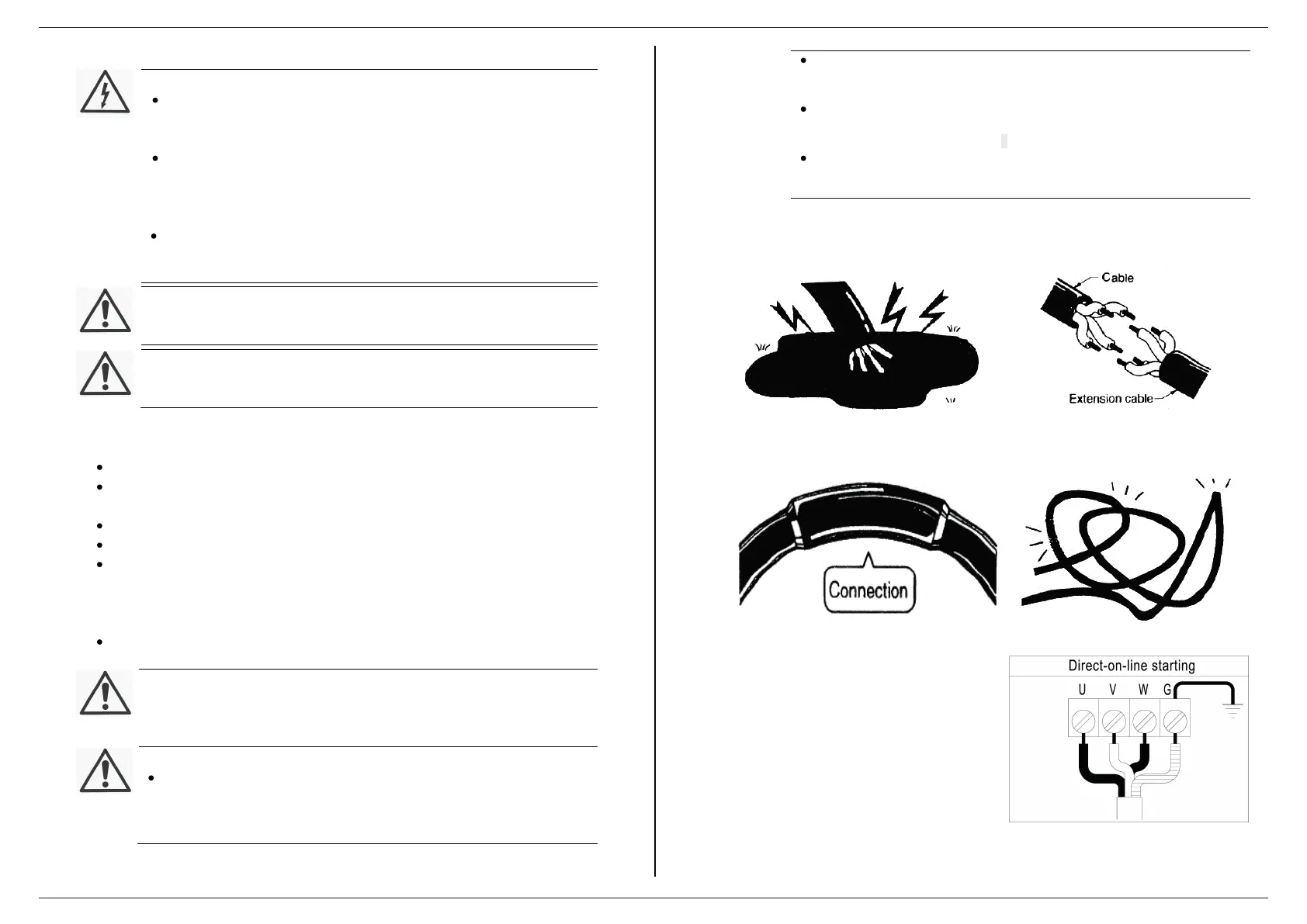
If the cable must be submerged in water, be sure to mold the connection
portion completely. Failure to do so may lead to current leakage, electrical
Never submerge the ends of a cable in water.
If the cable must be extended, use an
extension cable with the same or larger
core size as that of the cable that is
provided with the pump.
To prevent water from entering inside the cable,
be sure to securely mold the cable connection
portion.
To avoid damaging the cable, arrange the
cable run so that the cable is not bent,
kinked, or pressed against a structure.
a. Tighten the ends of the cable securely
against the terminal board.
b. The figure on the right shows how to
connect the cable properly
13 14



 To Next Page