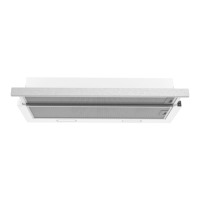
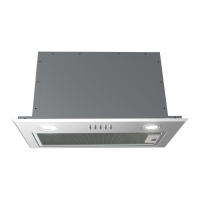
This document is a user manual for the Sôlt GGSSL60DR2S 60cm Slide-out Rangehood, an appliance designed to eliminate kitchen smells in domestic settings. The rangehood is proudly distributed within Australia by Residentia Group Pty Ltd.
The rangehood's primary function is to extract or recirculate air to remove cooking odors and steam from the kitchen environment. It features a slide-out design, which allows it to be discreetly integrated into kitchen cabinetry when not in use and extended during cooking for effective ventilation.
For operation, the rangehood is equipped with switch button controls offering two speed levels of extraction: a Low Power Setting for standard cooking operations and a High Power Setting for situations with high smoke or steam density. There is also a dedicated Light Operation Switch to turn the integrated 1.5W LED lamp on and off, providing illumination over the cooking area.
Installation of the rangehood requires careful consideration of ventilation type. Users can choose between an "air extracted" mode, where air is discharged out of the house through a pipe, or a "recirculating-air" mode, where air is purified using activated carbon filters and then discharged back into the house. The manual provides instructions for positioning a venting knob to select the desired mode. For ducted installations, the rangehood connects to a chimney using a flexible or rigid pipe of either 150mm or 120mm diameter. If a 120mm connection is used, a reducer flange is required. Charcoal filters, which are optional for extracted air but always used for recirculating air, may impact extraction power. The minimum safety distance between the cooker top and the rangehood is 650mm, though some models may allow for lower heights as specified in the installation paragraphs. Proper earthing is required for Class I appliances. The manual also warns against connecting the rangehood to exhaust ducts carrying combustion flumes from other appliances like boilers or fireplaces. Adequate aeration must be guaranteed in the room when the rangehood is used with non-electrical appliances to prevent backflow of exhaust gas.
Maintenance of the rangehood is crucial for optimal performance and longevity. The grease filters, which are 5-layer aluminum filters, should be cleaned every two months, or more frequently with heavy usage. Cleaning involves soaking them in 40-50°C clean water with a mild dishwashing liquid, gently scrubbing with a soft brush, or washing them in a dishwasher. Users are instructed to pull open the comfort panels, then remove the filters by pushing them towards the back of the unit and pulling downwards. Care must be taken not to apply too much pressure to avoid damage. After cleaning, the filters must be completely dry before refitting, ensuring the handle faces outwards. The color of the filter surface may change over time, but this does not affect efficiency. For recirculation models, the activated charcoal filters are not washable or regenerable and must be replaced approximately every four months, or more often with heavy usage. Replacing these involves removing the metal grease filters, then removing and fitting new charcoal filters before replacing the grease filters. The 1.5W LED lamp can also be replaced by disconnecting the appliance from the mains, removing the metal filters, levering the light fitting from the hood body, and disconnecting/reconnecting the light's connector.
General cleaning of the rangehood's main body should be done every two months using hot water and a non-corrosive detergent to prevent corrosion or stains. Stubborn stains can be tackled with a specific stainless steel cleaner. Important warnings include not using corrosive or abrasive detergents/cloths, keeping the motor and mechanics free from water, always switching off and unplugging the rangehood before cleaning, and contacting support if the plug or cord is damaged. Carbon filters should never be exposed to heat.
Troubleshooting information is provided for common issues. If the light works but the motor does not, potential causes include blocked blades, a damaged capacitor, or a damaged motor. If both the light and motor fail, the internal wiring of the motor might be disconnected or damaged, or the light itself could be damaged, or the power cord might be loose. Oil leakage could indicate an untightly sealed outlet or air ventilation entrance, or leakage from the U-shaped section and cover. Vibration might be caused by damaged blades, a loose motor, or an untightly fixed rangehood. Insufficient suction could be due to too large a distance between the rangehood and cooktop, or excessive ventilation from open doors/windows. If the rangehood inclines, the fixing or hanging screws may not be tight enough. For all these issues, the recommended solution is to contact the Residentia Group Support Team.
The manual also includes important safety instructions, emphasizing correct installation to prevent damages, ensuring mains voltage matches the rating plate, and proper earthing. It warns against connecting the rangehood to combustion flues and highlights the need for sufficient aeration when used with non-electrical appliances. Children should be supervised, and cleaning should not be performed by children without supervision. Accessible parts may become hot during use.
The product is designed for domestic use only to eliminate kitchen smells and should not be used for other purposes. Users are advised not to leave high naked flames under the hood or flame under the rangehood due to fire risk. Deep fat fryers should be continuously monitored.
Finally, the manual details disposal instructions, indicating that the product should not be treated as household waste but handed over to an applicable collection point for recycling electrical and electronic equipment, in accordance with the European directive 2012/19/EU on Waste Electrical and Electronic Equipment (WEEE).


 To Next Page
 General