EasyManua.ls Logo

Sony DPS-R7 - Reverberation Block Functions; Reverberation Block Signal Types; Reverberation Parameter Guidance; Core Reverberation Parameters

Sony DPS-R7
64 pages
Print Icon
To Next Page IconTo Next Page
To Previous Page IconTo Previous Page
Loading...
Reverberation
Block
This
block
can
be
divided
into
four
sub-blocks,
REVC, REVS,
REV17
and
REV2.
These
four
blocks
process
signals
received
from
the
Pre-effect
block
and
then
send them
to
the
Post-effect
block.
According
to
the
algorithm
type
used,
the
signals
from
the
Pre-effect
block
are
processed
through
different
sub-
blocks.
When
editing
a
preset
memory,
examine
which
algorithm
is
used
in
the
preset
memory.
Parameters
also
vary
as
the
algorithm
type
changes.
Stereo-in/stereo-out
(ST-ST)
type
and
monaural-in/stereo-out
(MONO-ST)
type
Algorithm
used
in
the
Reverberation
block
can
be
characterized
into
two
types;
stereo-in/stereo-out
(ST-ST)
type
and
monaural-in/stereo-out
(MONO-ST)
type.
The
ST-ST
type
is
used
for
a
stereo-processing
of
signals
of
ch1
and
ch2
while
the
MONO-ST
type
gives
different
effects
to
signals
of
chi
and
ch2.
Since these
two
types
have
their
own
signal
processing
configuration,
signals
pass
through
different
sub-blocks
according
to
the
algorithm
type
used.
Sub-block
to
be
able
to
edit
REVC(Reverberation
common)
sub-block
REVS(Reverberation
stereo)
sub-block
REVC
sub-block
REV1
(Reverberation
unit1)
sub-block
REV2
(Reverberation
unit2)
sub-block
Type
of
Algorithm
MONO-ST
Concerning
Parameters
Algorithms
contains
several
parameters.
After
being
familiar
with
them,
you
will
be
able
to
create
any
effect
exactly
as
you
imagine.
Note:
When
editing
the
Reverberation
block,
keep
the
balance
of
direct
sound
(DRY
control)
and
effect
sound
(EFFECT
control).
Unbalanced
adjustment
may
cause
insufficiency
in
the
resulting
effect.
Reverberation
Parameters
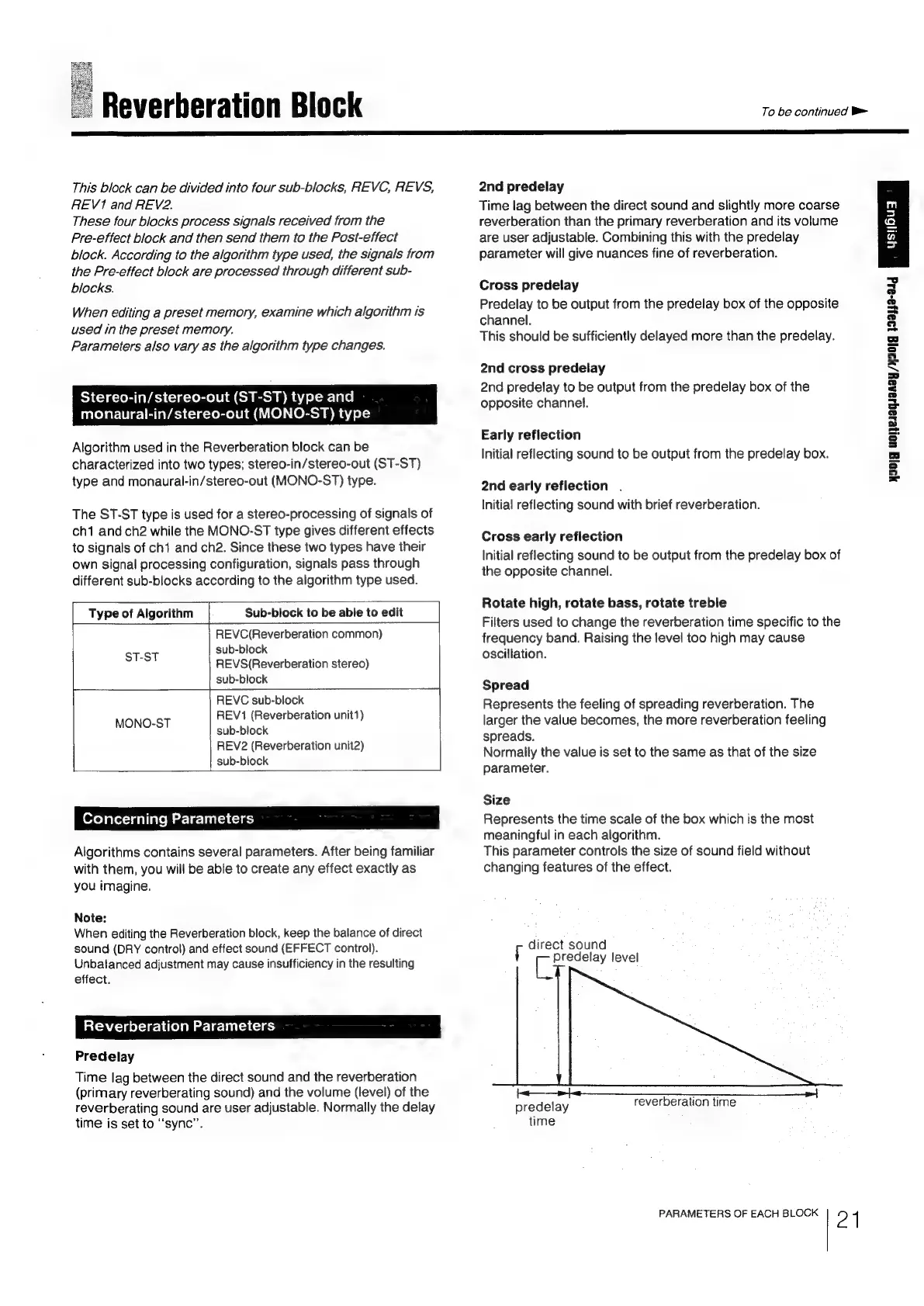
Predelay
Time
lag
between
the
direct
sound
and
the
reverberation
(primary
reverberating
sound)
and
the
volume
(level)
of
the
reverberating
sound
are
user
adjustable.
Normally
the
delay
time
is
set
to
“sync”.
To
be
continued
2nd
predelay
Time
lag
between
the
direct
sound
and
slightly
more
coarse
reverberation
than
the
primary
reverberation
and
its
volume
are
user
adjustable.
Combining
this
with
the
predelay
parameter
will
give
nuances
fine
of
reverberation.
Cross
predelay
Predelay
to
be
output
from
the
predelay
box
of
the
opposite
channel.
This
should
be
sufficiently
delayed
more
than
the
predelay.
2nd
cross
predelay
2nd
predelay
to
be
output
from
the
predelay
box
of
the
opposite
channel.
Early
refiection
Initial
reflecting
sound
to
be
output
from
the
predelay
box.
2nd
early
reflection
Initial
reflecting
sound
with
brief
reverberation.
Cross
early
reflection
Initial
reflecting
sound
to
be
output
from
the
predelay
box
of
the
opposite
channel.
Rotate
high,
rotate
bass,
rotate
treble
Filters
used
to
change
the
reverberation
time
specific
to
the
frequency
band.
Raising
the
level
too
high
may
cause
oscillation.
Spread
Represents
the
feeling
of
spreading
reverberation.
The
larger
the
value
becomes,
the
more
reverberation
feeling
spreads.
Normally
the
value
is
set
to
the
same
as
that
of
the
size
parameter.
Size
Represents
the
time
scale
of
the
box
which
is
the
most
meaningful
in
each
algorithm.
This
parameter
controls
the
size
of
sound
field
without
changing
features
of
the
effect.
direct
sound
"i
tN”
level
predelay
reverberation
time
time
PARAMETERS
OF
EACH
BLOCK
a
|
m4
o
.
eo
=
a
8
4
e
fx]
=
~
=
Cy
=
o
o
2
-"]
id
i}
s
a
S
oO
fw

Related product manuals