EasyManua.ls Logo

Sony mxp-29 - Page 25

Sony mxp-29
79 pages
Print Icon
To Next Page IconTo Next Page
To Previous Page IconTo Previous Page
Loading...
1.
OPERATION
111
o
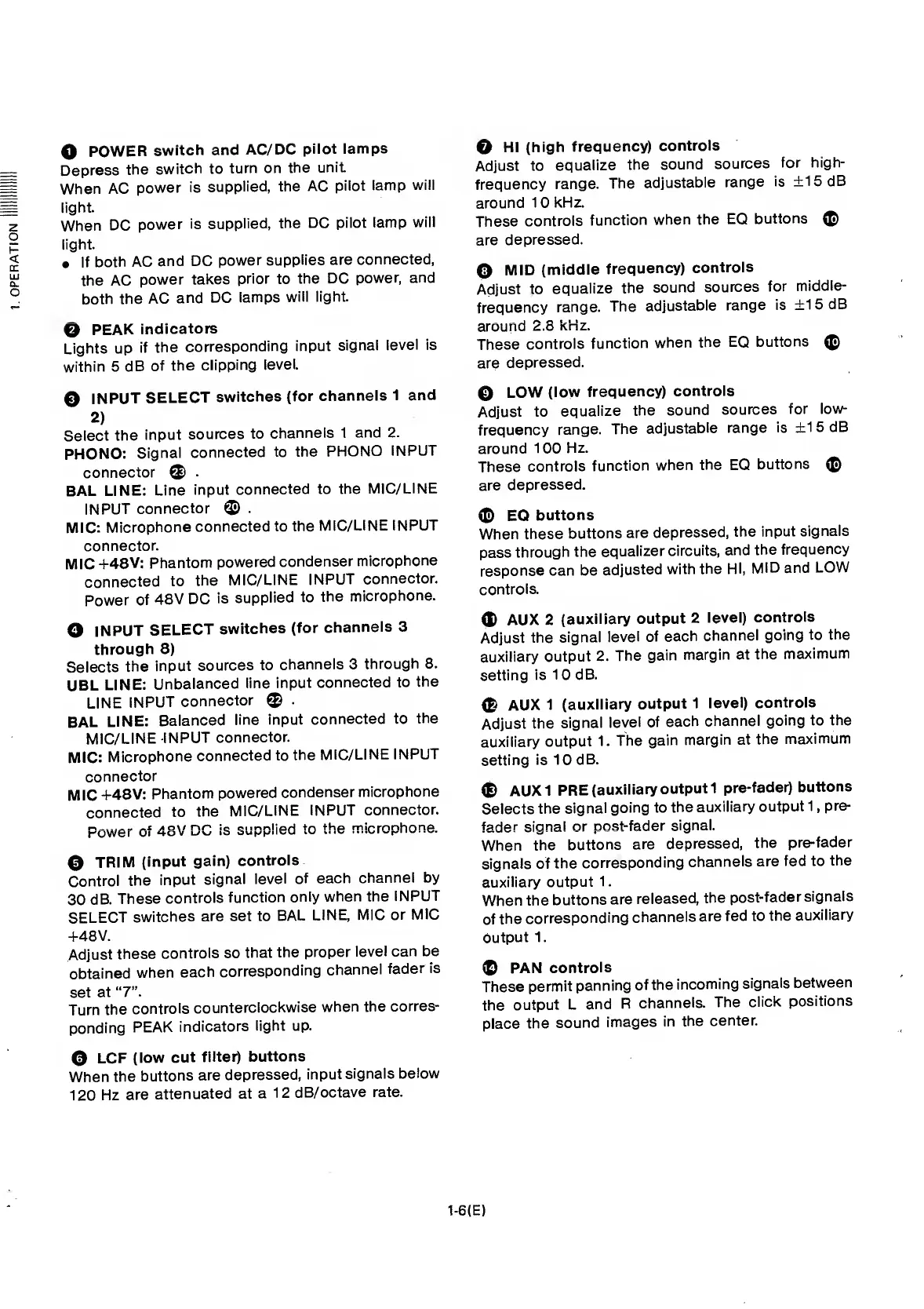
POWER
switch
and
AC/DC
pilot
lamps
Depress
the
switch to
turn on
the
unit.
When
AC
power
is
supplied, the
AC
pilot
lamp
will
light.
When
DC
power
is
supplied,
the DC
pilot
lamp
will
light.
If
both AC
and DC
power
supplies
are
connected,
the AC
power
takes
prior
to
the DC
power,
and
both
the
AC
and DC
lamps
will light.
©
PEAK
indicators
Lights up
if
the
corresponding
input
signal
level is
within 5
dB
of
the
clipping
level.
Q
INPUT
SELECT
switches
(for
channels
1 and
2
)
Select
the
input
sources
to
channels 1
and
2.
PHONO:
Signal
connected
to the
PHONO
INPUT
connector
®
.
BAL
LINE:
Line
input
connected to
the
MIC/LINE
INPUT
connector
©
.
MIC:
Microphone
connected
to the
MIC/LINE
INPUT
connector.
MIC
+48V:
Phantom
powered
condenser
microphone
connected
to
the
MIC/LINE
INPUT
connector.
Power
of
48V DC
is
supplied
to
the
microphone.
O
INPUT
SELECT
switches
(for
channels 3
through
8)
Selects
the
input
sources
to
channels 3
through 8.
UBL
LINE:
Unbalanced
line input
connected to
the
LINE
INPUT
connector
©
.
BAL
LINE:
Balanced
line
input
connected
to
the
MIC/LINE
INPUT
connector.
MIC:
Microphone
connected
to
the
MIC/LINE
INPUT
connector
MIC
+48V:
Phantom
powered
condenser
microphone
connected
to
the
MIC/LINE
INPUT connector.
Power
of
48V
DC
is
supplied
to
the
microphone.
©
TRIM
(input
gain)
controls
Control
the
input
signal
level of
each
channel by
30
dB.
These
controls
function
only
when the
INPUT
SELECT
switches
are
set to
BAL
LINE, MIC
or
MIC
+48
V.
Adjust
these
controls so
that
the
proper
level
can be
obtained
when
each
corresponding
channel
fader
is
set
at
“7”.
Turn
the
controls
counterclockwise
when the
corres-
ponding
PEAK
indicators
light up.
©
LCF
(low
cut
filter)
buttons
When
the
buttons
are
depressed,
input
signals
below
120
Hz
are
attenuated
at a
12
dB/
octave rate.
©
HI
(high
frequency)
controls
Adjust to
equalize
the
sound
sources
for high-
frequency
range.
The
adjustable
range
is
±15dB
around
1
0
kHz.
These
controls
function
when the
EQ
buttons
©
are
depressed.
©
MID
(middle
frequency)
controls
Adjust
to
equalize
the
sound
sources
for
middle-
frequency
range.
The
adjustable
range is
+15dB
around
2.8
kHz.
These
controls
function
when
the
EQ
buttons
©
are
depressed.
©
LOW
(low
frequency)
controls
Adjust
to
equalize
the
sound
sources
for
low-
frequency
range.
The
adjustable
range
is
±1 5 dB
around
1
00
Hz.
These
controls
function
when
the EQ
buttons
©
are
depressed.
©
EQ
buttons
When
these
buttons
are
depressed,
the
input
signals
pass
through
the
equalizer
circuits,
and
the
frequency
response
can be
adjusted
with
the
HI,
MID and
LOW
controls.
©
AUX
2
(auxiliary
output 2
level)
controls
Adjust
the
signal
level
of each
channel
going
to the
auxiliary
output 2.
The gain
margin
at the
maximum
setting
is
10 dB.
©
AUX
1
(auxiliary
output
1
level)
controls
Adjust
the
signal
level
of
each
channel
going
to the
auxiliary
output
1. The
gain
margin
at the
maximum
setting
is 10
dB.
©
AUX1
PRE
(auxiliary
output
1
pre-fader)
buttons
Selects
the
signal
going to the
auxiliary output
1
,
pre-
fader
signal
or
post-fader
signal.
When
the
buttons
are
depressed,
the
pre-fader
signals
of
the
corresponding
channels
are fed to
the
auxiliary
output
1.
When
the
buttons
are
released,
the
post-fader
signals
of
the
corresponding
channels
are
fed
to the
auxiliary
Output
1.
©
PAN
controls
These
permit
panning
of the
incoming
signals
between
the
output
L
and
R
channels.
The
click
positions
place
the
sound
images
in
the
center.
1-6(E)

Related product manuals