dts LFE (Low Frequency Effect) mix level
Initial setting : 0 dB
This paralneter lets you attenuate the level of the LFE
(Low Frequency Eftect) channel output fl'om the sub
woofer without effecting the level of the [)ass frequencies
sent to the sub woofer from tile fl'ont, center or rear
channels via tile "dts" bass redirection circuitry.
• Tile level can be adjusted in 1 dB steps from +10 dB to
20 dB (line level).
• Selecting OFF nmtes the sound of tile LFE channel fl'om
the sub woofer. However, the low fl'equency sounds of
the fl'ont, center, or rear speakers are output fl'om tile
sub woofl_r according to the settings made fi)r each
speaker in the speaker setup (page 18_20).
,,o
"(_"About the level differences in the LFEMIX settings
The "ctts LFE MIX" level is set to +10.0 dB and "LFE MIX" (Dolby
Digital) is set to 0 dB.
Dynamic range compressor (D. RANGE COMP)
Initial setting : OFF
Lets you compress tile dynamic range of tile sound track.
This may be usef\fl when you want to watch movies at
low volumes late at night.
• OFF reproduces tile sound track with no coinpression.
• STD reproduces the sound track with the dynamic
range intended by the recording engineer.
• 0.1 - 0.9 allow you to compress the dynamic range in
small steps to achieve the sound you desire.
• MAX provides a drainatic compression of the dynamic
range.
Note
Dynamic range compression is possible with Dolby Digital
sources only.
"_"_Aboutthe Dynamic RangeCompressor
This parameter allows you to rompress the dynamir range of the
sotmdtrack based on tbe dynamic range infi0rmation included in
tbe Dolby Digital signal. "STD" is standard compression, but
because many sotntes bave only light compression, you may not
notice much diftbrence when using 0.1-0.9.
Therefore, we recommend using tbe "MAX" setting. This greatly
compresses the dynamic range and allows you to view movies
late at night at low volumes. Unlike analog limiters, the levels are
predetermined and provide a very natural compression.
The EQ nlenu lets you adjust tile equalization (bass, mid,
and treble fl'equencies) of the front, center, rear L/R and
rear center speakers individually. The equalizer bank lets
you store up to 5 different equalizer settings.
The tk_llowing inenu is only available after pressing EQ
BANK and selecting one of the equalizers (EQ 1 - 5).
1 Start playing a program source encoded with multi
channel surround sound.
2 Press EQ.
Tile button lights up and tile first parameter is
displayed.
3 Press the cursor buttons (< or >) to select the
parameter you want to adjust.
4 Turn the jog dial to select the setting you desire.
The setting is entered automatically.
"_° You can turn off the equalization without erasing it
The equalizer settings are stored separately for each sound field.
Press the EQ BANK button repeatedly tmtil EQ IOFFI is
displayed.
Front speaker bass adjustment (Gain/Frequency)
(_) Use the cursor buttons (_/_) to seleet tile gain (dB)
or fl'equency (Hz).
@ Use the jog dial to adjust.
Repeat until you achieve the sound you desire.
• Tile gain can be adjusted _+10dB in 1 dB steps.
• Tile fl'equency can be adjusted fl'oin 99 Hz to 1.0kHz in
21 steps.
Front speaker midrange adjustment (Gain/
Frequency)
Adjust as deseribed in "Front speaker bass adjustinent'.
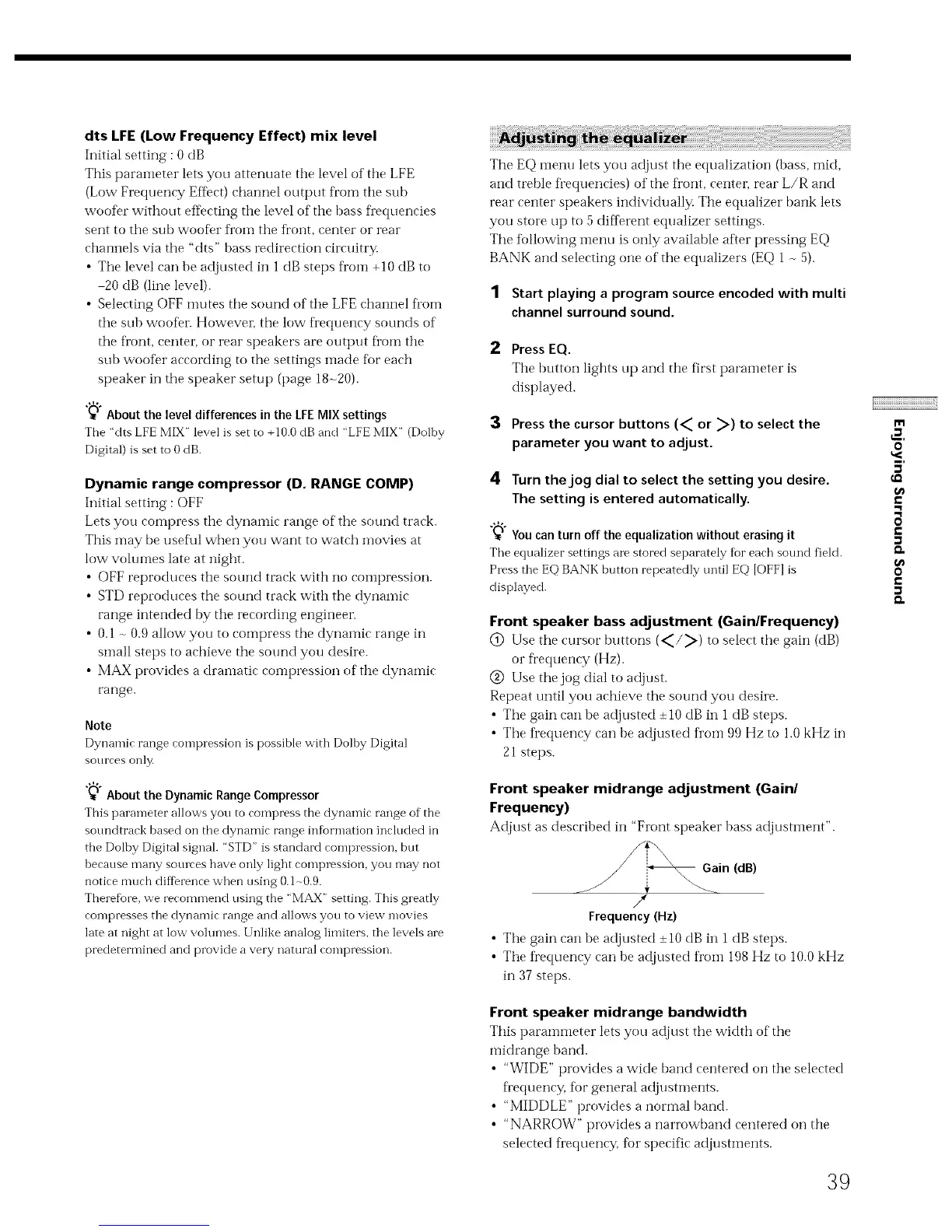
Gain (dB)
Frequency (Hz)
• Tile gain ean be adjusted _+10dB in 1 dB steps.
• Tile fl'equency can be adjusted ti'oin 198 Hz to 10.0 kHz
in 37 steps.
Front speaker midrange bandwidth
This paramineter lets you adjust tile width of the
midrange band.
• "WIDE" provides a wide band centered on the selected
fl'equency, fi)r general adjustments.
• "MIDDLE" provides a normal band.
• "NARROW" provides a narrowband centered on the
selected fl'equency, for specific adjustments.
39
f_
,=,
o
-I
e-
"R
e.
0



 To Next Page