o
¢D
o
"a
¢D
5'
Naming Preset Stations and
Program Sources
You can enter a name of up to 8 characters f_)rpreset
statioi-is and program sources. These names (for example,
"VHS") appear in the receiver's display when a station or
program source is selected.
Note that no more than one name can be entered fk)r each
preset station or program source.
This f\mction is useful fi)r distinguishing components of
the same kind. For exainple, two VCRs can be specified
as "VHS" and "8inm," respective[y. It is a[so handy tot
identif_/ing components connected to jacks meant for
another type of component, for example, a second CD
player connected to the MD/DATjacks.
1 To index a preset station
Rotate FUNCTION to select the tuner.
The last station you rereived is tuned in.
2
To index a program source
Select the program source (component) to be
named, then go to Step 3.
Tune in the preset station you want to create an
index name for.
If you are not fan-fi]iar with how to tune in preset
stations, see "Tuning to preset stations" on page 48.
3 Press NAME.
4
Create an index name by using the jog dial and
cursor buttons:
Turn the jog dia[ to se[eet a rharaeter, then press _ to
move the cursor to the next position.
1"o insert a space
Turn the jog dial until a blank space appears in the
display.
If you've made a mistake
Press <_ or _> repeatedly unti[ the character to be
changed flashes, then turn the jog dial to select the
right character.
5 Press ENTER.
To assign index names to other stations
Repeat Steps 2 to 5.
50
Recording
Your receiver makes it easy to record to and fi'om the
components connected to it. You don't [lave to connect
the playback and recording components directly to each
other: once you select a progranl source on the receiver,
you can record and edit as you normally would using the
controls on each component.
Beff)re you hegin, make sure you've connected a[[
components properly.
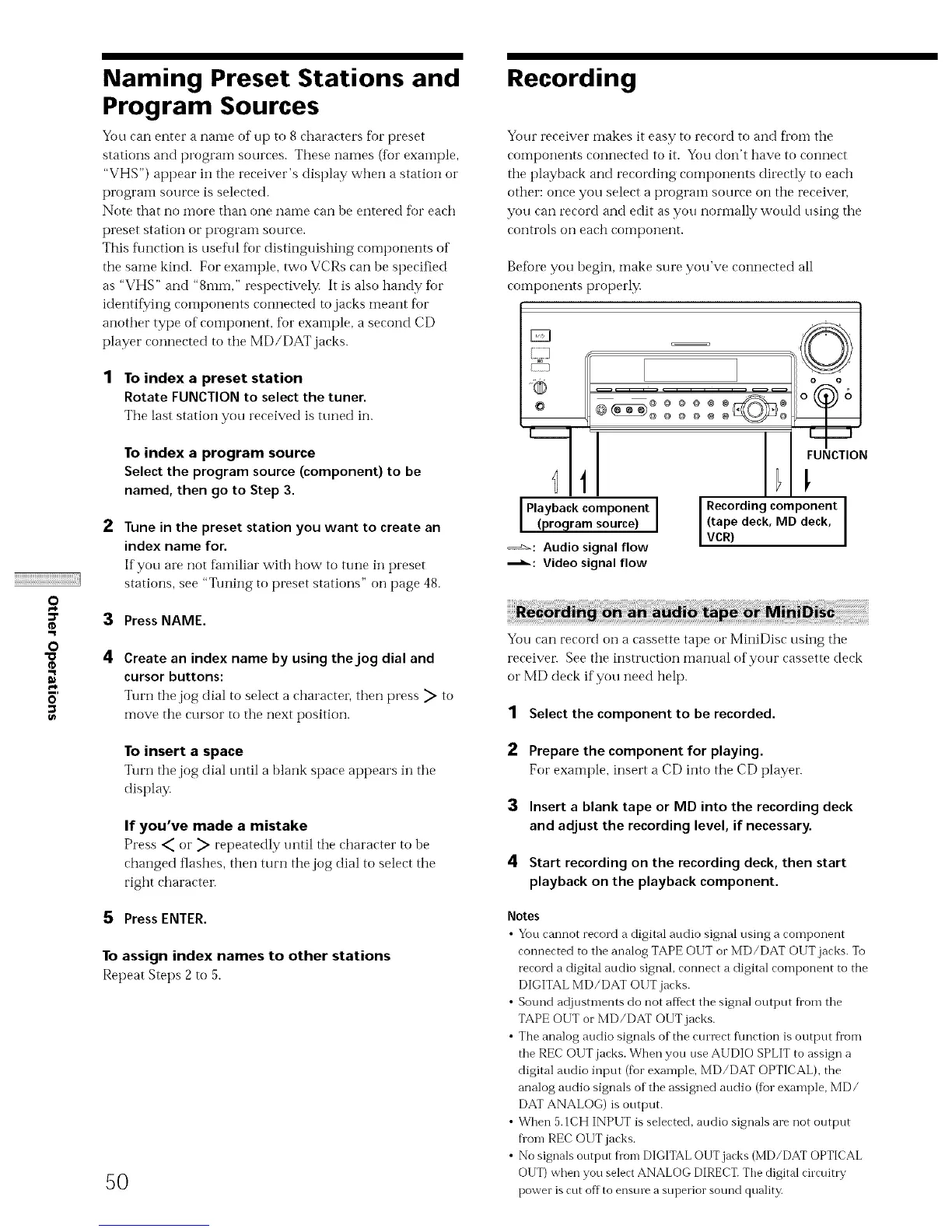
I Playback component(program source) I
_=_: Audio signal flow
•--_: Video signal flow
o o
o o >o@_ooooo o
t._ __O
FUNCTIO
!
Recording component
(tape deck, MD deck,
VCR)
You can record on a cassette tape or MiniDisc using the
receiver. See the instruction manual of your cassette deck
or MD deck if you need help.
1 Select the component to be recorded.
2 Prepare the component for playing.
For example, insert a CD into the CD player.
3 Insert a blank tape or MD into the recording deck
and adjust the recording level, if necessary.
4 Start recording on the recording deck, then start
playback on the playback component.
Notes
• You cannot record a digital at)dio signal using a component
connected to the analog TAPE OUT or MD/DAT OUT jacks. To
record a digital audio signal, connect a digital component to the
DIGITAL MD/DAT OUT jacks.
• Sound adjustments do not affect the signal outpt)t from the
TAPE OUT oc MD/DAT OUT jacks.
• The analog audio signals of the currect f\mction is outi)ut fcom
the REC OUT jacks. When you use AI IDIO SPLIT to assign a
digital audio input (fUr example, MD/DAT OPTICAL), the
analog audio signals of the assigned audio (for example, MD/
DAT ANALOG) is output.
• When 5.1CH INPUT is selected, audio signals are not output
flora REC Ol IT jacks.
• No signals output fi'om DIGITAL OUT jacks (MD/DAT OPTICAL
OUT) when you select ANALOG DIRECT. The digital circtfitry
power is cut off to ensure a superior sound qualiD_



 To Next Page