EasyManua.ls Logo

Sony TRINITRON KV-M1450E - Set-Up Adjustments; Preparation for Adjustments; Beam Landing Adjustment

Sony TRINITRON KV-M1450E
50 pages
Print Icon
To Next Page IconTo Next Page
To Previous Page IconTo Previous Page
Loading...
KV-M145
SECTION
3
SET-UP
ADJUSTMENTS
The
following
adjustments
should
be
made
whena
complete
realignment
is
required
or
a
new
picture
tube
is
installed.
These
adjustments
should
be
performed
with
the
rated
power
supply
voltage,
unless
otherwise
noted.
The
Contrast
and
Brightness
controls
should
be
set
as
follows
unless
otherwise
noted:
@
CONTRAST
control..........
80%
(or
Normal
by
commander)
x
BRIGHTNESS
control.......
50%
Perform
the
adjustments
in
the
following
order:
1.
Beam
Landing
2.
Convergence
3.
Screen
(G2),
Drive,
White
Balance,
Sub
Color
and
Sub
Brightness.
4.
Focus
Note:
Test
Equipment
Required.
1.
Color
bar/Pattern
Generator
2.
Degausser
3.
DC
Power
Supply
4.
Digital
multimeter
5.
Oscilloscope
Preparation:
In
order
to
reduce
the
influence
of
external
magnetic
forces
on
the
picture
tube,
face
the
TV
set
in
an
easterly
or
westerly
direction.
Turn
the
power
switch
for
the
unit
ON
and
erase
the
magnetic
force
using
a
degausser.
3-1.
BEAM
LANDING
Demagnetize
with
a
degausser.
1.
Input
an
all
white
raster
signal
from
the
pattern
generator.
CONTRAST
\
anil
BRIGHTNESS
Switch
the
raster
signal
of
the
pattern
generator
to
Red.
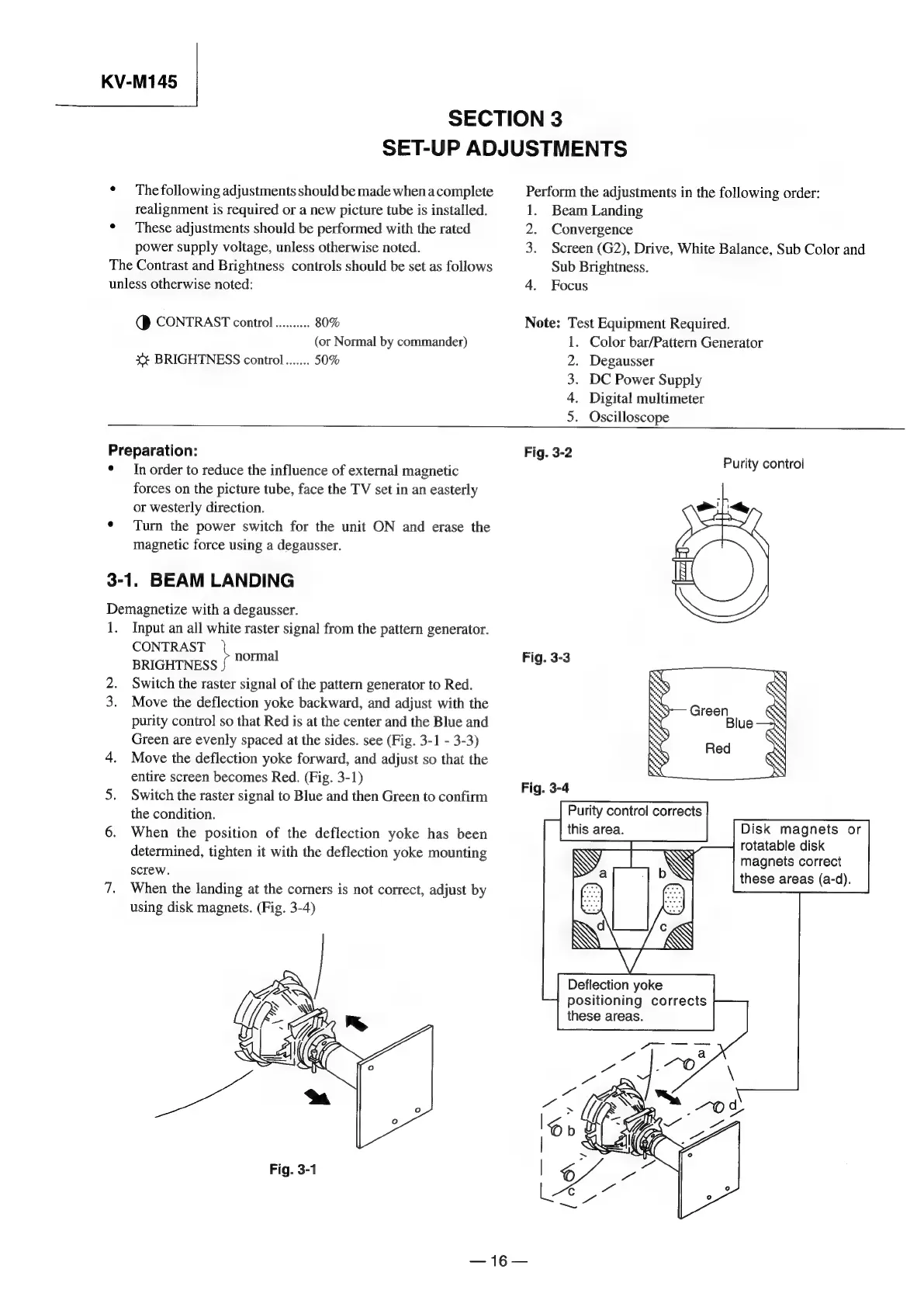
Move
the
deflection
yoke
backward,
and
adjust
with
the
purity
control
so
that
Red
is
at
the
center
and
the
Blue
and
Green
are
evenly
spaced
at
the
sides.
see
(Fig.
3-1
-
3-3)
Move
the
deflection
yoke
forward,
and
adjust
so
that
the
entire
screen
becomes
Red.
(Fig.
3-1)
Switch
the
raster
signal
to
Blue
and
then
Green
to
confirm
the
condition.
When
the
position
of
the
deflection
yoke
has
been
determined,
tighten
it
with
the
deflection
yoke
mounting
screw.
When
the
landing
at
the
corners
is
not
correct,
adjust
by
using
disk
magnets.
(Fig.
3-4)
Fig.
3-1
Fig.
3-2
9
Purity
control
Fig.
3-3
Fig.
3-4
Disk
magnets
or
rotatable
disk
magnets
correct
these
areas
(a-d).
Deflection
yoke
positioning
corrects
these
areas.
—16—

Related product manuals