14169000-IG, Edition 11.0
January 2018, Original document
29
LAN BasedSynchronization
Below you will find a description of how LAN based synchronization works, and what must be con-
sidered when synchronizing.
Note:
LAN based synchronization only works when using a Spectralink Handset.
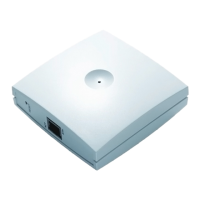
The latest generation of Spectralink IP-DECT Base Station s support the use of corporate Local
Area Network (LAN) for synchronization of the DECT radios when running software release
PCS15C or later.
In a multi-cell DECT system, the base station radios must be synchronized to each other in order to
achieve the optimum handover experience, when handsets are moving around among base sta-
tions. Spectralink supports the synchronization of digital DECT base stations via the wire and IP-
DECT base stations via the radio. IP-DECT base stations can use the LAN for synchronization as
well.
The LAN based synchronization has several advantages over synchronizing via the radio. The con-
figuration is much simpler because no synchronization chains need to be configured and maintained.
The synchronization is self-healing, because the system itself can handle if any base station is failing.
Finally, the system can be deployed with fewer base stations, because the base stations are no
longer required to be in range of each other.
It may, however, not be the ideal solution in all cases. LAN based synchronization requires that the
base stations involved in a handover are on the same network segment and the network deployment
(including LAN switches) meets a number of quality criteria.
Precision Time Protocol Background
Precision Time Protocol version 2 (PTPv2) is used to synchronize the radios of the IP-DECT base
station via the LAN. PTPv2 is defined in the standard IEEE 1588-2008 and a brief introduction can
be found here: http://en.wikipedia.org/wiki/Precision_Time_Protocol.
PTPv2 is based on a master-slave architecture, where the active master is automatically selected
among the base stations with the lowest serial number. Each network segment will have one active
master and the remaining base stations will be slaves. If the current master is failing a new one will
be automatically selected without disrupting the current synchronization state.
The PTPv2 datagrams are sent as multicast and transported via UDP on IPv4 or IPv6 or as raw Eth-
ernet packets without IP.
The LAN based synchronization is administrated centrally from the web based Administration Page
of the IP-DECT/DECT Server. The synchronization itself however is handled autonomously by the
base stations, and the server is not involved and hence does not need to be on the same network
segment.
Spectralink IP-DECT Server 400/6500 and DECT Server 2500/8000 Synchronization and Deployment Guide




 To Next Page