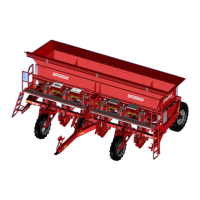
Operators manual MODEL 80XX Planter
page 62 of 173
Maintenance
General safety instructions
Regular maintenance is a prerequisite for operational reliability. The following safety advice is to be
observed during any maintenance, cleaning or repair work.
To prevent accidents, all relevant rules and regulations concerning safe and
competent working must be observed!
•Observe the adjustment, maintenance and inspection activities and intervals specified in this operating
manual, including details concerning the replacement of parts, subassemblies and equipment. These activities
may only be executed by trained personnel.
•Instruct operating personnel before beginning special operations and maintenance work! Delegate a
supervisor!
•Always observe the relevant safety measures and instructions specified in the operating manual when
carrying work related to the operation, adaptation, conversion or adjustment of the machine as well as
maintenance, inspection and repair activities.
•Ensure the working area is adequately secured during the maintenance work!
•Use suitable, tested tools when working on the machine, only use proper tools for unscrewing and tightening
screwed connections. Wear gloves!
•Switch off the machine completely before maintenance and repair work and ensure that it is secured against
inadvertent starting. The machine must not be switched on again while the work is being carried out!
-Switch off operating facilities.
-In the case of tractors, self-propelled harvesting machines and engine-driven machines, switch off the
engine, remove the ignition key and, if necessary, lock the cabin. Nobody is allowed to be within reach of the
controls so that functions cannot be switched on again by accident.
-Switch off the main switch and attach a warning sign, if necessary.
-Disconnect the machine from the power supply. Depressurize the hydraulic system and compressed air lines
and disconnect them from the supply.
•Carry out maintenance and repair work only when the machine is positioned on firm and level ground and
has been secured against inadvertent movement and toppling.
•When replacing individual parts and larger subassemblies, they should be carefully attached to lifting gear
and secured against falling down. To avoid the risk of accidents, sharp edges, corners and dangerous
projections must be covered and a warning sign attached. Use only suitable hoisting and lifting gear with
adequate load capacity which is in a proper working condition. Never work or stand under suspended loads!
•The securing of loads and the instruction of crane operators should only be entrusted to experienced
persons. A signaler giving instructions must be within sight of the crane operator and must be provided with a
radio link.
•Only carry out overhead assembly work using suitable ladders and platforms. Never climb on the machine
itself! Wear a safety harness when carrying out maintenance work at greater heights.
•Keep all handles, steps, handrails, platforms, landings and ladders free from dirt, snow and ice.



 To Next Page