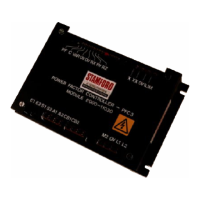
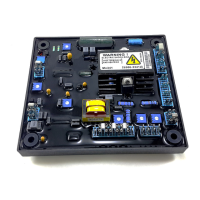
4.2.3 PFC3 Setting
Having set the AVR droop equipment the PFC3 can now be
commissioned as follows.
Important ! Make sure that the AVR Trim control is in the fully
counter-clockwise ( 0% ) position.
• Start the generator, synchronise it with the mains supply and
apply load as described in the section on droop setting. At
this point the power factor should still be near unity.
• The 'CB' LED on the PFC3 will indicate that the generator
circuit breaker is closed. Check that this is illuminated.
• Measure the voltage across terminals S1 an S2 on the PFC3
(at half-load). This voltage should be between 50- 180mVac.
If this is not the case then it suggests that the PFC3 C/T is
incorrectly rated (or fitted) and should be replaced by the
correct unit before proceeding further.
Note: At this point the generator is under the control of
the AVR and droop transformer and the following
steps simply check the basic functions of the PFC3
before it is put into full operation.
• Slowly adjust the PF/VAR control on the PFC3 to its fully
anti-clockwise position (maximum lag). If the generator
current rises to a high level as the adjustment is made, return
it to its central position immediately and re-check that the
AVR Trim control is in the fully anti-clockwise position.
• After a delay of approximately 20 seconds measure the
voltage appearing across AVR terminals A2 and A1. This
should be between +2Vdc and +5Vdc (meter leads: positive
on A2, negative on A1). If the reading is of opposite polarity
(-2Vdc to -5Vdc) then stop the generator and check the
wiring between the PFC3 and the AVR (A1 and A2). If the
wiring is correct then simply reverse the connections S1 and
S2 to the PFC3.
Note: Certain 'third-party' current transformers do not
comply with standard marking conventions.
• Re-start and parallel the generators, apply load and confirm
that the voltage across AVR terminals A2 and A1 is now of
the correct polarity.
• Slowly adjust the PF/VAR control on the PFC3 to its fully
clockwise position (maximum lead) and measure the voltage
appearing across AVR terminals A2 and A1. This should be
between -2Vdc and -5Vdc (meter leads: positive on A2,
negative on A1).
Stop the generator and turn the PF/VAR control on the PFC3 to
the midway position. Turn the Trim control on the AVR to the fully
clockwise position.
The PFC3 is now ready for operation.
4.3 Commissioning Options
Before the generator and its PFC3 is put into full operation it will
also be necessary to set-up any of the optional features being
installed. The operation of the PFC3 and AVR will have already
been checked during the Commissioning of the basic system.
4.3.1 Voltage Matching Option
The Voltage Matching Transformer /Isolating Transformer (user
supplied) should be connected as shown in Fig 9. With the
system voltage and frequency at its nominal value, the secondary
voltage (applied to PFC3 terminals L1 and L2) should be
nominally 100Vac to 120Vac. The phasing of this signal is
unimportant.
• Check that the voltage matching selection link is set to VMAT
E000 - 21030 (BLACK) only.
• Turn the AVR Tim control fully anti-clockwise. Start the
generator and run-up to rated voltage and frequency. DO
NOT PARALLEL. Set the AVR volts control to give a
generator terminal voltage that is in the centre of the
expected Mains Utility Supply Voltage variation, e.g. If the
expected Supply Voltage variation is 380 - 440V then set the
generator terminal voltage to 410 volts.
• If the expected Supply Voltage variation exceeds the rated
generator voltage stated on the nameplate, then stop the
generator and consult the factory before proceeding further.
• Stop the generator and turn the AVR Trim control to the
midway position.
• Start the generator and run-up to rated voltage and
frequency. DO NOT PARALLEL.
• The VMAT LED should be illuminated E000 - 22090
(GREEN) only.
• The PFC3 will now gradually adjust the generator voltage to
a new value which could be higher or lower than the bus
voltage. Return the generator voltage to the 'matched'
condition by slowly adjusting the BUSV control on the PFC3.
If the generator volts are 'High' (compared to the bus) then
the BUSV control should be adjusted slowly anticlockwise to
equalize the bus and the generator voltages. If the generator
volts are low then BUSV control should be adjusted
clockwise.
Note: The circuit may take several seconds to return the
generator voltage to the 'matched' condition. Due
allowance must be made for this delay whilst
making adjustments. For best results it is advisable
to adjust in small steps and wait for the response.
Stop the generator and turn the AVR Trim control to the fully
clockwise position.
The voltage matching option is now set.


 To Next Page
 Loading...