2.5 Voltage Matching Mode
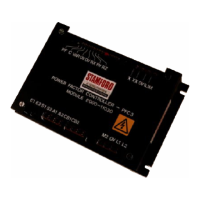
The PFC3 is equipped with a second set of voltage input
terminals which are supplied (optionally) with a signal
representative of the load bus voltage. It is essential that this
signal is fully transformer isolated and is approximately 110Vac. If
enabled; and prior to the arrival of the closure signal from the
generator circuit breaker; the difference between the signals
representing the generator and bus voltages is fed to the input of
the main comparator/amplifier and adjusts the AVR set-point until
both signals match. The circuit is automatically disabled when the
generator circuit breaker closes. The table shown in Fig 3
explains the operation of the PFC3 when connected for voltage
matching.
E1/E2
SUPPLY
CB1/CB2
CONTACT
L1/L2
SUPPLY
OPERATING
MODE
ON OPEN
NON
PRESENT
AVR
CONTROL
ONLY
ON OPEN
APPROX
110V
VOLTAGE
MATCHING
MODE
ON CLOSED X
PF
CONTROL
MODE
OFF X X
AVR
CONTROL
ONLY
2.6 Dead-Band or Dynamic Control Modes
The PFC3 can be set to operate in one of two control modes
dependent upon the requirements of the installation. In dynamic
mode, the output from the PFC3 continually adjusts the AVR set-
point in response to the smallest change in power factor (or
reactive current). In dead-band mode, the power factor (or
reactive current) is allowed to vary between user settable limits
before any adjustment is made. Dead-band mode results in a less
accurate control but can eliminate problems of stability caused by
interaction with engine governing systems.
VMAT
X = ANY POSITION
C
NORM
Links should be connected as shown
(Applies to PFC3 Part Numbers
E000-11030 & 21030 only)
Fi
.3 Volta
e Matchin
Mode


 To Next Page