4.3.4 Dead-Band and Dynamic Control Options
For the majority of applications, dynamic control is recommended
as this is the more accurate and has the fastest response time of
the two operating modes. However, if instability is encountered,
then dead-band control may provide the necessary flexibility
within the generator control loop to overcome this undesirable
effect.
In dynamic mode, correction signals are continually fed to the
AVR in order to maintain the set power factor. In dead-band
control, the power factor is allowed to 'drift' within pre-set limits
before any corrective action is taken. Allowing the loop to 'open'
in this way provides for a less accurate control but much
improved stability.
In dead-band control mode the correction signals take the form of
pulses which change in width as the error (deviation from
setpoint) changes.
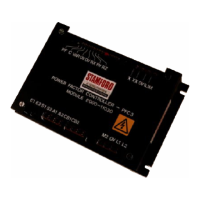
The three controls which alter the overall performance of the
PFC3 in dead-band mode are as follows:
[ BAND ] Adjusts the Dead-band width in dead-band mode
and allows the PF (or VAr) to drift between wider
limits before AVR set-point adjustments are made.
[ CLK ] Sets the rate at which AVR adjustments are made
(in dead-band mode only).
[ GAIN ] Makes the controller more or less sensitive to
deviation from the set-point (in dead-band mode
only) by altering the size of each adjustment.
For more information on the above adjustments see the section
on User Adjustable Controls and Selection Links.
If dead-band mode is selected it is strongly recommended that
the Gain and Band are set fully counter-clockwise (lowest gain,
widest band). These controls can then be adjusted from their
initial positions by trial and error to find the optimum setting.
As an aid to setting, red light emitting diodes (LEDS) indicate
increase (INC) and decrease (DEC) excitation signals. The clock
(CLK) indicates the rate of error correction signals and is pre-set
at the factory at approximately one per second.
4.4 Power Factor Correction
With the generator operated as a power factor correction system
it will be possible to overload the generator windings with a PFC3
setting of near unity power factor WITHOUT overloading the
engine/prime-mover. In this situation the generator has to supply
the necessary reactive current to the load in order to correct the
mains supply power factor to that set on the PFC3. The generator
output current is therefore independent of the governor setting
(kW) and/or the power factor setting on the PFC3.
Before the generator is put into operation in this mode the Current
Limiting option MUST be installed and commissioned (see
section 4.3.2).
The commissioning engineer should also attempt to establish the
nature of the site load. Since the generator will be expected to
supply all or part of the reactive component of load current, any
condition which would result in the generator operating at leading
power factor must be treated with care. Operating the generator
at leading power factor will cause the excitation to be reduced to
a level where loss of synchronisation may occur. This may cause
protective equipment to operate and the loss of the correcting
influence of the generator or, in extreme cases, equipment
damage.
Where these conditions are likely to exist it is recommended that
the Low Excitation Limiting option be used (see section 4.3.3).
Use of Excitation Loss equipment is also strongly recommended
for all installations where industrial ac generators run in parallel
with the mains supply (see section 3.2).


 To Next Page
 Loading...