3
SAFETY AND PREPARATION FOR USE
**********WARNING **********
This unit contains hazardous high voltages.
Please make certain that the high voltage is
completely discharged before removing the high
voltage cable. High voltage cables can store
charge if they are disconnected from the supply
while the high voltage is on. The charge on
the cable can cause injury or damage even after
the cable is disconnected from the unit.
Do not change the high voltage polarity unless
the power is off.
***********CAUTION **********
This instrument may be damaged if operated
with the LINE VOLTAGESELECTOR set for
the wrong AC line voltage or if the wrong fuse is
installed.
Line Voltage Section
The PS300 series operates from 100, 120, 220 or
240 Volts nominal AC power source with a line
frequency of 50 or 60 Hz. Before connecting the
power cord to a power source, verify that the
LINE VOLTAGE SELECTOR card, located in
the rear panel fuse holder, is set so the correct
AC input voltage is visible.
Conversion to other AC input voltages requires a
change in the fuse holder voltage card position
and fuse value. Disconnect the power cord, open the
fuse holder cover door, and rotate the fuse-pull lever
to remove the fuse. Remove the small printed circuit
board. Select the operating voltage by orienting the
printed circuit board. Press the circuit board firmly
into its slot, so the desired voltage is visible. Rotate
the fuse-pull lever back into its normal position.
Insert the correct fuse into the fuse holder.
Line Fuse
Verify that the correct line fuse is installed before
connecting the line cord. For 100 V / 120 V, use a 1
Amp fuse and for 220 V / 240 V, use a 1/2 Amp fuse.
Line Cord
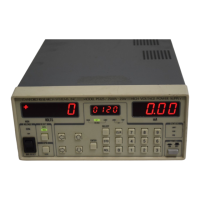
The PS300 series use a detachable, three-wire power
cord for connection to the power source and to a
protective ground. The exposed metal parts of the
instrument are connected to the outlet ground which
provides protection against electrical shock. Always
use an outlet which has a properly connected
protective ground.
Connection to Other Instruments
The back panel BNC shields are connected to the
chassis ground and the AC power source ground via
the power cord. Do not apply any voltage to the
shield. The high voltage SHV connector is also
connected to the chassis ground and CANNOT be
floated away from ground.


 To Next Page