2-3
Stellar 4500 Manual
Crane Precautions
1. Movement of the control levers should be slow
and smooth to meter oil flow for safe operation.
Avoid jerky and sudden movements.
2. The crane controls should be clearly marked
with decals. If these are missing or
illegible,replace immediately. (See Chapter 5:
Decals)
3. Lift load slightly off the ground to check the
safety of the cargo. Do not use stability to
determine the safety. Consult the capacity
charts and strictly adhere to them.
4. Be constantly aware of the boom position when
operating the controls.
5. The boom tip should be centered directly over
the load before making the lift to avoid swinging.
6. Do not drag loads with the crane.
7. Do not attempt to lift fixed loads.
8. Do not load boom in a sideways direction.
9. Know the weight of the rigging and load to avoid
overloading the crane.
10.
Do not extend or rotate a load over anyone.
11. Wear protective gear such as hard hat, safety
glasses, steel-toed boots, and gloves.
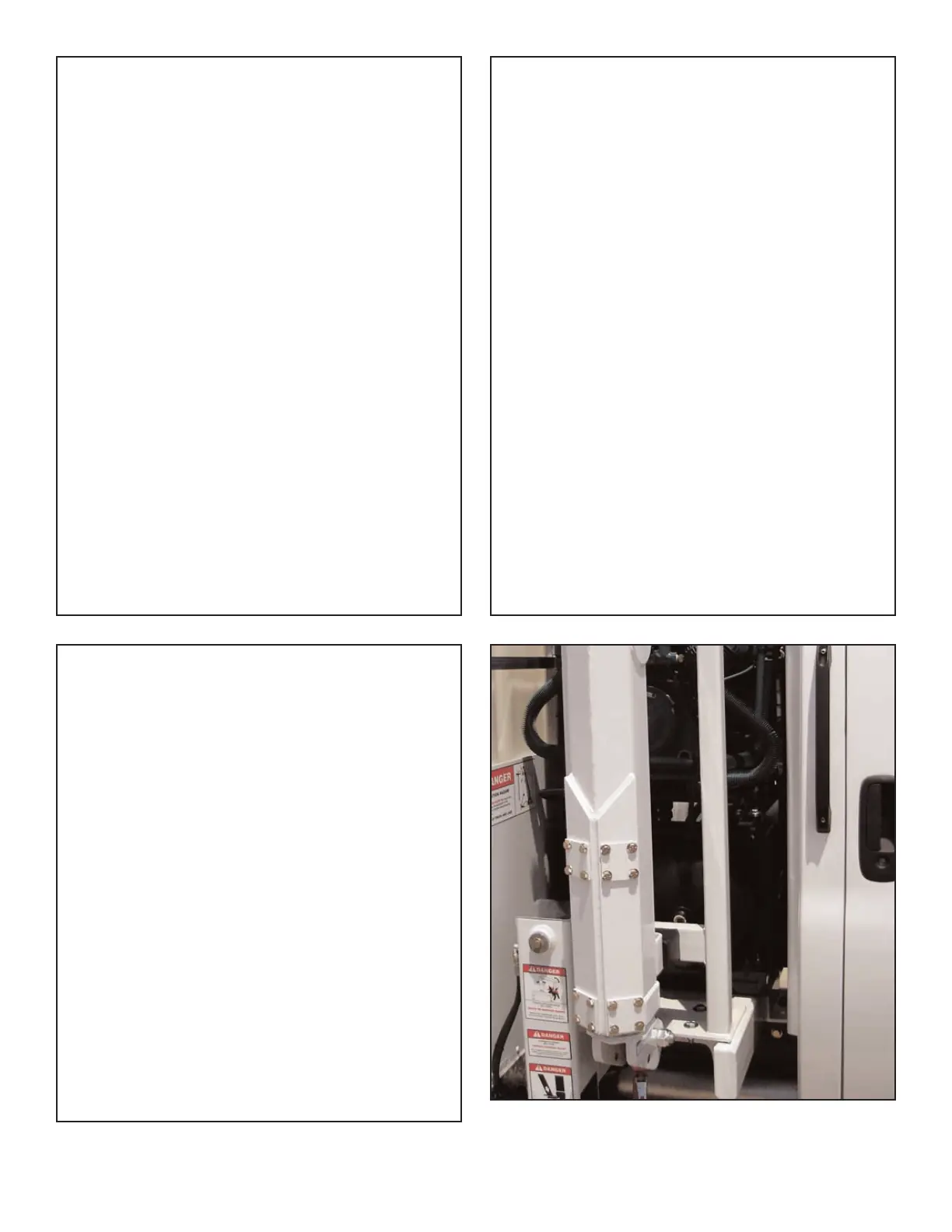
Crane Transport
Before transporting the crane, do the following:
1. The crane must be in the stored position.
2. Outriggers must be securely stowed and not
extended horizontally or vertically.
3. Hook and sheave assemblies must be securely
fastened to prevent swinging.
4. All loose accessories, tools, and remote
controls must be securely stored in their
respective compartments or fasteners.
5. The PTO must be disengaged.
6. The parking brake must not be released until
all of the above procedures are completed.
7. Do not drive the carrier vehicle while a load is
present on the hook.
8. Do not drive the carrier vehicle with less than
proper tire inflation.
9. Do not drive the carrier vehicle in areas where
the vertical clearance is unknown.
10. Do not allow personnel to ride on the
equipment during transport.
The crane MUST be in the stored position before transporting.
Hook Precautions
1. Hooks are designed and manufactured to lift
specific loads. The specified rated load of a hook
applies to loads held uniformly in direct tension
and does not take into account shock loads,
hook tip loading, side loading, bending,
torsional, or related loads.
2. Do not attempt to lift a load that is larger than the
load rating of the hook.
3. Never use a hook’s yield point as an indicator of
its capacity
.
4. Do not use a hook to lift personnel.
5. Know the rated load of the hook in use.
6.
Never weld attachments to a finished hook in
field applications. This will alter and destroy the
design properties of the hook material.
7. Keep fingers, hands, body, and loose clothing
from between the hook and the load.
8. Avoid shock loading.
9.
Inspect the hook regularly for excessive wear
and maintain it in safe operating condition.



 To Next Page