25
4.6 ELECTRICAL LOAD
4.6.1 BALANCING LOADS
Balancing loads section applies to model
SM5000CH (120v/240v.)
When operating your SurgeMaster generator
please be aware of load balancing when using
120v receptacles.
The alternator powers two legs of 120v each
(series). Each leg supplies half the amps, specic
to receptacles on each leg (one leg to each 120v
receptacle and both legs to 240v receptacle).
240V will balance automatically since both legs
are connected to the same load. (unless the load
is split further down the line)
Since 120v legs are independent of each other
they can be loaded differently and become unbal-
anced. Signicantly unbalanced loads will cause
one leg of the alternator to heat up more than the
other causing uneven wear in the alternator and
can lead to eventual failure.
Before connecting loads to the generator, nd
the amperage draw of each load and combine
and distribute the loads so that they are bal-
anced across all receptacles. Balancing can be
achieved, for example, by spreading multiple
loads over 2 receptacles rather than running all
loads from one receptacle.
When the generator supplies 120v exclusively,
then both legs share the load (parallel) and there
is no need to balance the load.
Make sure the accumulated wattage rating of
tools or appliances does not exceed that of the
generator.
4.6.2 WATTAGE AND LOAD
Your SurgeMaster generator has two wattage
(power) specications that need to be considered
when you are connecting loads: continuous watts
and maximum watts.
At the same time there are two different types of
loads, resistive and reactive.
REACTIVE LOAD
Generally a tool or appliance that contains an
electric motor is a reactive load, Reactive loads
have two modes of operation: startup and running.
An electric motor starting watts (reactive load)
could possibly require up to 3 x its running watts
at start up.
In other words wattage will spike at starting and
level off to running (continuous) wattage when it is
operating normally. (See wattage chart)
RESISTIVE LOAD
A resistive load is lighting, hot plate, TV, etc,
Resistive loads generally will not spike and start-
ing wattage is the same as running wattage. (See
wattage chart)
CONTINUOUS WATTAGE
Continuous wattage is the wattage range that
can be safely generated by the alternator for an
extended period.
MAXIMUM WATTAGE
Maximum wattage is the wattage range the
generator can produce but for only short periods
of time (electric motor starting). Drawing maxi-
mum wattage for extended periods will cause the
breaker to trip.
4.6.3 CALCULATING LOAD
When calculating load in watts, you will need to
determine two wattage values:
• running wattage + starting wattage: de-
termine the starting wattage of your reactive
loads and add them to the running wattage of
your resistive loads.
• running wattage only: add up the running
wattage of both the resistive and reactive
loads.
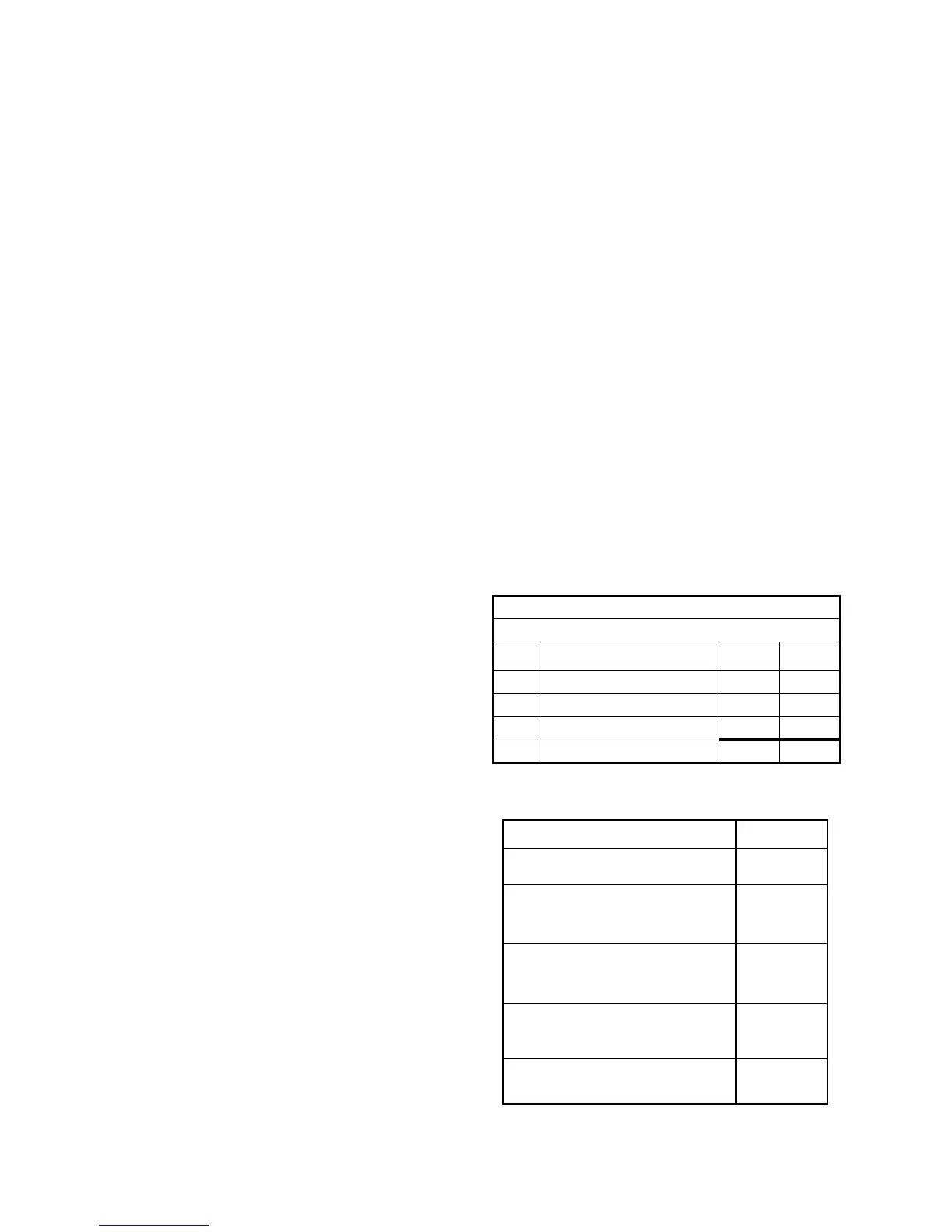
The example totals match the second combination
on the chart, and shows that the run status is OK.
load calculation ex-
ample
wattage combination
chart
Wattage Combination Status
total starting wattage + total running wattage is
within the continuous rating
OK
total starting wattage is over the continuous
rating but below maximum, and total running
wattage is within continuous rating
OK
total starting wattage is over the continuous &
maximum rating, and total running wattage is
within continuous rating
Stop
total starting wattage is over the continuous &
maximum rating, and total running wattage is
over continuous rating
Stop
both the total starting wattage and total running
wattage are over the continuous rating but
Stop
Qty Load
1
Refrigerator/Freezer 1200 192
1
Furnace Fan (1/8 hp) 500 300
6
Lighting (40w ea) 240 240
Totals
1940 732
Generator Spec: 2000 maximum watt, 1500 continuous watt


 To Next Page