8.2. RF Info Screen
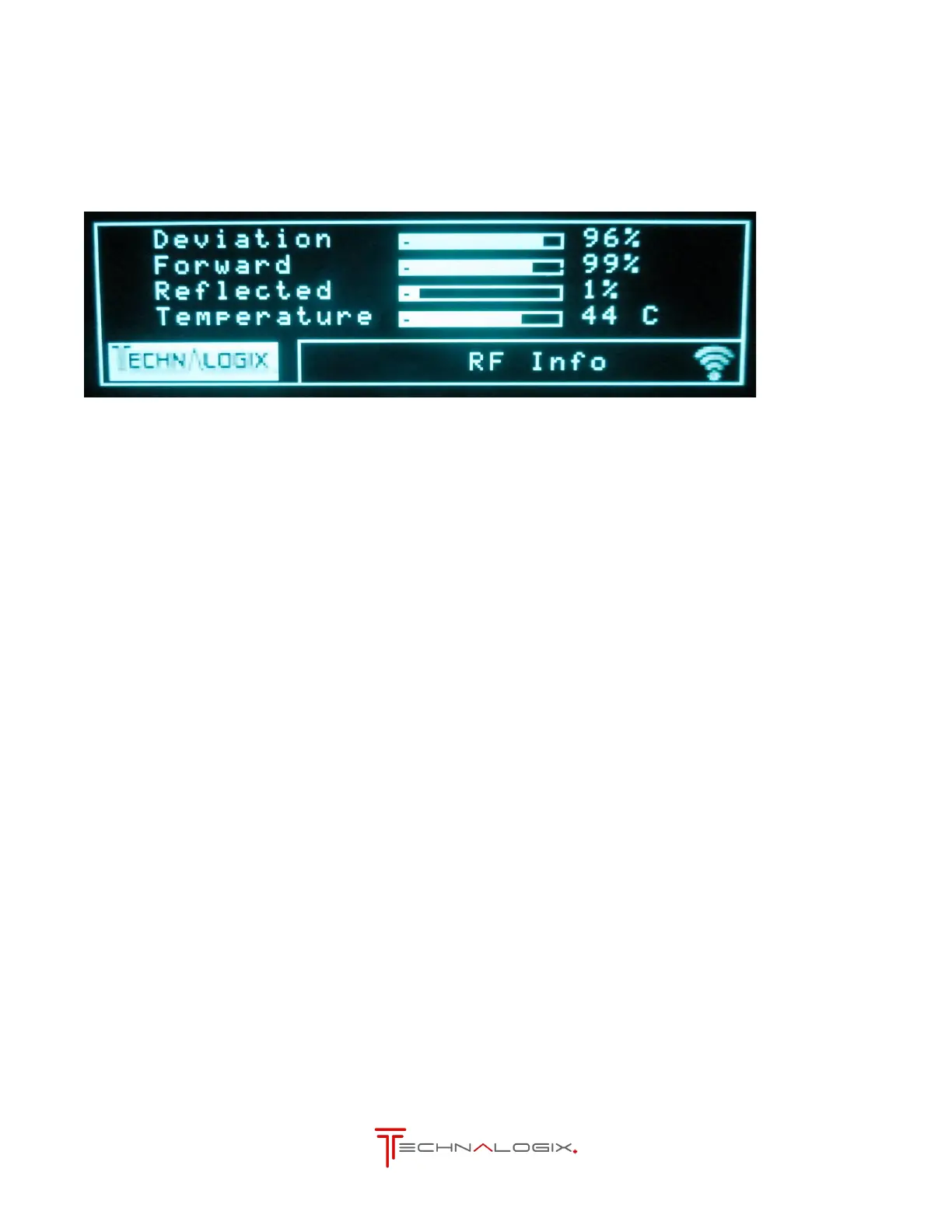
The RF Info Screen summarizes key parameters for the RF carrier of the FM signal, as illustrated in the
sample screen below:
The maximum frequency deviation from the carrier centre frequency is
illustrated on this level bar. Typical maximum deviation, required by Industry
Canada or FCC, is 75 kHz to avoid bleeding into adjacent channels. 100%
represents a full 75 kHz deviation.
This is the power out of the transmitter to the antenna or load, measured in
watts or scaled percentage, depending on how the units are set in the
Settings Screen.
This is the power coming back into the transmitter from the antenna or load,
measured in watts or scaled percentage, depending on how the units are
set in the Settings Screen. As there is no internal circulator or isolator
installed within the enclosure, it is important to minimize VSWR with a good
quality antenna installed using proper broadcast techniques. Ice build-up on
the antenna and damages to 50 ohm transmission line can also generate
damaging reflected power.
The temperature is measured on top of the heatsink near the final transistors
and displayed here. User can toggle between Celsius and Fahrenheit from
the Settings Screen. In the event that this temperature exceeds the factory
set trip point, the RF carrier level will fold back to protect the unit. Common
causes for high temperatures can include failed internal fans or air
conditioning in the broadcast facility or a blocked fan.
Controls from RF Info Screen
Changes between screens or settings



 To Next Page