11
When you squeeze the brake levers
hard or all the way to the end of
their leverage, the braking force can
increase sharply! Please familiarise yourself
with this new braking behaviour. Ensure that
you receive and read the manufacturer’s op-
erating manual.
The brake levers should be set up
so that your hands can safely and
comfortably apply them as a straight
extension of your arms.
In order to allow people with smaller hands to
safely apply the brakes, the levers can be set up
to be closer to the handlebars using an adjusting
screw (located in the lever).
In some models it is
possible to bring the
brake levers closer to
the handlebars, using
special devices.
Set up the cable tension
in such a way that the
brake levers do not touch
the handlebar grip, even
when they are applied to
their fullest extent!
Mechanical brakes
are usually able to be
readjusted by turning
the adjustment screw
located on the handle.
Loosen the adjustment
screw from the handle until the braking function
becomes more secure. Secure the adjustment by
tightening the locknut on the handle.
Back pedal brakes
If your bicycle is equipped with back pedal brakes,
you brake by pushing the pedals backwards in-
stead of forwards. This means that your bicycle
will not freewheel and you are unable to rotate the
pedals backwards freely as you otherwise can!
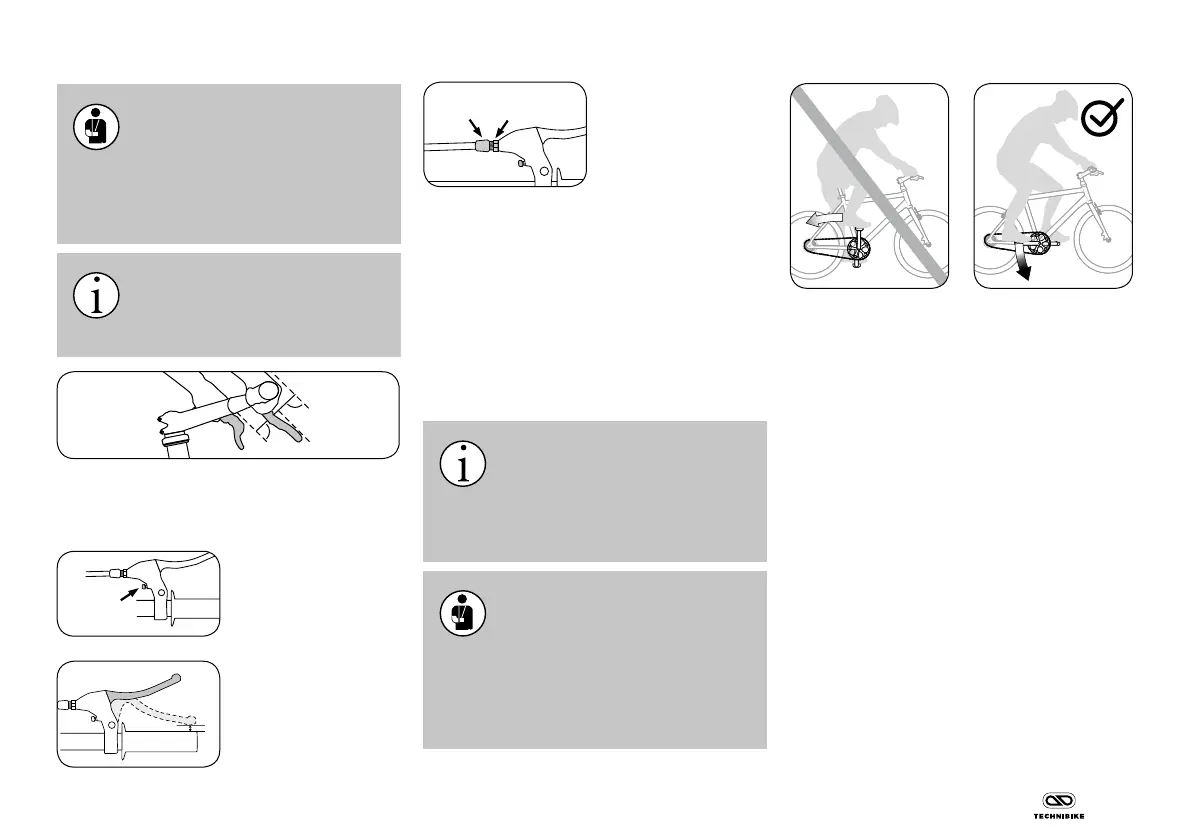
The safest way to brake using back
pedal brakes is when the line of the
pedals is horizontal. If one pedal is
at the top and one at the bottom, the poor
force output produced is not conducive to
effective braking!
The effectiveness of back pedal
brakes can deteriorate substantially
on long inclines! This type of brak-
ing system can become very hot from con-
tinuous braking. You should also use the
front brake to slow down on long inclines.
Try to give back pedal brakes the chance to
cool down and do not touch them.



 To Next Page