15
Maintenance / upkeep
Please have your bicycle checked
by a specialist retailer on a regular
basis. These experts can identify
damaged and worn parts and are able to ad-
vise you in selecting replacements. Refrain
from repairing key parts yourself (frame,
fork, handlebars, stem, headset, brakes,
lights).
As is the case for all mechanical
parts, bikes take on wear, tear and
heavy use. Because of heavy use,
different materials and components can react
to wear and tear in different ways. If a compo-
nent is used for longer than it is designed for,
it may suddenly stop working and possibly
lead to injury or cause additional damage.
Any kind of rip, puncture or colour change
seen in an overused area indicates that the
component’s use has reached its limit; the
component should in this case be replaced.
When replacing the original tyres or the
cranks, make sure that there is enough free
space between the tyres and the shoe. Acci-
dents and severe falls could otherwise occur.
Screws and torque spanners
When working on the bicycle,
please ensure that all screws are
tightened to the correct torque. The re-
quired torque is printed on many parts with
a screwed connection.
Measurements are given in Newton metres
(Nm) and applied with a torque wrench. It is
best to use a torque wrench that displays the
tightening torque as it is in use. Otherwise
screws can snap or break. If you don’t own a
torque wrench then you should always leave
this work up to a specialist retailer!
A table listing the most important torques
for bolted connections is provided on
page 25.
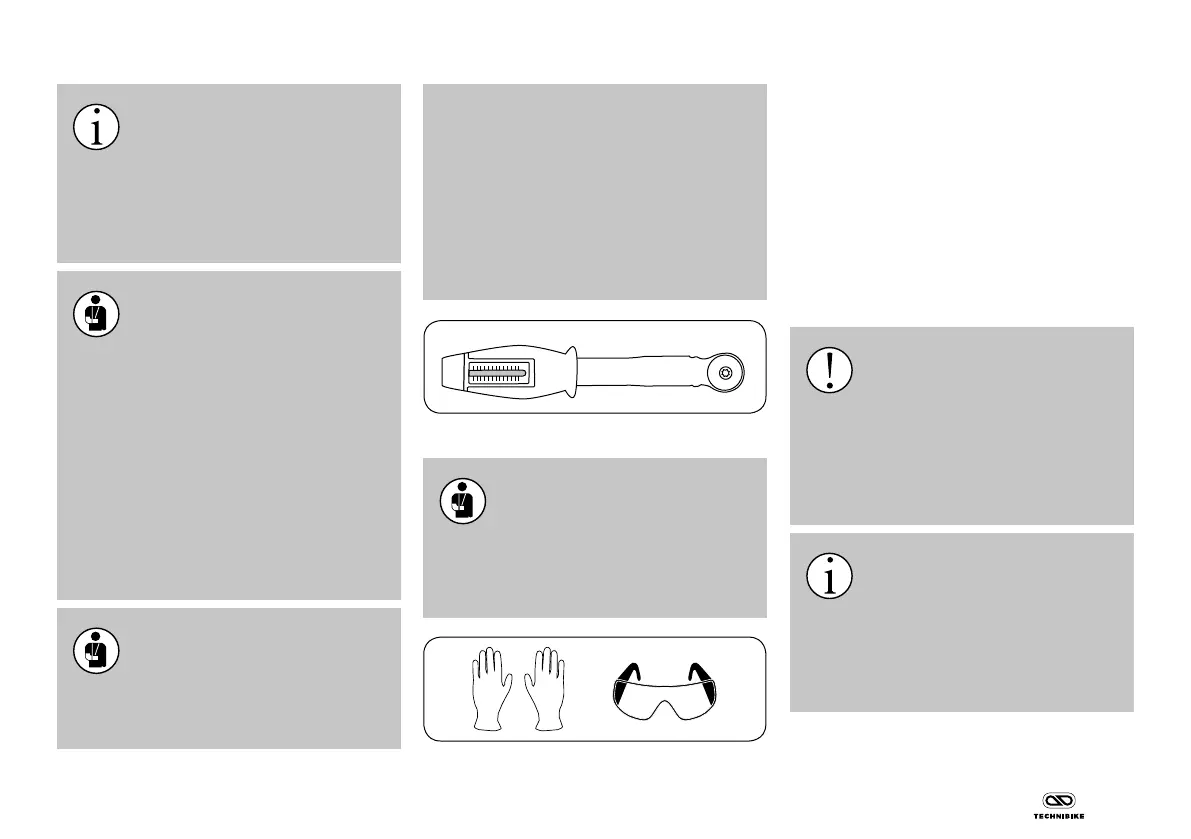
Torque spanner
Wear suitable protective clothing,
protective gloves and protective
goggles during all installation and
maintenance work. Otherwise, contamina-
tion or injuries, that might be caused by lu-
bricants and auxiliary materials among other
things, could be the result.
Chain
To ensure that it can work effectively, the chain
has to be cleaned and greased regularly (see
page 24). Dirt can be removed when washing
the rest of the bicycle. Otherwise you can clean
the chain by rubbing it with an oily clot. When the
chain is clean, it should be greased at the joints
with suitable lubricant. After being left to soak,
the excess lubricant should then be removed
Chain tension
To ensure that the chain and gears
can work safely, the chain has to
have a certain level of tension. De-
railleur gear systems tense the chain auto-
matically. For hub transmissions that are
mounted without a chain tensioner, the
chain must be tightened if it is found sag-
ging. Otherwise they can come off and lead
to a fall.
In the case of bicycles with adjusta-
ble dropouts, the mounting screws
of the axle housing should be loos-
ened and tightened, and not the axle nuts. If
the bottom bracket shell contains an eccen-
tric bush, please tighten the chain according
to the instructions provided by the corre-
sponding manufacturer.
* see page 25



 To Next Page