14
Most suspension seat posts can be
adjusted to the rider’s weight. How-
ever, in most cases this requires the
seat post to rst be extracted from the
frame. Please talk to your specialist retailer
before carrying this out.
Suspension frames and their suspension-
related parts
In this case, the frame’s rear fork is exible and
has suspension and damping from a shock ab-
sorber.
Some shock absorbers use a steel spring to ab-
sorb undulations, while others do this with an
air chamber. The damping, which regulates the
speed of compression and stretching, can be ad-
justed in high quality shock absorbers.
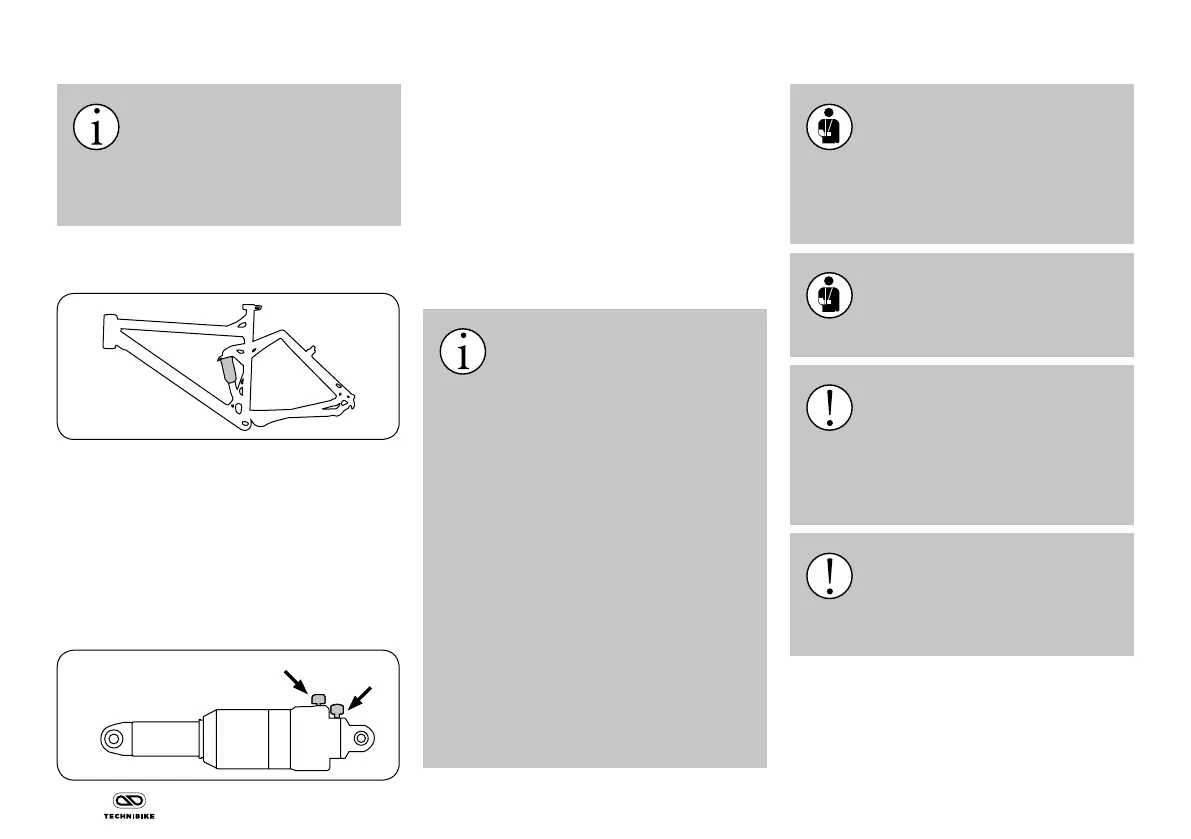
Here is a depiction of a typical spring element:
Adjusting spring
stiffness
Adjusting
damping
For detailed information, please read the instruc-
tions supplied by the manufacturer.
A suspension part may only be adjusted according
to the manufacturer’s operating manual. In general,
the suspension part should noticeably “give” when
riding over uneven surfaces, but not reach the end
of the travel. A suitable basic setup would see the
suspension pushed in around 10 – 15 % (cross
country), 15 – 20 % (touring) or 25 – 33 % (endu-
ro, freeride, downhill) of the spring travel when
the rider is sitting normally on the bicycle.
Avoid washing your bicycle with a
high-pressure cleaner as the clean-
ing uid can penetrate sealed areas
due to the high pressure and then eventually
destroy them.
The shock absorber’s sliding pistons and gas-
kets should be carefully cleaned with a soft
cloth as part of your regular bicycle clean-
ing routine. Spray lubricant on the running
surface of the shock absorbers and gaskets
helps keep the system working effectively.
Special spray lubricant is available specical-
ly for this purpose, e.g. from Brunox
®
.
You should regularly check the links of the
rear fork for play. Grip the frame securely
and attempt to move the rear wheel side-
ways. You can also test for play in the shock
absorber attachment by rapidly lifting and
dropping the rear wheel. If you a) notice play
anywhere or b) hear rattling, you should im-
mediately take your bicycle to be checked
by a specialist retailer.
Avoid riding the bike until it has been repaired.
The functionality and secure t of
the suspension parts are vital for
your safety! Clean and check your
full suspension bicycle on a regular basis!
Warm water with a little washing up liquid or
light cleaning agents are suitable for clean-
ing this part of the bicycle.
Tighten all screws to the recom-
mended torque. Otherwise the
screws could break and parts could
fall off (see page 25).
Full suspension bicycles are not
suitable for use with trailers and
child bike trailers!
The bearings and attachments are not de-
signed to withstand this sort of force. This
could result in strong wear and breaks with
serious consequences.
If you have a full suspension frame
with a short seat tube which is open
at the bottom, the seat post can only
be lowered to the point that it does not touch
the spring element when it uses its full travel.



 To Next Page